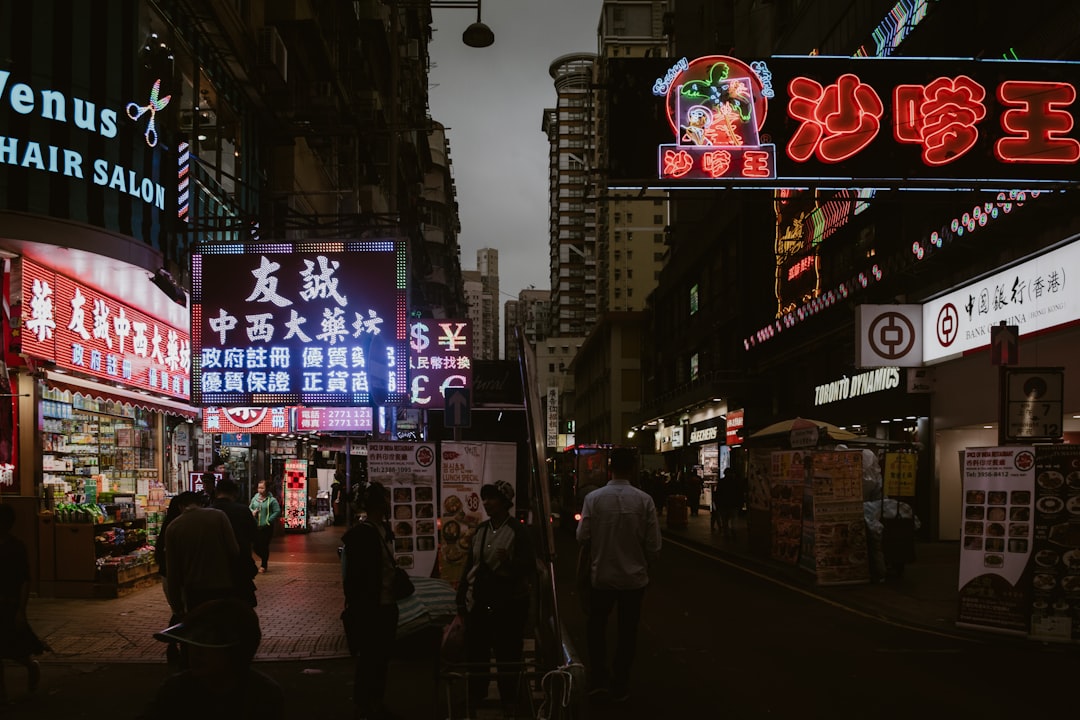
We were standing in the middle of Temple Street, somewhere between the fortune tellers and the counterfeit handbags, when we noticed something strange. A woman in her sixties, wearing a floral apron over a stained T-shirt, was sitting on a plastic stool behind a stall selling dried seafood. She was eating a bowl of something pale and unidentifiable, using chopsticks in one hand and a cleaver in the other. Not chopping. Just holding it, like a third utensil. Every few bites, she’d scrape the bowl’s edge with the blade, then go back to eating. Nobody around her seemed to think this was unusual. That was our first clue that Kowloon’s night markets had layers we hadn’t begun to understand.
The egg waffle is the problem. It’s everywhere — in guidebooks, on Instagram, in every “10 Things to Eat in Hong Kong” listicle ever written. And it’s fine. It’s a warm, sweet, eggy snack that tastes exactly like what it is. But it has become a gatekeeper, a default that keeps visitors walking past stalls they’d never otherwise notice, because they’ve already filled a hand with something familiar. We decided, before arriving, that we wouldn’t touch a single one. Not out of contrarianism, but because the Kowloon night markets deserve better than a tourist’s shortcut to satisfaction.
Our first real discovery came on the second evening, in the maze of alleys behind the main Temple Street strip. The market’s famous section runs along the main road, bright and loud and full of knockoff watches and LED toys. But take any turn into the side streets — we took the one past the pawn shop with the red neon sign — and the character shifts entirely. The stalls here aren’t aimed at tourists. They’re aimed at people who live upstairs, who need a bag of ginger, a replacement rice cooker lid, or a late dinner that costs less than twenty Hong Kong dollars. We found a woman frying something that looked like flatbread but wasn’t. She was using an old wok, the kind whose patina suggests decades of use, and the oil she was working with smelled aggressively of sesame. We asked what it was, in our broken Cantonese. She said something that sounded like “gung-gung,” and held up three fingers. Three dollars. We handed over a five-dollar coin and she shook her head, dug through a pouch for exact change, then handed us a piece wrapped in newspaper. It was chewy, savory, studded with what turned out to be dried shrimp and chives.
We later learned it was a kind of traditional cong you bing — scallion pancake — but one made with a rice flour base and deep-fried rather than pan-fried. The woman had been making them for three decades, we discovered through a combination of gestures and a helpful bystander who spoke English. She started the stall after her husband died, because she needed to feed three children and the garment factory where she’d worked had closed. The stall paid for all three children to finish secondary school. That story is not on any food blog. It’s just there, in the way she hands you the wrapped pancake without smiling, like this is a transaction, not a performance.
Twelve-dollar bok choy at 2 a.m.
The vegetable market along Reclamation Street changes how you understand Kowloon’s night economy. It doesn’t start until well after midnight — around 1:30 or 2 a.m., when the main market stalls are packing up and the streets are briefly quiet. Then the produce sellers arrive. Trucks back up onto the pavement from the Western Wholesale Food Market, and crates of bitter melon, water spinach, and long beans are unloaded directly onto tarps spread across the ground. The prices are wholesale-adjacent; we watched a woman in bedroom slippers buy six pounds of bok choy for what we calculated to be about twelve Hong Kong dollars. Nothing is washed or prettied for display. The dirt is still on the roots. This is where the city’s actual cooks — the ones running cha chaan tengs and dai pai dongs — buy their ingredients, and the efficiency is brutal. A man in a truck cab shouted at us for standing in the wrong spot. We moved.
At 2:30 a.m., we found a stall selling fresh sugar cane juice, squeezed on the spot from stalks still damp from the truck. The vendor was a young guy, maybe twenty-five, who told us he’d taken over the route from his father. He said the secret to good sugar cane juice was to never refrigerate the stalks; they have to be pressed within hours of being cut or the sweetness turns flat. We paid eight dollars for a cup that tasted like liquid candy, but thinner, with a grassy edge that cut the sweetness. A woman next to us ordered hers with a squeeze of lime and a pinch of salt. We copied her.
The contrast between night and morning in these markets is sharper than any temperature shift. At 10 p.m., Temple Street is a tourist attraction. At 3 a.m., it’s a loading zone. By 5 a.m., it’s a ghost street. Then at 6, the breakfast stalls appear — portable carts with sterno cans and metal steamers, selling glutinous rice wrapped in lotus leaves, and congee so thick it barely pours. We sat on a milk crate outside a shuttered electronics shop and ate a rice dumpling with pork and salted egg yolk, wrapped in a leaf that had been steamed so long it turned brown. The woman running the cart didn’t speak any English, but when we tried to pay with a fifty-dollar note, she waved it away and pointed to a smaller denomination. She charged us fifteen dollars. The whole interaction took about forty seconds.
None of this is secret, exactly. The people who live in Kowloon know about the midnight vegetable market, the early-morning congee carts, the woman with the cleaver. But there’s a gap between what locals know and what visitors are told, and that gap is where the real eating happens. The guidebooks — even the good ones — tend to treat night markets as a single experience: arrive after dark, walk the main strip, try the egg waffle and some curry fish balls, call it done. What they miss is that the market is less a place than a schedule. The same street has four or five completely different food economies depending on when you show up.
We stumbled onto one of the best meals of the trip at 11 p.m. on a Tuesday. A light rain had started, the kind that doesn’t quite justify an umbrella, and most of the Temple Street crowd had scattered. We ducked under the awning of a stall that seemed to be selling nothing but clay pots — the unglazed kind used for cooking rice. The stall’s owner was a man in his fifties with a cigarette behind his ear and a towel over his shoulder. He was eating dinner himself, sitting on an overturned bucket, and when we approached his pots he just pointed at his bowl and said “You want?” then laughed. We said yes. He ladled out two bowls from a pot we hadn’t noticed, sitting on a portable butane burner behind his display. It was a chicken and mushroom clay pot rice, but unlike any version we’d had in a restaurant. The rice at the bottom was scorched, black in places, with a crunch that comes from cooking in a pot that’s too hot and not being stirred. The chicken was on the bone, cut into small pieces with the cartilage still attached, braised in a sauce that was mostly soy and ginger and something sweet we couldn’t identify. He charged us nothing. We insisted on paying. He eventually accepted twenty dollars, but only after making a show of being reluctant. We later found out that’s how many of the stallholders eat — they cook one pot for themselves, somewhere behind the display, and anyone who wanders by at the right moment gets offered a portion. It’s not a business. It’s a byproduct of the fact that they have to eat too.
The fish ball stalls are a trap, but not for the reasons most people think. The ones on the main strip — bright orange, bobbing in a fluorescent broth — are fine. But the best fish balls in Kowloon’s night markets aren’t sold as fish balls at all. They’re sold as “fish skin” at a stall on Ning Po Street, run by a family that has been there since the 1970s. They take the skin of freshwater fish — we watched them use grass carp — scrape off the scales, then deep-fry the skins until they puff up like chicharrones. The texture is nothing like a fish ball. It’s crispy, then chewy, with a faint marine flavor that doesn’t taste fishy. They serve them with a dip made from fermented bean curd and chili. We bought a bag for ten dollars and ate it walking back toward the MTR station.
The thing that surprised us most, across all the nights we spent in those markets, was how little of the food was actually what you’d call “street food.” A lot of it is raw ingredients. People buy their dinner not as a finished dish but as components — a bag of live clams, a bunch of garlic chives, a block of tofu they’ll cook at home. The stalls selling skewers and fried noodles are a minority, not the majority. Most of the market is a grocery store that happens to operate at night, for people whose schedules don’t align with a supermarket’s opening hours.
On our last night, we went back to the woman with the cleaver. She was still sitting on the same plastic stool, still eating something out of a bowl, the cleaver still in her hand. We’d learned by then that she was a worker at a dried seafood wholesaler across the street, and her dinner break fell at the same time every evening. The cleaver was for opening crates. The bowl was her own dinner, brought from home. She wasn’t part of the market at all. She was just eating next to it, in the only spot where the light was enough to see what she was doing. We never did find out what was in that bowl.

📷 Photos: Gerald Tan (Unsplash), Kaden Taylor (Unsplash)