The woman at the ferry counter in Central Pier 4 looked at us like we’d asked for directions to a place that had already vanished. She didn’t say that. She just slid two tickets across the counter — eleven dollars each, exact change only — and gestured toward the gangway without quite meeting our eyes. The ferry was nearly empty. A few elderly passengers sat spaced apart, each one holding a bag of something: vegetables, a plastic container, a folded newspaper. No one was taking photos. That should have told us something.
Hong Kong’s outlying islands are not a secret. Anyone who’s been here more than a weekend knows about the hiking trails on Lantau, the seafood at Sai Kung, the temple on Cheung Chau during the Bun Festival. What’s less known is that the ferry network that reaches those places also stops at villages that are, by any reasonable measure, already halfway to ghost town. The government has plans for most of them. Reclamation, highway extensions, new town developments — the language of infrastructure, applied to places that still smell of woodsmoke and fish drying on racks. The ferries still run. The question is for how long.
We picked a destination that appears on no tourist map we could find. A friend of a friend — someone who grew up on Lamma in the eighties — mentioned a village called Tai O, but that’s too obvious, already on the tourist circuit. No, he said, go further. Take the ferry to Mui Wo, then the bus that goes past the last stop on the sign, then walk until the road turns to dirt and you see the old temple with the broken roof. It sounded like directions from a different era, and in a way they were.
The bus driver didn’t ask where we were going. He just nodded when we showed him the name written on a scrap of paper — a village called Tung O Wan, which translates roughly to “eastern bay cove.” The bus wound through hills covered in scrub and the occasional patch of what might once have been farmland, now reclaimed by weeds and wild grass. The road got narrower. At some point the pavement ended and the bus kept going, jolting over gravel, past houses that had been abandoned long enough for vines to grow through the window frames.
We got off where the driver pointed, at a junction that was really just a wider patch of gravel with a single signpost — rusted, the characters faded almost to nothing. The afternoon heat was heavy, the kind of humid stillness that makes even the air feel thick. To the south, the sea glittered through a gap in the hills. To the north, the village spread out along a narrow bay: maybe thirty houses, a pier, and what looked like a single shop with its shutters half-down. We walked toward it.
The path was concrete, but old concrete, cracked and uneven, with patches of moss and the occasional mushroom pushing through. The smell was the first thing that registered: salt, low tide, and the faint sweetness of dried shrimp or fermented bean paste from a nearby house, where an old woman sat on a plastic stool sorting through a pile of squid. She looked up as we passed, nodded once, and went back to work. No curiosity. No welcome. Just the acknowledgment that strangers sometimes still come this way.
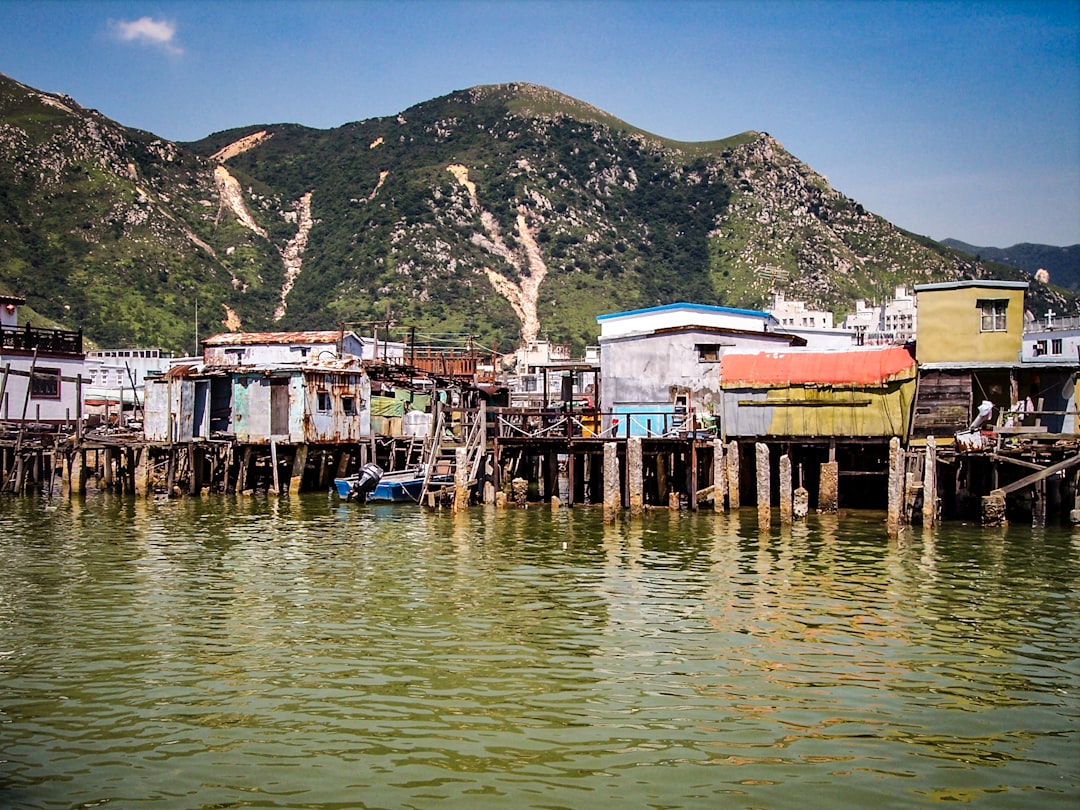
A hundred yards further, the village ended abruptly. Beyond it was a stretch of coastal scrubland — mangrove, tidal mudflats, the occasional egret picking through the shallows. The pier was in worse shape than it had looked from a distance: concrete pillars stained dark with algae, a rotting wooden deck, a sign warning in Chinese and English that the structure was unsafe. We approached anyway, stepping carefully over the gaps where boards had fallen through. At the end, standing on a section that still felt solid, we could see the mainland — or what used to be the mainland. A massive reclamation project was visible on the horizon, a flat line of earthmoving equipment and half-built roads stretching into the sea. From this distance it looked less like construction and more like a slow, deliberate erasure.
We spent the afternoon walking the coastline. There was no trail to follow, just the edge of the mudflats and the occasional fisherman’s path worn into the grass. The tide was going out, leaving behind pools of water that reflected the sky in patches of pale blue and grey. In one pool, a small crab — barely bigger than a thumbnail — scuttled sideways across a bed of broken shells. The silence was startling. Not the absence of noise, but the absence of anything mechanical: no traffic, no construction, no drone of an air conditioner or the distant hum of a highway. Just the sound of water lapping against mud, and the occasional cry of a bird circling overhead.
Around four o’clock, the light changed. The sun dropped behind a bank of clouds, casting the whole bay in a soft, even grey that made the colours of the mangroves — dark green, almost black, with pale roots reaching into the mud — seem sharper than they had in the harsh afternoon glare. We found the temple the friend had mentioned, tucked into a grove of trees about a hundred metres inland from the beach. The roof was indeed broken — a section of terracotta tile had collapsed inward, exposing the interior to the weather. Inside, the altar was still intact: a faded statue of Tin Hau, goddess of the sea, surrounded by offerings that looked recent — a bowl of oranges, a half-burned incense stick, a small cup of tea. Someone was still maintaining this place. Someone still believed the sea needed looking after.
We sat on the temple steps and ate the snacks we’d brought: packaged biscuits and a bottle of water, nothing romantic. Across the bay, the reclamation site had gone quiet for the evening, the machines still, the workers gone. A fishing boat chugged past, heading toward the open water, its wake spreading in a V that slowly dissolved into the flat grey of the sea. The air cooled. The tide crept back in, covering the mudflats inch by inch, erasing the footprints we’d left an hour earlier.
We took the last bus back to Mui Wo, the one that leaves at 6:47 and doesn’t wait for stragglers. The driver was the same man who’d brought us out, or at least he had the same quiet, unflappable demeanour. He glanced at us in the rearview mirror as we climbed aboard, and for a moment we thought he might say something — ask where we’d been, what we’d seen, or something like that. He didn’t. He just waited until we sat down, closed the door, and pulled away. Through the window, the village shrank behind us, a cluster of roofs and the single light of the shop growing smaller until the hills swallowed it entirely.
The ferry back to Central was busier than the morning crossing. Commuters, students, a man carrying a live chicken in a mesh bag — the ordinary traffic of a city that extends further than the skyscrapers suggest. The lights of Hong Kong Island came into view across the harbour, glowing against the darkening sky. It was beautiful, in the way all cities are beautiful from a distance at night — the complication hidden, the seams invisible. But we had spent the day somewhere those seams were still visible, where the edges of the city frayed into something older.
The next morning, we looked up the village online. There was almost nothing. A single forum post from 2018, a mention in a hiking guide that described it as “all but abandoned.” No recent news articles. No development plans explicitly naming the village. But the reclamation we’d seen from the pier is part of a larger project, and the government’s blueprints show the coastline extending outward, year by year, swallowing the bays and coves that once defined this part of the territory. The ferry schedule hasn’t changed yet. The woman still sorts her squid on the plastic stool. The incense at the temple is still lit. But the maps are being redrawn, and it doesn’t take a cartographer to see which way the line is moving.
We spent one more day on the water, taking a different ferry — to Peng Chau this time, an island small enough to walk across in twenty minutes. The village there is still alive, still functioning, with a bakery that sells egg tarts from a window and a tiny ferry terminal where passengers wait on wooden benches. A man we met at the dock — not a local, just someone who’d been coming here for decades — told us he remembered when the ferry was the only connection to the mainland, and every village on the island had its own pier, its own boat, its own way of life. “Now they’re all connected by road,” he said. “Or they will be. I don’t know, maybe it’s just the way it goes.” He didn’t sound angry about it. He sounded tired.
We bought two egg tarts — seven dollars each — and ate them sitting on a rocky outcrop overlooking the channel between Peng Chau and Lantau. The water was a deep, clear green, the kind of colour that only shows on days when the sediment settles and the light hits at the right angle. A pair of cormorants dried their wings on a buoy. Across the channel, the hills of Lantau rose green and quiet, and somewhere over them, the faint rumble of construction — or maybe just a plane — drifted through the afternoon air. It was hard to tell, and soon, it would be harder to remember what it sounded like before.

📷 Photos: Akash Rai (Unsplash), Akash Rai (Unsplash)