The harbour at Labuan Bajo smells like diesel and salt and, depending which way the wind pushes, grilled fish from the warungs lining the waterfront. I had expected a sleepy fishing town, the kind where you kill an afternoon watching boats get repaired. Instead, it felt like a frontier — construction dust rising from new hotels, dive shops competing for space with hardware stores, and a pace that suggested someone had decided this place was next. The boat I boarded was a traditional phinisi, but with a fiberglass hull and a Yamaha outboard that could push me across the Savu Sea faster than any sail had ever managed. Five days, four islands, and a route I’d plotted from a combination of forum posts and a single conversation with a man named Yanto who ran a dive operation out of a shipping container near the pier.
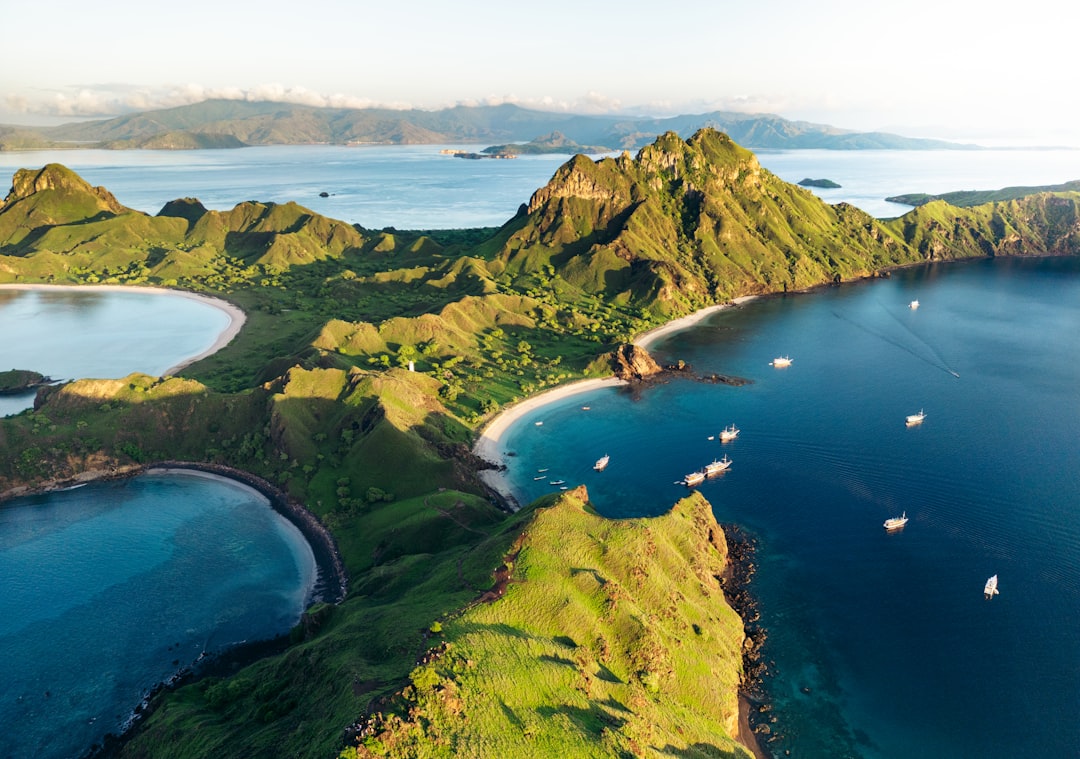
Most itineraries for this part of Flores focus on Rinca and Komodo islands, the two places where the dragons live in numbers large enough to guarantee sightings. And they do deliver — the dragons at Loh Buaya on Rinca were sprawled across the ranger station veranda like they owned it, which they effectively did. But what surprised me was how quickly the dragons became a supporting character rather than the lead. The real show began the moment I left the jetty. The water around Komodo shifts from turquoise to a deep indigo in the span of a hundred metres, and the islands rise out of it like sudden afterthoughts of the volcanic chain that built them. Pink Beach gets its colour from red coral fragments mixing with white sand, and it’s the only stretch of coastline I’ve seen that looks more saturated in person than in photographs. The snorkelling there was better than any I’d done in Raja Ampat the year before — current sweeping across a reef drop-off where turtles hung in the current like they were waiting for something.
Yanto had told me most travellers skip the eastern side of Flores entirely, and I understood why after spending a day getting there. The road from Labuan Bajo to Ruteng is not a road in any conventional sense; it’s a ribbon of broken asphalt that clings to the mountainside, and the bus drivers treat it like a rally stage. I counted three landslides, two water buffalo standing in the middle of a blind corner, and a gradient that made the engine whine in a pitch I’d only heard from tea kettles. But the potholes and delays were worth it for the moment the landscape opened up into the rice terraces at Cancar. These are not the carefully manicured tourist terraces of Ubud; they’re working fields, carved into the hillside in concentric rings that form a spiderweb pattern visible only from a specific vantage point near the road. No entrance fee, no parking attendant, just a faded sign and a view that makes you forget you’ve been in a vehicle for six hours.
The temperature drops noticeably as you climb inland from the coast. Labuan Bajo sits at sea level, where the air feels heavy and damp even in the dry season. By the time I reached Ruteng, elevation somewhere around twelve hundred metres, I needed a jacket. The local coffee — served in a glass with condensed milk already settled at the bottom — tasted like something between fuel and medicine, and I drank three cups over the course of an afternoon. A woman named Ibu Rina who ran a small homestay told me the coffee comes from the hills above the town, where the volcanic soil grows beans that are darker and more bitter than what most Indonesians drink. She gestured toward a mountain I could barely see through the mist and said the harvest happens twice a year, and that the men who pick it carry the bags down on their backs because no vehicle can reach the plantations.
Diving at Batu Bolong requires timing. The site sits in a narrow channel between two islands where the current runs through like a river, and if you hit it at slack tide you get a gentle drift over coral gardens that hold more reef fish than I thought possible in one place. Hit it wrong, and you’re fighting a current that can push you past the pickup point in minutes. Our guide, a Sundanese man named Asep who’d been diving these waters for fifteen years, checked his tide tables three times before we entered the water. He pointed out a pygmy seahorse on a sea fan that I would never have spotted on my own — smaller than a fingernail, perfectly camouflaged against its host. The site is famous among serious divers but barely mentioned in the mainstream itineraries, and I understood why: it’s not easy to reach, it demands attention to conditions, and it rewards preparation in a way that casual snorkellers rarely get to experience.
The village of Wae Rebo sits at the end of a hike that most people underestimate. I had read the distance — six kilometres from the nearest road — and assumed it would take maybe two hours. It took four, and most of it was uphill through forest that felt ancient and wet, with tree roots forming natural steps that were more slippery than any staircase. The reward is a clearing of traditional Mbaru Niam houses, cone-shaped structures with thatched roofs that look like they grew out of the ground rather than being built on it. I arrived just as the fog rolled in, and for a moment the entire village seemed to float above the cloud line. A young man named Darius, who had grown up there and now guided the occasional group, explained that each house represents a family line and that the central pole inside is carved from a single tree trunk that was cut and carried up the mountain generations ago. He showed me the space beneath the roof where they dry coffee and vanilla pods, and the smell was unlike anything I’ve encountered — sweet and woody and slightly smoky, as if the building itself was breathing.
Snorkelling at Manta Point is a game of patience. The cleaning station sits in about fifteen metres of water, and the mantas approach with a steadiness that feels almost choreographed. I floated on the surface watching a female with a wingspan easily three metres across glide past so close I could see the pattern of spots on her belly, each one distinct like a fingerprint. The guides maintain a strict no-touch policy and enforce it with a whistle that cuts through the water. One French tourist learned this the hard way when she tried to swim directly above a manta and got called back so sharply that the entire group turned to watch. The mantas don’t seem to care about human presence as long as you stay still and let them come to you. I counted seven individuals over the course of forty-five minutes. Not one changed course to avoid me.
The seafood market in Labuan Bajo that operates only in the hours before dawn deserves more attention than it gets. I woke at four in the morning on my last day, guided by a tip from a fisherman I’d met on the dock the evening before. The market occupies a concrete slab near the main pier, and by five it was full of women sorting the night’s catch by torchlight. Tuna the size of small children were laid out on plastic tarps, their scales catching the orange glow of cooking fires where vendors fried fish cakes and rice for the early shift of dockworkers. A woman named Yuli sold me a skewer of grilled squid that had been swimming less than six hours earlier, and the flavour was so clean and direct that I understood why the locals rarely bother with sauce. The market winds down by seven, when the sun gets high enough to heat the concrete and the remaining catch gets loaded onto motorbikes for delivery to restaurants across town.
The hike to the crater lakes at Kelimutu requires leaving Flores by road, crossing to the eastern end of the island near Ende. The lakes change colour unpredictably — I’ve seen photographs where they appear turquoise, green, red, even black on different visits. When I arrived just after sunrise, they were a pale jade on one side and a deep burgundy on the other, with the third lake somewhere between rust and copper. A local guide explained that the colours come from mineral reactions and volcanic gases, but also that the local people believe the lakes hold the souls of the dead, with each shade corresponding to a different category of spirit. The viewing platform was crowded with Indonesian tourists who had driven through the night from Maumere, and the atmosphere felt more like a pilgrimage than a sightseeing stop. Someone had brought a portable speaker and was playing a dangdut song that echoed across the crater, and for a moment the scene was so absurd and so earnest that I couldn’t help laughing. This is what Flores does — it gives you something ancient and sacred, then reminds you that it’s still a living place where people bring music and children and folding chairs.
The decision to add a day in the fishing village of Seraya ended up being my best unplanned detour. I had heard about it from a diver on the boat who mentioned that the coral reef there was healthy and uncrowded, but what I found was a community so far removed from the tourist economy that the children followed me through the village asking for pens and notebooks instead of money. The homestay had no running water after nine in the evening, and the mattress was thin enough that I could feel every bamboo slat beneath it. But the reef was exactly as described — a gentle slope of hard coral that dropped into deep water where reef sharks circled in the blue. I spent three hours snorkelling alone, with only the sound of my own breathing and the occasional crackle of fish feeding on the reef. When I came back to the beach, a woman was roasting corn over a fire of coconut husks, and she handed me an ear without asking if I wanted it. The kernels were charred and smoky. Sweetest thing I ate the entire trip.

📷 Photos: Simon Spring (Unsplash), Simon Spring (Unsplash)