The first thing I noticed was the smell of fried garlic drifting up from the street below, mixed with the low thrum of engines that never quite stops in Hanoi’s Old Quarter. I was standing on the rooftop of a building I’d found through a series of accidental discoveries — a wrong turn down an alley that led to a café, then a staircase I wasn’t sure I was supposed to climb, then a narrow spiral of metal steps that deposited me onto a flat concrete terrace with a view that didn’t seem to belong to anyone.
Below me, the intersection of Phung Hung and Hang Dieu was doing what it does every afternoon: about four hundred motorbikes were trying to occupy the same space at the same time, in a fluid negotiation that looked chaotic from ground level but made an odd kind of sense from above. To my right, the curved roof of a temple — Chua Hang, though I didn’t know its name until later — rose above the tin roofs of a row of shop houses, its ceramic tile ridge catching the late light. The spire came up exactly where the traffic jam bottlenecked, so the whole scene arranged itself into a single frame: the slow river of metal and plastic below, the ancient curve of the temple roof above, and between them, nothing but the humid air of a Hanoi afternoon.
A young woman in an apron came up through the stairwell, balancing two glasses of iced coffee. She set them on a small plastic table that hadn’t been there a moment ago — someone must have unfolded it while I was looking at the view. “You find this place okay?” she asked. Her English was careful, each word placed deliberately. I said I’d followed the smell of coffee and the sound of a fan. She nodded like this was a common explanation, then gestured at the glass. “Is egg coffee. From my mother’s recipe. Very old.”
I’d never had egg coffee before — the real kind, not the tourist version served in the cafes around Hoan Kiem Lake, where the presentation is fussy and the price is three times what it should be. This one came in a simple glass, no saucer, no latte art, just a layer of whipped egg yolk and condensed milk floating on top of dark, bitter coffee. The woman — her name was Linh, I learned later, and she ran the café with her husband — watched me take the first sip. “Too sweet?” “Just right,” I said, which was true. The sweetness cut the bitterness without cancelling it.
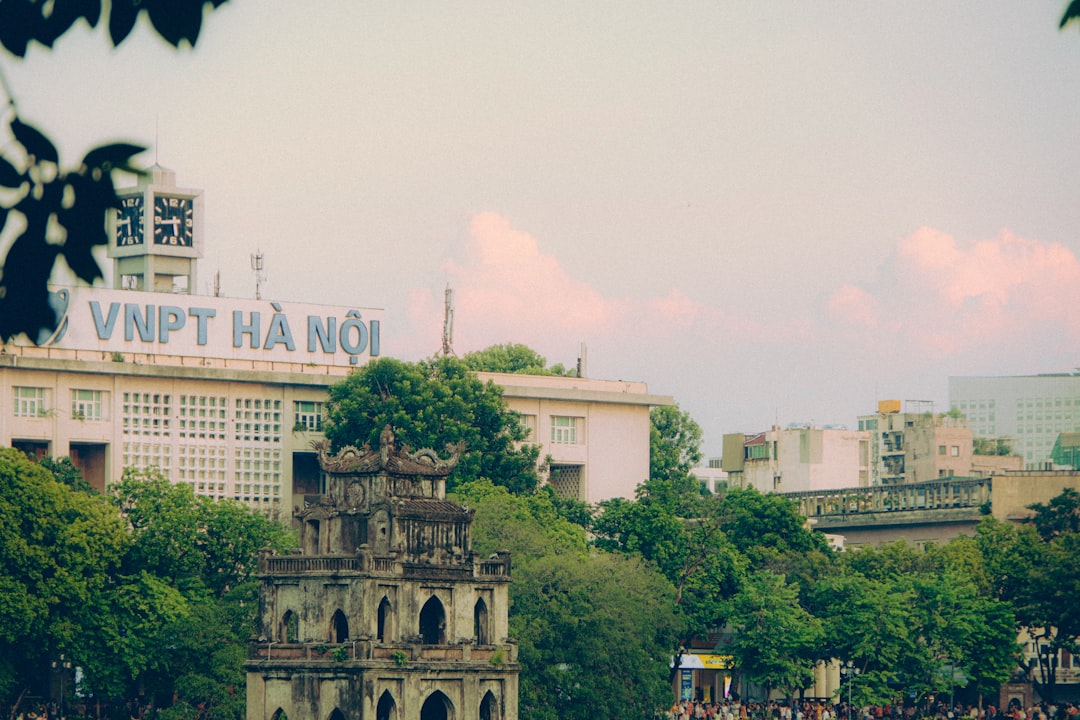
I’d been in Hanoi for three days by then, and I’d already developed a theory about the city: the best views aren’t the ones you plan for. My first afternoon, I’d walked to the Turtle Tower in the middle of the lake, like every guidebook suggests. The tower itself is small, almost underwhelming from shore, and the crowds around the lake were dense enough that I gave up after ten minutes. The second day, I tried the balcony of the Hanoi Opera House, thinking maybe the French colonial architecture would give me the perspective I was missing. But the balcony faces the street, not the city, and I ended up looking at tour buses and a man selling grilled corn from a cart.
It wasn’t until late on the second evening, when I was wandering through the maze of alleys between Hang Bac and Hang Gai, that I stumbled onto the idea of going up. I’d stopped at a small restaurant for a bowl of bun cha — the kind where the family who runs it lives upstairs, and the kitchen is basically a charcoal grill set up on the sidewalk. The owner, a man in his sixties with a thin face and a faded denim jacket, pointed upstairs when I asked about a toilet. I climbed a set of stairs that creaked with every step, found the bathroom, and on the way back, noticed a door left ajar that opened onto a small balcony. From there, I could see the street below — the same mad flow of motorbikes and bicycles and pedestrians — but also, for the first time, the roofs of the Old Quarter, layered like overlapping tiles, some ancient, some patched with corrugated iron. I stood there for maybe five minutes, not wanting to overstay my welcome, but long enough to realize what I’d been missing.
The next morning, I started asking around. I wanted a rooftop, specifically, and one where I could see both the traffic and something older — a temple, a pagoda, a piece of the city that predated the motorbikes. The first person I asked was the owner of a bookstore on Hang Buom, a quiet man who seemed more interested in the book he was reading than in my questions. “Many roof,” he said, without looking up. “Just go up.” It wasn’t helpful, exactly, but it was honest — there are hundreds of roofs in the Old Quarter, and I’d eventually figure out which one worked.
The second person was a cyclo driver I found napping in his vehicle outside the Dong Xuan Market. I woke him by accident, and he looked annoyed until I offered to buy him a coffee. Over a plastic cup of ca phe den at a nearby stall, he told me about the rooftop at 25 Hang Dieu. “Very famous,” he said, but when I pressed for details, he just shrugged. “Famous for photographers. They go up and take picture of the traffic. I don’t know why. Traffic is traffic.” He said it with the weariness of someone who’d been sitting in it for thirty years.
Number 25 Hang Dieu turned out to be a building that housed a tailor shop on the ground floor and, above it, a series of small apartments. There was no sign indicating a café or a viewing platform, and the front door was locked. I stood outside for a moment, trying to decide whether to knock, when a woman came out carrying a bag of vegetables. She looked at me, then at my camera, and said something in Vietnamese that I didn’t understand. I pointed up. She nodded and held the door open.
The staircase was narrow and dark, the walls covered in decades of layered paint — cream, then green, then beige, then cream again. On the third floor, a child’s bicycle was chained to the railing. On the fourth, someone had left a pair of flip-flops outside a door. I kept climbing until I reached a metal door that opened onto the same rooftop I’d eventually come to know well: flat concrete, a low wall, a clothesline with a few faded shirts, and that view. The motorbikes were still there, of course — they’re always there — but now I could see the temple spire behind them, and the curve of the road that led toward the Red River, and the smudge of green that was the island in the middle of the lake.
I stood there for maybe twenty minutes, trying different angles, waiting for gaps in the traffic that never came. It was a Tuesday afternoon, and the heat was significant — not the wet heat of the south, but a dry, dusty heat that settled into the concrete and radiated back up. A man came out onto the rooftop from a different door, carrying a bowl of noodles. He sat down on an overturned bucket, ate his lunch, and watched me take photos with the mild curiosity of someone who sees this happen once a week and still finds it slightly strange. “You want to stand on the wall?” he asked, between noodles. “Better view.” I declined.
Over the next few days, I returned to that rooftop at different times. Early morning, just after sunrise, when the light was flat and the traffic was already thick but somehow less aggressive — the drivers seemed more patient, the horns less insistent. Midday, which was brutal but gave the most contrast between the dark mass of the traffic and the bright white of the temple walls. Late afternoon, an hour before sunset, when the light turned the dust in the air into something almost golden and the temple spire cast a long shadow across the street. Each time, the scene was recognizably the same — the same intersection, the same building — but the feeling of it changed completely. At noon, the traffic felt like a problem to be solved. At dusk, it felt like a river, or like a kind of music I hadn’t learned to hear yet.
I started to notice patterns I hadn’t seen from ground level. The way a single motorbike could change the flow of the entire intersection by hesitating for half a second. The way pedestrians would step into the traffic with a confidence that seemed reckless until you realized they were reading the gaps, not the lights. The way a delivery scooter loaded with five cages of live chickens would somehow weave through spaces that didn’t seem to exist. From above, it looked less like chaos and more like a language — one I didn’t speak, but could see the grammar of.
Linh, the café owner, told me she’d been serving coffee on that rooftop for eleven years. “Before that, it was my mother’s,” she said. “She started in 1998, just a table and two chairs. Now I have eight tables, but only for coffee. No food, because the smell is bad for the neighbors.” She gestured at the low wall. “The foreigners come. They take pictures. Sometimes they stay for hours. I don’t mind, as long as they buy coffee.” I bought coffee every time I came, sometimes two.
The first time I walked out onto that rooftop, I almost left without taking a photo. It felt intrusive, somehow, to frame someone else’s daily life into a picture I’d take home. But Linh had told me, on my third visit: “You take picture. Show people. They come, they buy coffee. Everyone wins.” Or something like that, anyway — the exact words might have been slightly different.
On my last afternoon in Hanoi, I went up one final time. The light was different that day — rain had been threatening all morning, and the clouds had turned the sky into a flat gray dome that absorbed color instead of reflecting it. The motorbikes looked duller than usual, the temple spire less bright. But there was something about the scene that worked anyway: the grayness made the yellow of the temple walls stand out more, and the traffic, stripped of its usual golden-hour romance, looked like what it actually was — a city getting on with its business. I took one photo, then put my camera away. I drank my coffee, and Linh came out to collect the glass. “You leave tomorrow?” she asked. “Yes.” She nodded, then said something I didn’t quite catch. It might have been “goodbye” or “come back” — the words were similar enough in Vietnamese that I couldn’t tell the difference.
I walked down the stairs one last time, past the child’s bicycle and the flip-flops, past the layers of paint on the walls and the sound of someone cooking in an apartment I couldn’t see. The front door was open now, and the street hit me with its full force: the heat, the noise, the smell of exhaust and fried garlic and something sweet from a bakery down the block. I stepped into the traffic without hesitating, reading the gaps the way I’d watched the pedestrians do from above, and crossed the street without needing to look back.

📷 Photos: Nguyen Minh Kien (Unsplash), Josh Stewart (Unsplash)