I found the first one by accident, which is usually how it happens. I was trying to shortcut through an alley in Seminyak to avoid the midday traffic on Jalan Kayu Aya, and instead of coming out at the beach, I ended up in a small courtyard behind a warung. A massive mural of a woman with a jellyfish for hair painted across the entire back wall of a laundromat. Her tentacles were made of old telephone wires. The paint had faded in the tropical sun to a soft, chalky version of what it once was, but the detail in the jellyfish’s bell — iridescent blues and greens that caught the light, the kind of colour you can only get from a tube you’ve squeezed too hard — was still sharp.
That was the beginning of a week spent not quite following a map. Bali’s street art doesn’t cluster in one obvious district like Melbourne’s laneways or Berlin’s East Side Gallery. It scatters across the island, appearing in places where you least expect it and disappearing just as quickly when a wall gets painted over or a landlord decides to repaint. What I found, after several long walks, a few wrong turns, and one conversation with a local artist, was that the best work exists in five distinct pockets, each with its own character.
Seminyak, where I’d started, has a reputation for being commercial, and it’s earned it. But the commercialism creates a certain kind of opportunity. The alleyways between the high-end boutiques and the beach clubs are where a lot of the commissioned work ends up — brands paying artists to paint their walls for a season, or a hotel commissioning a piece to create a photo backdrop for guests. The jellyfish woman wasn’t branded. She was just there, a remnant of whoever had the wall before the laundromat took over. But a few blocks away, behind a cafe called Revolver, a series of smaller pieces lined a corridor leading to the bathroom. A portrait of a man with a bird’s nest growing out of his hat. A cat wearing a crown. A garuda rendered in a style that looked almost like a children’s book illustration. None of it felt precious, which is part of why it worked. The artists seemed to be having fun.
One afternoon, I sat at a table outside the cafe with a cup of iced coffee and watched a young woman with a spray can add a final flourish to a piece she’d been working on for two days. Her name was Dita. She told me she was from Denpasar and that she’d been painting for about five years. “The walls here are rented, basically,” she said, gesturing at the building behind her. “The owner lets me paint for six months, something like that. After that, someone else gets a turn, or they paint it white for a new tenant.” She wiped her hands on her shorts and looked at the wall. “It’s not like a gallery where the work stays forever. It’s more like a conversation that keeps changing speakers.” I asked her where else I should look. She thought for a moment, then said, “Go to the river.”
The river in question was the Ayung, which cuts through the heart of Ubud. But she didn’t mean the tourist trail along the Campuhan Ridge Walk. She meant the stretch near the bridge on Jalan Raya Ubud, where the concrete banks drop down about six metres to the water. From the bridge, the walls below look like a chaotic jumble of faded colours and half-erased letters. But if you climb down the steps near the temple — a route I spent twenty minutes trying to find, walking back and forth past the same sarong vendors — you reach a hidden gallery. The scale is different here. The pieces are bigger, the surfaces rougher, and the damp air from the river gives the paint a slightly tacky feel even on a dry day. A mural of a giant dragon’s head, its eye the size of a dinner plate, stared across the water at a painted row of tiny birds perched on an electrical cable that wasn’t actually there. The mismatch in scale was deliberate. It felt like the artist was making a joke about perspective.
The stones underfoot were slippery in places where the moss had taken hold, and the smell was a mix of river water and concrete dust and something floral from a frangipani tree that had overhung the bank. I didn’t see another person the entire time I was down there. A scooter engine rumbled overhead every few minutes, but down on the bank, the sound was muffled, distant. I sat on a low wall for a while, just looking. The dragon’s teeth were painted with a level of detail that felt unnecessary, in the best way. Each tooth had a small chip or crack painted into it, giving the creature an aged, weather-beaten look that the actual weather was already beginning to replicate. You stayed longer than you meant to.
The next morning, I went looking for a completely different kind of street art, and I found it in a place that felt like an afterthought: the back streets of Sanur. Sanur is not a neighbourhood that courts attention. It’s a long, flat strip of beach hotels and seafood restaurants, popular with older travellers and families. But the side streets that run perpendicular to the beach host a small, concentrated collection of murals that seem to function as a kind of community bulletin board. A wall outside a primary school was painted with a scene of Balinese children flying kites, but the kite strings turned into the roots of a banyan tree. A set of garage doors on a residential street featured a series of portraits — a farmer, a fisherman, a woman carrying offerings — all rendered in a flat, graphic style that reminded me of woodblock prints. The paint was fresh, bright, unweathered. I guessed it was less than a month old.
A man washing his scooter outside one of the houses saw me taking photos and called out, “You like?” He had a friendly, gap-toothed smile and a towel slung over his shoulder. His name was Pak Made. He told me that the murals were part of a project organised by the local banjar, the village council, to make the streets more appealing for a festival that had already happened. “The festival is finished,” he said, “but the paintings stay.” He pointed at the fisherman portrait. “That one is my uncle. He’s been fishing here for forty years.” The portrait didn’t look like a specific person — it was too stylised for that — but that didn’t matter. The gesture of claiming the wall for a real person, even symbolically, gave the piece a weight that the jellyfish in Seminyak didn’t have.
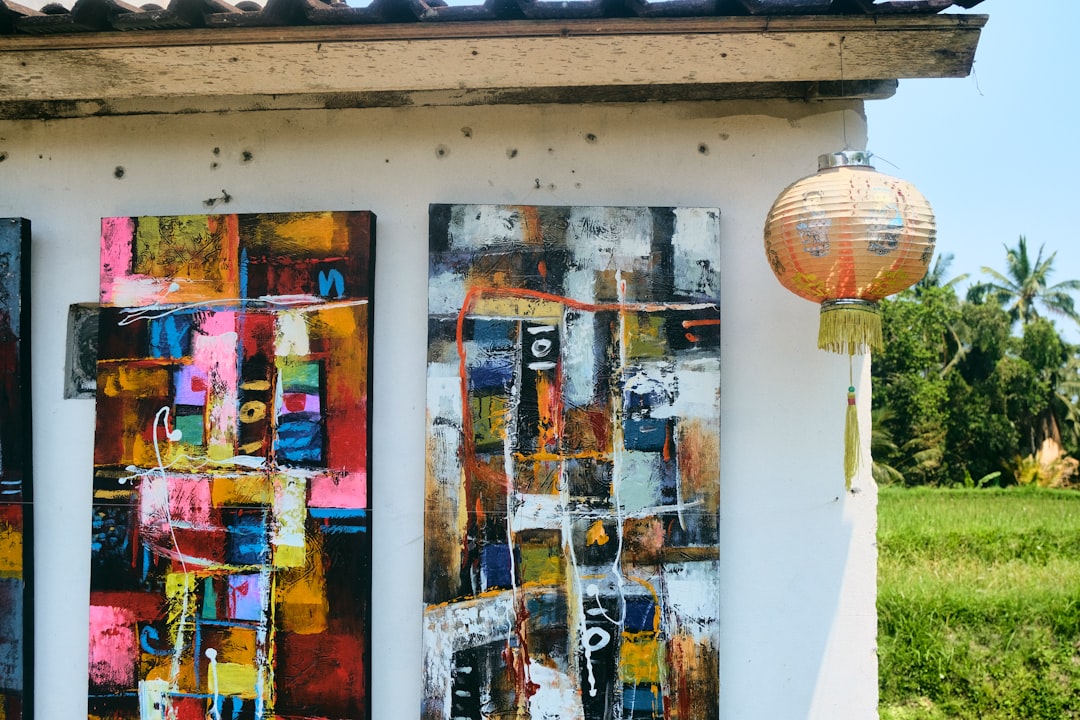
The fourth neighbourhood was the one I almost skipped. Canggu has become so synonymous with a certain kind of digital-nomad lifestyle that I assumed the street art there would be the same: generic, hashtag-friendly, designed to be photographed in front of by someone in a wide-brimmed hat. And a lot of it is. But tucked away on the narrow roads around Batu Bolong, behind the smoothie bowl cafes and the co-working spaces, I found a cluster of work that felt genuinely experimental. A wall near the Berawa intersection had been painted entirely in black, with a single glowing crack running from top to bottom, like the surface of a broken screen. The paint was phosphorescent. At night, it would glow faintly, a thin green line in the dark. Another piece, on the side of a building that looked like it was under construction, was a massive, abstract explosion of overlapping geometric shapes in primary colours. It had no obvious subject. It wasn’t trying to light up a story. It was just a collision of shapes, and the effect was exhilarating.
The fifth neighbourhood was the hardest to get to and the one that felt the most like a real discovery. Penestanan, a small village just outside Ubud, has a network of footpaths that wind through rice paddies and family compounds. The streets are too narrow for cars. You walk, or you take a scooter and park where you can. The walls here are not commissioned. They are not curated. They are the work of whoever lives behind them, or whoever passed through and left a mark. I found a small mural of a frog riding a snail, painted on a retaining wall with what looked like house paint. The brushwork was clumsy. The frog’s legs were misaligned. But someone had taken the trouble to paint it, and that intention mattered more than the skill. A few metres away, a more accomplished piece — a woman’s face composed entirely of leaves — covered the side of a small shop selling cold drinks. The shopkeeper told me that her nephew had painted it. “He’s studying in Jakarta now,” she said, handing me a bottle of Bintang. “But he comes home and paints every year. It’s his way of remembering.”
The humidity got into the paint. The sun bleached the colours unevenly. A mural that looked crisp and vivid in the morning could look washed out by late afternoon, depending on how the light hit it. In Sanur, the sea salt in the air had caused some of the paint to bubble and peel, giving the portraits a slightly distressed look that the artist probably hadn’t intended but that added a layer of texture. In Penestanan, the rain had smeared the edges of the geometric shapes on one wall, turning sharp lines into soft blurs. An artwork in Bali has a lifespan measured in months, not years. The walls are rented, the weather is aggressive, and the next artist is already waiting for their turn.
I spent my last afternoon back in Seminyak, standing in front of the jellyfish woman. The light was different now — a softer, later light that brought out the green tones in her hair. A group of teenagers walked past, laughing, paying no attention to the wall. A woman with a small dog stopped to look, then moved on. The mural had been there for at least a year, Dita had said, maybe longer.

📷 Photos: Rebecca Clarke (Unsplash), Deny Napitupulu (Unsplash)