The road from Yogyakarta to the village of Giriloyo is not a straight line, nor a particularly forgiving one. I had been told the journey would take forty minutes. It took closer to two hours, most of it spent behind a truck carrying live chickens stacked in bamboo cages, the air thickening with dust and the occasional wave of heat from the engine ahead. By the time the driver pulled over at a junction where the asphalt gave way to compacted dirt, the afternoon light had already begun to soften, casting long shadows across the rice paddies that stretched between the road and the first cluster of houses.
Giriloyo sits on a slope above the temple complex of Imogiri, a place most visitors to Java know only as the burial site of the Mataram sultans. The tour buses stop there, let people climb the long staircase to the royal graves, and then leave. They do not continue up the hill. The village itself has no ticketed entrance, no sign announcing its presence, no souvenir stalls arranged in a neat row. What it has is a handful of families who have been making batik by hand for generations, and one of them, a man in his late seventies named Pak Karto, is widely regarded as the last living practitioner of a technique called batik tulis kombinasi — a method that combines hand-drawn wax lines with a particular kind of resist dyeing that requires the cloth to be dipped and dried as many as fifteen separate times.
I found his workshop on the recommendation of a textile curator I had met months earlier in Jakarta. She had scribbled the directions on a napkin — “turn left at the big banyan tree, then follow the sound of the wooden hammer” — and it turned out to be accurate. The hammer in question is used to beat the wax-dipping tool, a small copper vessel called a canting, to keep the wax flowing at a consistent temperature. The sound is a soft, rhythmic tap, not unlike a distant woodpecker, and it carries surprisingly far through the still air of the village.
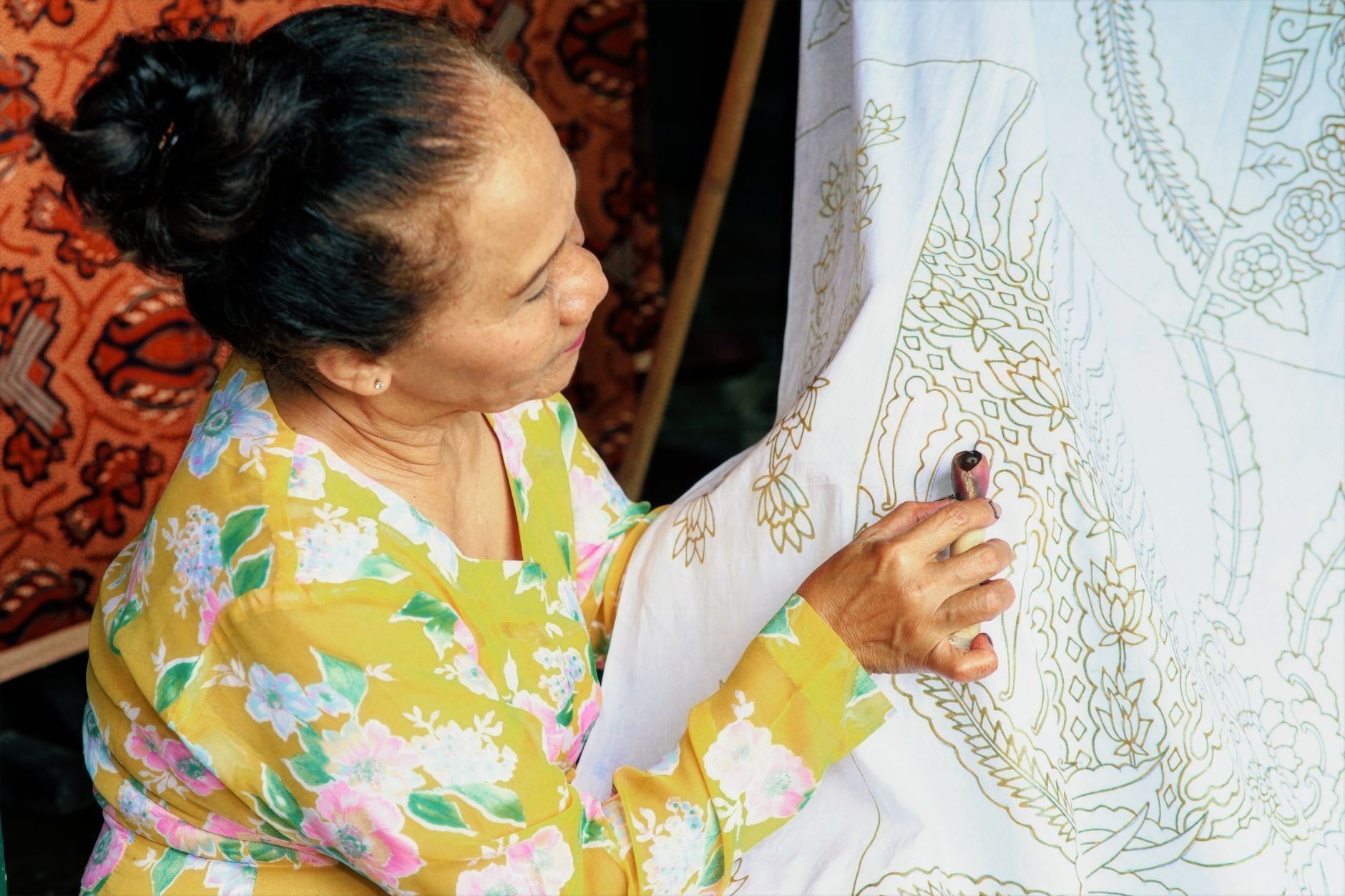
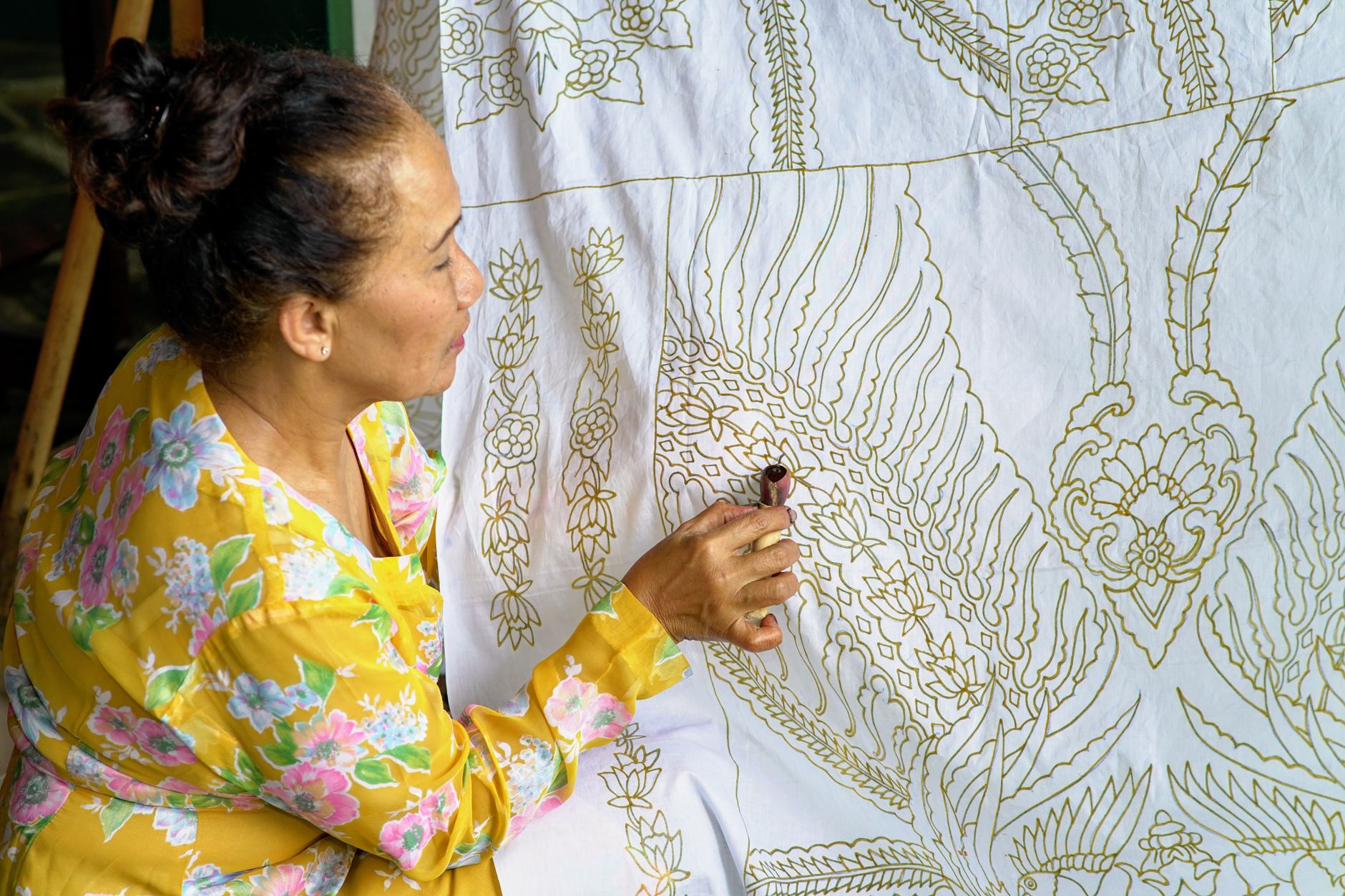
Pak Karto was seated on a low stool under the overhang of his porch when I arrived, his back to the wall, a bolt of white cotton stretched across a wooden frame balanced on his knees. He did not look up immediately. The concentration in his face was absolute, the hand moving the canting across the fabric in a pattern of tiny dots that, from a distance, looked like nothing more than a random scattering of dark flecks. Up close, it resolved into the shape of a parang motif — a series of diagonal waves that, in Javanese tradition, represents the ocean and the unbroken line of life itself. It is a pattern so old that its origins are lost to recorded history, and he was drawing it entirely from memory, without a single guide line or stencil.
The first thing that surprised me was the heat. The wax is kept molten in a small clay pot over a charcoal brazier, and the air around Pak Karto’s work area was dense with the smell of beeswax and resin, thick and sweet and slightly smoky. The afternoon sun beat down on the corrugated iron roof of the porch, and the temperature inside the shaded work space was easily several degrees warmer than the open air. Sweat beaded on his forearms as he worked, but he did not pause to wipe it away. “If the wax cools,” he said in Javanese, his voice low and unhurried, “the line breaks. You have to stay with it until the cloth tells you it’s done.” His daughter, who spoke some Indonesian, translated from the doorway where she was folding finished pieces.
The cloth tells you it’s done. I had never heard anyone describe the process of making something in quite those terms. It suggested a relationship between maker and material that went beyond skill or technique — something closer to a negotiation. Pak Karto has been doing this since he was seven years old, learning from his father, who learned from his father before him. He is the fourth generation. His daughter has learned the basics, she told me, but she works primarily in a different style, using a copper stamp called a cap that allows for faster production. The tulis method, she said, takes too long. A single piece of cloth, depending on the complexity of the pattern, can take three weeks to a month to finish. The economics of it are brutal. A hand-drawn batik piece might sell for the equivalent of fifty or sixty US dollars in the local market — a price that, when divided across the weeks of work, works out to less than two dollars a day.
This is the part of the story that the glossy travel magazines tend to leave out. The romance of the “last living master” is real enough, but so is the fact that the craft is dying not because people have lost interest in it, but because it no longer makes economic sense for anyone young to pursue it. The village of Giriloyo, I learned over the course of the afternoon, once had close to five hundred families practicing the tulis method. Now there are fewer than ten, and most of them are over sixty. Pak Karto’s own granddaughter left for Jakarta two years ago to work in a call center. She sends money home, but she has no interest in learning batik.
“The wax stains your hands,” Pak Karto said, holding up his own palms, which were covered in a fine network of tiny brown dots, some of them permanent, others just residue from that day’s work. “She doesn’t want that.” He said it without bitterness, simply as a statement of fact. The village itself, meanwhile, is quiet in a way that feels less peaceful than it does emptied. During the morning hours, I saw mostly older women and children. The men, I was told, had gone to work in the nearby city of Bantul, or further afield, in Yogyakarta. The houses themselves are a mix of traditional Javanese joglo structures — with their distinctive peaked roofs and carved wooden pillars — and newer concrete blocks, built with remittance money from relatives abroad. The contrast is jarring, the old and the new sitting side by side without quite blending.
I spent the rest of the afternoon watching Pak Karto work and, eventually, trying my own hand at it. The canting, I discovered immediately, is a deceptively simple tool. It looks like a small copper teapot with a spout the width of a pinhead, attached to a wooden handle. The principle is straightforward: you dip the spout into the molten wax, let it fill the reservoir, and then draw it across the cloth, letting the wax flow out in a thin, even line. In practice, it is nearly impossible. The wax cools almost instantly the moment it leaves the spout, so the line must be drawn at a steady, consistent speed, without hesitation. The first few lines I attempted were a mess — blobs where I paused, thin gaps where I went too fast, a general unevenness that made the pattern look like an earthquake had passed through it. Pak Karto watched without comment for several minutes, then reached over and guided my hand, adjusting the angle of the canting by a few degrees. “Like writing with water,” he said through his daughter. “You cannot hold the pen too tight.”
The phrase stuck with me, not because it was poetic — it was, in fact, quite practical — but because it captured the exact tension of the craft. You need control, but not the kind of control that comes from gripping hard. You need a steady hand that is also a relaxed one, which is a contradiction that takes years, not hours, to resolve. I gave up after twenty minutes and sat back to watch him resume his work, the canting moving across the cloth in a rhythm that looked effortless precisely because it had been practiced for seven decades.
The light changed as the afternoon wore on. The shadows grew longer and the heat began to recede, and a breeze came up from the valley below, carrying the smell of cooking fires and the distant sound of a gamelan rehearsal drifting from somewhere deeper in the village. A rooster crowed from a nearby yard, and a group of children ran past on their way home from school, laughing at something I could not see. But I could not shake the knowledge that the idyll was built on a foundation that was quietly crumbling. The gamelan rehearsal, I later learned, was for a performance by the village’s last traditional ensemble, whose youngest member was forty-seven years old. The children running past were not learning the music. They were listening to K-pop on their phones.
Before I left, Pak Karto showed me a piece he had finished a few weeks earlier. It was a large cloth, maybe two meters by one and a half, depicting a scene from the Ramayana — a battle between the monkey king Hanuman and the demon king Ravana. The detail was extraordinary. Each figure was composed of thousands of tiny wax dots, the lines of the monkeys’ fur and the demons’ armor built up from a density of marks that seemed impossible to have been made by a single human hand. The colors came from natural dyes: indigo for the blue, soga from the bark of the pelawa tree for the brown, and a deep red from the roots of the mengkudu plant. The process, he explained, had taken forty-two days. He would sell it for the equivalent of about one hundred and fifty dollars. I asked him if he ever felt frustrated by the discrepancy between the time he invested and the price he could command. He looked at me for a long moment, then laughed — a short, sharp sound. “I am too old to be frustrated,” he said. “I am only tired.”
His daughter, who had been listening from the doorway, interjected. “He is tired,” she said, “but he will not stop. Until he cannot hold the canting anymore.” She said it with a mixture of exasperation and affection, the way you might describe a parent who refuses to give up a dangerous habit. It was not a sentimental moment. It was a statement of fact, delivered flatly, with no expectation that I would understand it any better than I already did.
Night fell while I was still in the village. The power in the area is unreliable — it goes out several times a week, sometimes for hours at a time — and the houses lit up with kerosene lamps and candles as the darkness settled in. I sat on the porch of a small warung near the junction, eating a bowl of soto — a chicken soup with turmeric and lime — while the owner’s dog slept at my feet. The road back to Yogyakarta was dark, the only illumination coming from the occasional motorbike that passed, its headlamp a brief, piercing glare in the night. The driver who had brought me was waiting at the junction, asleep in the front seat of his car. I woke him, and we drove back in silence, the chickens long gone, the road empty and winding.
The next morning, I visited the batik market in the city of Bantul, about twenty minutes from Yogyakarta. It is a large, covered market where bolts of cloth are stacked in piles taller than a person, and the air smells of dye and dust and the particular mustiness of stored fabric. Most of the batik for sale here is machine-printed or cap-stamped, produced in factories in Solo or Pekalongan, sold for a fraction of the price of the hand-drawn pieces. The stallholders are friendly and aggressive in equal measure, offering discounts, insisting on a sale, pulling down bolts of fabric and unfurling them across the counter before you have time to decline. I bought a piece of cap batik for about eight dollars, a geometric pattern in brown and cream that looked perfectly fine and would, on a wall or a table, pass for the real thing to anyone who did not look too closely. It was not the same as what I had seen in Giriloyo. It was not even close. But it was affordable, and it was available, and it was what most people would buy. That, more than anything, is the economic logic that has pushed the tulis method to the edge of extinction.
I have thought about Pak Karto many times since returning from that trip. Not because his story is tragic — it is not, at least not in the way that word is usually used. He is doing exactly what he wants to do, and he will continue doing it until he cannot. The tragedy, if there is one, is that the knowledge he carries will likely die with him. His daughter knows the basics, but she does not have the patience for the tulis method, and she is honest about that. His granddaughter is in a call center in Jakarta, and she has no intention of returning. The canting that sits in his hand for ten hours a day will, one day, sit in a box, unused, its copper spout clogged with cold wax.
On my last afternoon in Yogyakarta, I went back to the village one more time. I did not have a reason. I just wanted to see the light again — the way it fell across the rice paddies at the end of the day, the way the smoke from the cooking fires rose straight up in the still air, the way the sound of the wooden hammer carried across the valley. Pak Karto was on his porch, in the same spot, working on a new piece. He nodded when he saw me, and his daughter brought out a cup of sweet, strong coffee. I sat on a crate near his work area and watched him draw for another hour, the canting moving in its unhurried rhythm, the wax line following a path he could see in his mind long before it appeared on the cloth. The village was quiet. The light was soft. And somewhere down the hill, the tour buses were loading up and pulling away, unaware that they had passed within a few hundred meters of something that would not be there forever.
📷 Photos: Ruyat Supriazi (Pexels), Ruyat Supriazi (Pexels)