The heat in Yogyakarta during the dry season doesn’t arrive in waves. It settles. By eleven in the morning, the air in the alleyways behind the Taman Sari water palace feels thick enough to hold its shape. I had been walking for about forty minutes, past the main tourist drag where batik printed on cheap cotton hangs in rows under fluorescent lights, when I turned down a lane so narrow the corrugated-iron roofs on either side nearly touched overhead. The smell of melted paraffin hit me before I saw anyone.
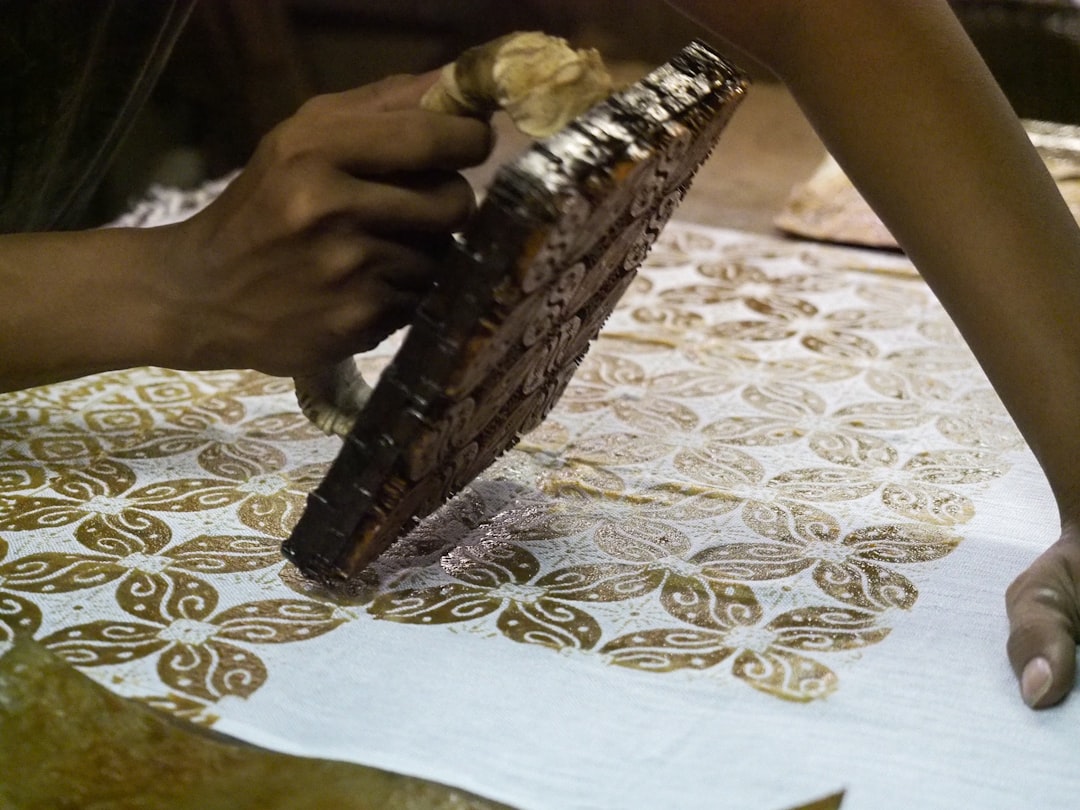
Most coverage of batik in Yogyakarta sends you to the big workshops in the northeast of the city, places like Batik Winotosastro, where you can watch artisans at work in a climate-controlled showroom and buy a piece for a price that includes the air conditioning. There is nothing wrong with those places. But they are not where the hand-painted batik — the batik tulis, literally “written batik” — lives in the way it has for generations. The batik tulis lives in these alleys, in open-sided terraces where the wax pot sits on a charcoal brazier and the heat is part of the process, not something you escape from.
A woman named Ibu Sari was bent over a length of white cotton stretched across a bamboo frame. She was using a canting, the small copper pen that delivers molten wax in fine lines to the cloth. Her hand moved with a rhythm that looked casual and was anything but — the kind of motion you can only replicate after thousands of hours. Her canting held wax at a precise temperature; too hot and it bleeds through the fabric, too cool and it won’t penetrate. I asked if she minded me watching. She shrugged without looking up. “The tourists never come down here,” she said. “They don’t know we exist, or something.”
She told me she had been doing this work for thirty-seven years. I had no reason to doubt her. Her hands, when she paused to dip the canting back into the pot, showed the small burns that are the occupational hazard of working with hot wax at close range. The piece she was working on showed a pattern of stylized clouds and a single bird, all done in the brown and cream that characterizes Yogyakarta batik as opposed to the coastal styles from Pekalongan or Cirebon. She called the colour sogan, from the tree bark used to make the dye. A chemical version exists now, cheaper and more predictable. She uses the bark anyway.
The economics of this kind of work are brutal in a way that doesn’t come across in the glossy coffee-table books about Indonesian crafts. Ibu Sari told me a piece of batik tulis the size of a sarong takes her about two weeks to complete, working six hours a day. The cloth alone costs a significant portion of what she can sell the finished piece for. The markup that happens between her terrace and a gallery in Jakarta or Singapore means she sees very little of the final price. She sells mostly to a middleman who comes by every Friday afternoon on a scooter.
I asked if I could buy something directly from her. She examined me for a moment — the kind of look that assesses whether you are serious or just being polite — then disappeared into the back of the house and returned with a folded cloth. It was a shoulder cloth, about a metre and a half long, with a pattern of small diamond shapes interspersed with dots. The work was exceptionally fine; the dots, each one individually applied with the tip of the canting, numbered somewhere around five hundred, maybe more. She named a price that was roughly half of what a similar piece would cost in the Malioboro street market. I paid it without haggling. She looked almost disappointed, as if the negotiation was part of the ritual she had been denied.
The transaction revealed something about the gap between how this craft is marketed and how it is lived. In the tourist literature, batik is an art form. In the alley, it is piecework. The government has designated batik as a UNESCO Intangible Cultural Heritage, and it deserves that recognition. But the recognition has not changed the fact that the people who actually apply the wax to the cloth are working in conditions that would be considered substandard in almost any other context. There is no pension. There is no health insurance. There is the middleman on Friday, and there is the cloth, and there is the heat.
On my third day, I went back to the alley with a different purpose. I had brought a small notebook and the intention of understanding the process better, not just watching it. Ibu Sari’s neighbour, a man named Pak Darto who had been a batik artisan for even longer than she had, agreed to let me try the canting myself. I sat down at his frame, took the copper tool in my hand, and immediately understood why his lines were straight and mine looked like the path of a drunk ant. The wax cooled too fast. The tip clogged. I pressed too hard and the wax bled through to the other side. I pressed too lightly and nothing came out at all. I spent twenty minutes producing a mess that looked like a child’s drawing of a rainstorm. Pak Darto watched in the patient silence of someone who knew exactly what would happen. “It takes about a year,” he said, “to make lines that don’t embarrass you.”
The experience gave me a different respect for the pieces I had already seen. A batik tulis cloth is not a print. It is not something a machine can replicate. Each line, each dot, each tiny variation in pressure and angle is a record of a human hand moving at a specific moment. The slight waver in a line that a factory would consider a defect is, in a hand-painted piece, the evidence of aliveness. Ibu Sari had told me that she can identify the work of different artisans in her neighbourhood just by looking at the character of the lines — the way one person leans into the canting, the way another holds it at a steeper angle. “We all have our own handwriting,” she said.
The next morning I walked through the Taman Sari complex with fresh eyes. The old royal garden was built in the eighteenth century, a maze of pools and pavilions that the sultans used for meditation and, according to local stories, for less meditative purposes as well. The underground mosque, the sumur gumuling, is a cool, circular chamber with a central staircase that makes the acoustics behave strangely. I stood in the middle of it and heard the call to prayer from a nearby mosque layered over the sound of tourists taking selfies. The contrast between what the place was designed for and what it has become is impossible to ignore. But the batik artisans in the alleys around it are doing something closer to the original purpose of the place than the souvenir stalls inside the walls.
I had lunch at a small warung near the northern gate of Taman Sari, a place that served nasi gudeg — the jackfruit stew that Yogyakarta is famous for — on banana leaves. The woman running it had no menu and no prices posted. She asked what I wanted, brought it, and told me the total after I finished eating. It was twelve thousand rupiah, about seventy US cents. The gudeg was sweet and rich and had been cooking since before dawn. The sambal, a bright orange paste of ground chillies and shrimp paste, was fresh enough to make my eyes water. I ate it with my fingers, the way everyone else in the warung did, and watched the street life move past: a man delivering gas canisters on a bicycle, a group of schoolgirls in white uniforms, a stray dog napping in the shade of a parked becak.
These are the details that the official guides do not cover. They will tell you about the sultan’s palace and the Prambanan temple and the bird market. They will not tell you that the best batik in Yogyakarta is being made in a room smaller than your apartment’s bathroom, by a woman who learned the craft from her mother, who learned it from her mother, and who has no plan to stop despite the fact that her hands ache by the end of every day. They will not tell you that the fabric you buy in the air-conditioned gallery on Jalan Tirtodipuran probably came from one of these alleys, marked up by a factor of ten, its origin story sanded down to something marketable.
On my last afternoon in the city, I went back to say goodbye to Ibu Sari. She was working on a new piece, this one a large rectangle of cotton that would become a wall hanging. The pattern was more complex than what I had seen before — a central motif of a stylized tree, surrounded by smaller elements that she identified as leaves, flowers, and birds, all arranged in a symmetry that was not quite perfect. She told me she had been working on it for three weeks and expected to finish in another five or six. Someone had already commissioned it, she said, a collector in Kuala Lumpur who came to see her every year. The collector paid her directly, cutting out the middleman, and the price was better. But even so, she said, the economics of it meant she could not afford to take on only commission work. She still needed the middleman for the regular pieces that kept the household running.
I asked if she had ever taught the craft to her children. She shook her head. “They want to work on computers,” she said. “They don’t want to sit and draw lines all day.” The sentence was not wistful. It was a simple statement of fact, as neutral as if she had told me the price of rice. I thought about what it meant for the future of batik tulis — not the UNESCO designation, not the government programs, not the luxury labels in Jakarta that use “heritage” as a marketing term, but the actual skill, the thing that lives in the hands and can only be passed on by demonstration and repetition over years. Ibu Sari’s children were not going to learn it. Pak Darto’s children were not going to learn it. There were younger artisans in the neighbourhood, but they were in their forties and fifties. The teenagers had smartphones and dreams of jobs that did not involve burns on their fingers.
The afternoon light had started to angle through the gap between the roofs, casting a long rectangle of brightness across Ibu Sari’s lap. She was in the middle of a line of wax, and the light caught the tool and the cloth at the same moment. She did not look up. She kept drawing the line, steady and unhurried, the way she had been doing for thirty-seven years. The cloth I had bought from her was folded in my bag. I had not unwrapped it since the day I bought it. I wanted to open it somewhere that matched the care that had gone into making it, and I had not found that place yet. Maybe the point was just to know that the care existed.

📷 Photos: Agto Nugroho (Unsplash), Camille Bismonte (Unsplash)