The first thing you notice on a Madura salt pan is not visual at all. It’s the sound — a dry, crystalline crunch underfoot that is almost percussive, as if the ground itself is giving way grain by grain. By the time I reached the western edge of the island, somewhere between the town of Bangkalan and the more famous salt-producing villages near Kamal, the afternoon sun had already begun its long slide toward the strait. The pans stretched out in geometric blocks, each one a shallow rectangle of brine that caught the light differently depending on which stage of the evaporation cycle it was in. Some were milky white, almost opaque. Others reflected the sky with a faint pinkish tinge that had nothing to do with sunset and everything to do with the algae living in the supersaturated water beneath.
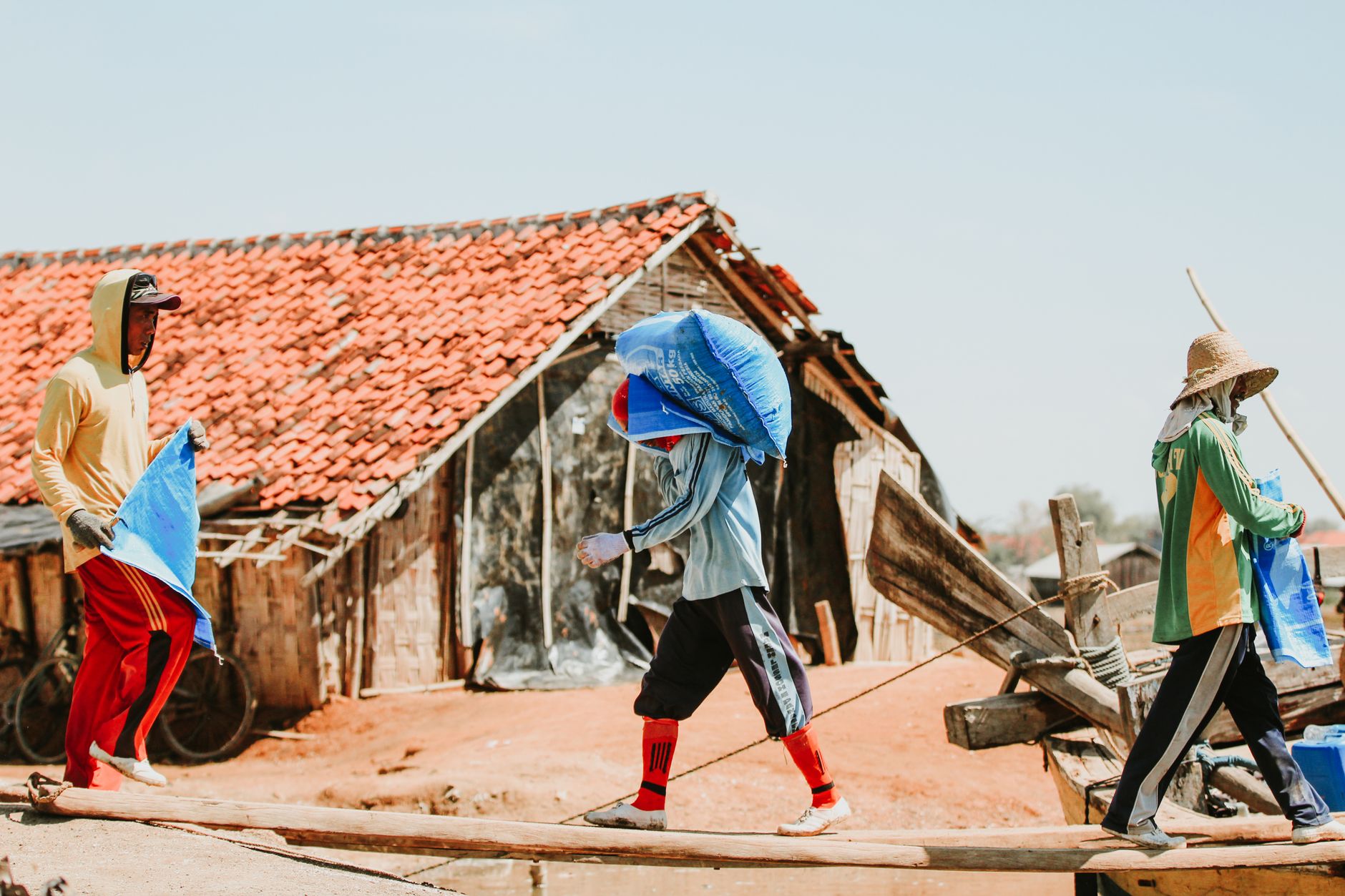
Most coverage of Madura’s salt farming focuses on the post-harvest piles — those monumental white pyramids that sit along the roadside like something out of a desert landscape film. And those are striking, certainly. But what I found myself drawn to, hour after hour, was the quieter geometry of the working pans themselves. The farmers, almost all of them men past fifty, wade through the brine in rubber sandals, pushing wooden rakes that look like they were built in another century. The motion is repetitive and slow, the same stride and scrape repeated across a grid that seems to go on for acres. It is not a photogenic kind of labor in the conventional sense. There is no dramatic gesture, no moment of visible effort. The work is so steady it barely registers as motion at all.
I had arrived on the island via the Suramadu Bridge, the longest bridge in Indonesia, which connects Surabaya to Madura across a stretch of sea that is famously murky and tidal. The crossing takes about twenty minutes by car, and the change on the other side is abrupt. Surabaya is dense, loud, industrial. Madura, even just past the bridge’s toll gates, feels immediately more open, the air saltier, the horizon wider. The main road hugs the coast for much of the journey west to east, and it is along this road that the salt pans become visible, set back from the asphalt by a few hundred meters of scrubby dirt and goat trails.
The golden hour on Madura is not a gentle thing. It arrives with a particular aggression, the sun turning from yellow to orange to a deep vermilion in the span of perhaps forty minutes, and the salt pans act as enormous reflectors. The light bounces off the water, off the crystalline crust forming at the edges of each pan, off the white heaps of harvested salt stacked at intervals along the pathways. Everything glows, but not evenly. The uneven texture of the salt crystals catches the light at a thousand different angles, producing a kind of natural glitter that no filter could replicate. I watched a farmer stop mid-stride, lean on his rake, and just stare at the horizon for a long moment. He wasn’t posing. He was resting. But the light caught his silhouette so precisely that the image felt staged.
I had come to Madura with a specific intention: to photograph not just the salt, but the relationship between the geometric order of the pans and the human labor that sustains them. The pans are laid out in a grid, yes, but the grid is imperfect. Some are slightly rectangular, others nearly square, a few trapezoidal where the land slopes. The pathways between them are worn by foot traffic, curving slightly where generations of farmers have taken the path of least resistance. From ground level, the geometry seems ordered but organic. From a slight elevation — standing on the back of a pickup truck, or on the low ridge of a bund — the order becomes apparent. The pans are aligned to catch the maximum amount of sunlight during the dry season, their long axes running roughly east to west. You have to stop moving to see it.
I had arranged, through a contact in Surabaya, to spend an afternoon with a farmer named Pak Ridwan, who had been working the pans since he was fourteen. He was sixty-three when I met him. He did not speak English, and my Indonesian is functional but not fluent, but we managed well enough through gestures and the occasional translation app. He showed me the rake he used, the handle worn smooth by decades of grip. He showed me the small hut at the edge of his plot where he stored tools and sometimes slept during the harvest season, when the work started before dawn and ended after dusk. The floor was packed earth, the walls woven bamboo. There was a single kerosene lamp and a plastic jug of water. It was not a romantic space.
What surprised me most was the water. The brine in the pans is not seawater in the usual sense. It is pumped from the Madura Strait into a series of holding ponds, where it is left to evaporate and concentrate before being channeled into the working pans. The process is dependent on wind and sun and the precise salinity of the source water, which changes with the tides and the monsoon. Pak Ridwan explained, through a combination of hand signals and simple words, that the water in the pans must reach a specific density before the salt will crystallize properly. If it is too dilute, the crystals form too slowly and the harvest is thin. If it is too concentrated, the salt becomes bitter with magnesium and other minerals. There is a window, he said — “harus pas” — that can be measured by feeling the water on the skin and tasting it on the tongue. No hydrometer. No lab. Just the accumulated knowledge of half a century, or something like that.
The light by then had mellowed into the deep amber that photographers chase, though on Madura the color lasts longer than it does in most places. The low sun throws long shadows across the pans, and the figures of the farmers become elongated, almost abstract. I found myself walking the bunds barefoot, the salt crust sharp against my soles, the brine cool where the water had seeped through. The sensation is not entirely pleasant. The salt abrades the skin, and within an hour my feet felt raw. But the experience of being inside the landscape, rather than observing it from outside, shifted my attention from composition to texture. The salt beneath my feet. The wind across the pans. The distant sound of a motorbike on the main road, incongruous and ordinary.
There is a detail that most visitors miss about Madura’s salt industry, and it has nothing to do with the harvest itself. The salt is not consumed locally in any significant quantity. Most of it goes to Surabaya, where it is processed for industrial use — chemicals, textiles, water treatment. The salt you see piled in those enormous white mountains is not destined for anyone’s kitchen table. It is too coarse, too mineral-rich, too variable in grain size. Pak Ridwan’s salt would end up in a factory, not a spice rack. I found this oddly deflating at first, as if the romance of the harvest was undercut by its industrial destination. That feeling passed though. The work does not care about romance. The workers do it because it is what they have done, because the pans are inherited, because the land is too salty for almost anything else.
One inconvenience shaped the afternoon more than I expected. The rental car I had driven from Surabaya developed a persistent rattle in the suspension around midday, and by three o’clock it was making a sound like loose metal. I pulled over at a small roadside warung near the village of Telang, where the owner, a woman in her fifties with a patient expression, directed me to a mechanic she knew a few kilometers down a dirt track. The mechanic, a man named Agus, spent forty minutes underneath the car, emerging with a diagnosis involving a loose bolt and what he called “the usual Madura problem” — salt corrosion on the undercarriage. He tightened what needed tightening, charged me the equivalent of about two dollars, and sent me on my way. The delay meant I arrived at Pak Ridwan’s pans later than planned, missing the early golden hour entirely. But the light I found at five-thirty was, if anything, more interesting — lower, warmer, casting longer shadows across the grid. The inconvenience became an adjustment, not a loss.
I stayed until the light was gone, until the pans turned from white to gray to a deep navy under the twilight. The farmers had mostly left by then, their tools stored, their sandals rinsed. The wind picked up, carrying the smell of brine and dry earth and something faintly sulfurous from the mudflats beyond the pans. I packed my camera gear and walked back to the car, my feet still raw, my mind full of the odd geometry I had spent hours trying to capture. The photographs I took that afternoon are not the best I have ever made. They are not the most dramatic, nor the most technically accomplished. But they are the truest I have ever taken of a place, because they required me to slow down, to feel the ground beneath my feet, to accept the delay and the rust and the unfamiliar rhythm of a work that has not changed in generations. The salt pans of Madura are not a secret. They are just a place that asks you to arrive on its terms, not yours.

📷 Photos: setengah lima sore (Pexels), Vishnu R (Unsplash)