The boatman didn’t speak English, and I didn’t speak Vietnamese beyond a handful of food words, so when he pointed at the sky and then at his wrist—pantomiming that we’d be late, that the light was already moving—I understood the universal language of impatience. He’d been waiting for me since 4:15. I’d found him through a recommendation in a forum post from 2019, the kind of contact that feels fragile, like it might have expired without anyone updating the thread. But here he was, his boat a narrow wooden thing with a Yamaha outboard, tethered to a concrete pier I’d located in the dark by the smell of fish sauce and damp canvas.
Can Tho at that hour is not asleep, exactly, but in a kind of suspended animation. The streetlights along the riverfront cast yellow pools that don’t reach the water. Motorbikes pass in ones and twos, their headlights wobbling over potholes. A woman had set up a portable stove on the sidewalk and was frying what turned out to be banh xeo, the crispy crepe, folded over a handful of bean sprouts and shrimp. I ate one standing up, the grease soaking through the paper napkin, because the boatman had gestured that we could take ten minutes but no more. The crepe cost 15,000 dong—about sixty cents—and it was the best thing I ate in the Mekong Delta. You don’t forget a crepe like that.
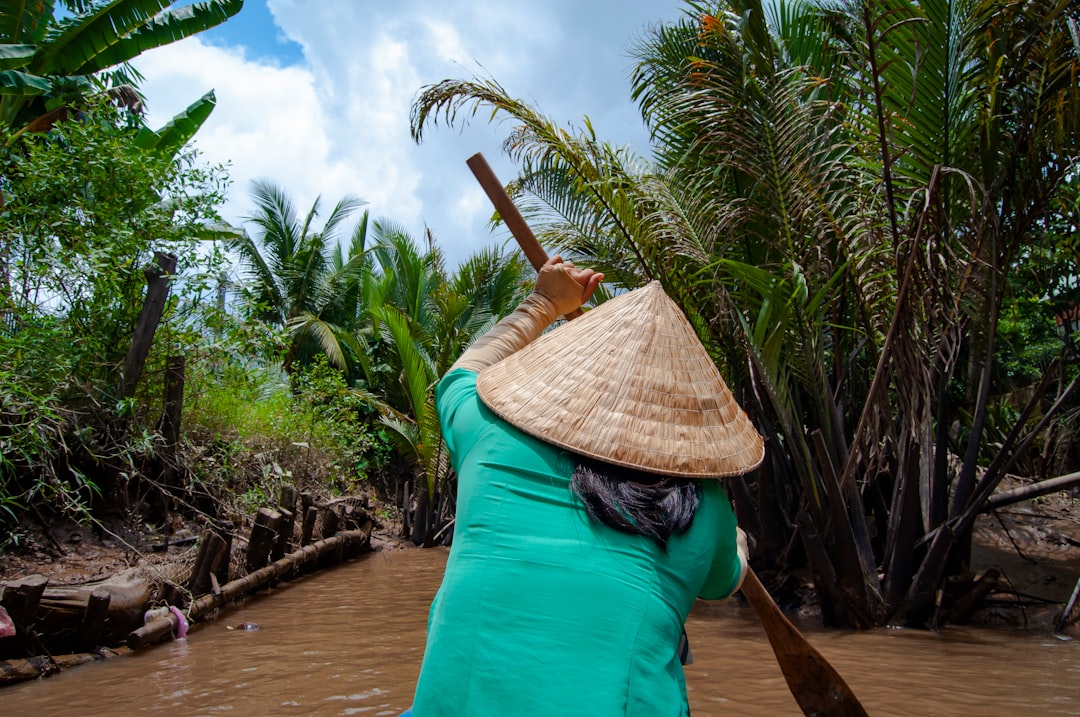
The engine coughed twice before catching, and then we were moving, the city receding into a line of lights along the bank. The air changed immediately. On land, it had been thick and still, the humidity already pressing in though the sun was still an hour below the horizon. On the water, the breeze found us, carrying the smell of mud and gasoline and something floral I never identified. The boatman—his name, I learned later from a scrap of paper he handed me, was An—steered with one hand and kept the other free to point at things I wouldn’t have noticed: a fruit-laden sampan drifting in the current, its owner asleep under a tarp; a cluster of boats tied together, their decks glowing with the soft light of cooking fires.
I’d come to the Mekong Delta expecting a certain kind of photographic cliché: the conical hats, the baskets of fruit, the golden light that makes everything look like a National Geographic cover from 1975. And I suppose I found some of that. But the clichés exist for a reason. The light at that hour is genuinely different. It arrives not as a flash but as a slow bleed, a shift from black to deep blue to a kind of silver that sits on the water like a skin. I had my camera out before the sun broke the horizon, but I didn’t take a single frame for the first twenty minutes. I just watched the way the river changed color, the way the boats emerged from the dark not all at once but one detail at a time: first the shape, then the color, then the face of the person at the bow.
The floating market at Cai Rang is the largest in the delta, and by mid-morning it’s a tourist attraction in the full sense of the word—dozens of tour boats jostling for position, their passengers wearing matching hats provided by the operators, the air thick with the drone of outboard engines and the tinny sound of Vietnamese pop from portable speakers. But at 5:30 AM, before the tour boats have made it out from Can Tho proper, the market is still a working one. The big boats, the ones that serve as wholesalers, tie a sample of their wares to a long pole at the bow—a pineapple, a bunch of bananas, a cluster of dragon fruit—so that the smaller boats can see what’s for sale without having to pull alongside. This is the signal system, and it’s been in use for decades, passed down by families who have worked this stretch of river for generations. A pole with a single jackfruit means a boat carrying jackfruit. A pole with a whole assortment means a general trader. Simple, functional, and entirely visual.
I spent the first hour photographing from An’s boat, which he maneuvered with the kind of precision that comes from doing the same thing every morning for twenty years. He’d cut the engine and let us drift, then give it a brief burst of throttle to slide us into a gap that seemed too narrow, then cut it again. I never heard him sound the horn. The other boatmen did the same—a silent choreography of idle and surge, the boats slipping past one another with inches to spare. I shot wide, trying to capture the density of it: the boats stacked with pineapples and watermelons and long beans, the women in their conical hats squatting on the decks, sorting produce by hand, the water itself a brown-green mirror that caught the sky in patches.
Around 6:15, the sun cleared the trees along the bank, and the light changed from silver to gold. The water took on a honeyed quality, and the shadows of the boats stretched across the surface in long, distorted lines. But what struck me more than the aesthetic effect was the way the market itself shifted in response. The wholesalers began packing up, their work mostly done. The smaller boats, the ones that buy in bulk and sell at smaller markets along the tributaries, started to disperse. The tour boats arrived, their engines loud and their passengers holding up phones. By 7 AM, the market was still active, but its character had changed. The working urgency was gone, replaced by a kind of performance.
I asked An, through a combination of gestures and the Google Translate app on my phone, whether he preferred the early hours or the later ones. He typed a response and showed me the screen: “Early. Before the show starts.” I couldn’t tell if he meant the tourist spectacle or something else—the daily performance of commerce that the market becomes once the sun is fully up and the cameras are out. Probably both.
There was a moment, around 6:30, when I made a mistake that I’m still not sure was a mistake. I’d been shooting from the boat, and the composition I wanted required me to lean out over the water, far enough that An grabbed the back of my shirt. I got the shot—three women in a sampan, their boat so low in the water that the gunwale was nearly level with the surface, a pyramid of green coconuts rising behind them. But in the process, I’d let my camera bag slide off the bench seat and into a puddle of bilge water on the floor of the boat. Not the river, at least, but greasy, diesel-stained water that seeped through the fabric and soaked the lens cap and the microfiber cloth and the spare battery. The battery survived. The cloth did not. And the lens cap developed a smell—something between fuel and old fish—that I couldn’t wash out for weeks. I spent the rest of the morning paranoid about moisture in the camera body, stopping every few minutes to check the seals, which meant I missed a sequence I probably would have shot otherwise: a young boy, maybe seven or eight, steering a sampan by himself, a baguette balanced on the bow, his face completely serious with the responsibility of it. I saw it, reached for the camera, hesitated, and by the time I’d pressed the shutter, he’d turned his head and the moment was gone.
This kind of thing happens constantly, of course. The hesitation between seeing and shooting is where photographs go to die. But that particular missed frame bothered me more than most, maybe because the boy looked like he was doing something genuinely important—bringing breakfast to his family, or making a delivery—and I’d been too distracted by my own gear to honor the scene. An noticed my frustration and did that shrug like it was water under the bridge or something. He was right, but I didn’t let it go. I thought about that boy for the rest of the morning.
One of the wholesalers—a woman in her fifties with a face lined by sun and laughter—waved me onto her boat. This is common practice in the floating markets; the traders are generally welcoming, even proud, of their boats and their produce. She showed me her inventory with the air of a gallery owner: mangoes stacked in precise pyramids, jackfruit the size of a child’s torso, bundles of herbs tied with banana leaves. She offered me a segment of pomelo, which I accepted, and then she offered me another, and then she pointed at my camera and made a gesture that clearly meant “take my picture.” I did. She examined the result on the screen, nodded approvingly, and then held out her hand. For a moment I thought she wanted money. Instead, she pointed to the camera again and then to herself, miming that she wanted the photo. I didn’t have a printer. I showed her the image on the screen one more time, and she seemed satisfied with that, as if the digital version counted as a kind of possession.
An had been watching this exchange from his boat, and when I climbed back aboard, he typed another message on his phone: “She will tell her family. She is famous now.” The joke was gentle, not sarcastic. I smiled, but it sat oddly with me. What does it mean for someone to become “famous” in the space of a photograph that will live on my hard drive and, eventually, in a folder labeled Vietnam 2025? She didn’t know me. She’d never see the image again. But for a moment, the transaction of photography—the assumption that my looking at her was worth something—had felt reciprocal, and that’s rarer than you’d think.
By 8 AM, the market had thinned considerably. The tour boats were still there, but they’d clustered around the few remaining wholesalers, and the atmosphere had shifted from commerce to spectacle. A woman in a boat selling noodle soup had tied up alongside a floating fuel station—a boat with a dozen plastic jugs of gasoline arranged on its deck—and was serving breakfast to a group of men who’d been working since before dawn. I asked An if we could pull over, and he did, and I sat in the bow of his boat eating a bowl of hu tieu—clear broth, pork slices, shrimp, a squeeze of lime—while the men talked and laughed in a language I couldn’t follow. No one looked at me. No one seemed to care that I was there. The soup cost 20,000 dong—about eighty cents.
On the way back to Can Tho, with the sun now high and the heat building, I finally put the camera away. An opened the throttle and we planed across the water, the wind drying the sweat on my face, the river opening up around us. We passed a small stilt house where a woman was washing clothes, the suds swirling in the current. We passed a dog asleep on a floating platform. We passed a man repairing a net, his fingers moving with the mechanical precision of someone who’s done the same motion ten thousand times.
An dropped me at the same concrete pier where he’d picked me up. The woman with the banh xeo was still there, her stove now crowded with students in white shirts, their uniforms crisp despite the humidity. I bought another crepe, partly because I was hungry and partly because it felt like a way to close the loop—to end where I’d started, sixty cents and one small meal later. An shook my hand and handed me another scrap of paper, this one with his phone number and an email address that included the name of a travel agency I’d never heard of. I assume he works with them occasionally, that this is how he supplements his income. The earlier forum post had described him as “the best boatman on the river,” and I believed it.
Back in my guesthouse, I showered and downloaded the morning’s images onto my laptop. Most were mediocre. A few were good. One—the woman with the pomelo, her hands raised in a gesture of offering, the light catching the translucent segments of fruit—was better than good. I stared at it for a long time, trying to decide what made it work. The lighting, yes. The composition, the way her hands framed the fruit. But also something else: the moment, just after she’d handed me the pomelo and before I’d raised the camera, when she’d looked at me not as a photographer but as a guest. The image carried that residue, the memory of a small human exchange that preceded the photograph. I don’t know how visible that is to anyone who wasn’t there.
I’d come to the Mekong Delta to photograph a specific kind of light, and I got that. But I also got a greasy lens cap that smelled like a fishing boat bilge for weeks, and a missed frame of a boy steering a sampan that I still think about, and a pomelo segment that tasted like nothing special but came with a moment of being a guest instead of a shooter. An’s boat slipped into gaps too narrow for logic. The woman waved me onto her deck like I was a neighbor. The boy turned his head and the moment was gone, and maybe that’s the nature of the transaction—you take what you get, and some of it you don’t get to keep.

📷 Photos: Veronica Reverse (Unsplash), Veronica Reverse (Unsplash)