The sampan felt too small for the work it was doing. A woman in a conical hat, her face hidden by the brim, was weaving long strips of palm frond into a roof panel while balanced on the narrowest part of the hull, one foot in the water for stability. She didn’t look up when we drifted past. The channel was maybe three meters wide, lined with mangroves whose roots made a latticework of mud and shadow. This was day three, and we had already stopped asking ourselves what we were supposed to be looking at.
The Mekong Delta has a way of making that question feel irrelevant. You don’t arrive at the sights so much as the sights happen around you while you’re trying to get somewhere else. We had planned a careful one-week loop: Ho Chi Minh City down to My Tho, then by boat through Ben Tre and Tra Vinh, across to Can Tho for the floating markets, then a slow bicycle ride through the orchards of Cai Be before circling back. It looked tidy on a map. On the ground, it looked like what it was — a dense, humid, intensely green tangle where every canal forks into two more canals, and the ferry schedule is written in someone’s head.
We made our first mistake before we left the city. I say “we” loosely — it was mostly my fault. We had read that the best way to see the Delta was independently, that group tours rushed everything and herded you past the good parts. That’s probably true. What we hadn’t accounted for was that “independently” in the Delta means navigating a system where the boat driver knows the river and you don’t, and the difference between a shortcut and a wrong turn is measured in hours. We hired a private boat in My Tho through a guesthouse owner named Saoirse, a Vietnamese woman who had spent ten years working in Saigon before coming home to run a small place on the river. She quoted us a price that seemed reasonable — 800,000 dong for a half-day, about thirty-two dollars — and we agreed without asking what exactly it covered. It covered a trip up a main channel, past a coconut candy workshop where we were gently pressured to buy, and back. That was it. We had assumed we’d be taken through the smaller canals, the ones where the water hyacinths clot against the hull and the houses lean out over the bank on stilts. Those required a different boat, a smaller one, and a different price.
The lesson cost us the afternoon and a small renegotiation fee. It wasn’t a scam, exactly — Saoirse was honest about what we’d paid for once we asked the right questions. The mistake was ours for not asking them earlier. After that, we learned to be specific: not “canals” but “the narrow ones, the ones the big boats can’t fit through.” Not “floating market” but “which one, and what time do the vendors actually arrive.” The Delta is full of people willing to help. It just doesn’t reward vagueness.
Day two was better. We found a boatman named Mr Huy at the dock in Ben Tre — he was repairing an outboard motor with a cigarette in his mouth, which should have been a warning but turned out to be a recommendation. He spoke no English, and we spoke no Vietnamese beyond the usual pleasantries, but he understood “small canal” well enough. He took us through a network of waterways so narrow that the palm fronds scraped both sides of the boat, and at one point he stopped the engine, let the boat drift, and pointed at a kingfisher perched on a branch so close we could see the blue of its chest moving with each breath. We sat there for maybe three minutes. Then Mr Huy started the motor again, and we moved on. That was the whole transaction. He didn’t charge extra for the pause, didn’t try to sell us anything, didn’t look at us for approval. It was the most natural thing in the world, and it felt like a secret we had stumbled into.
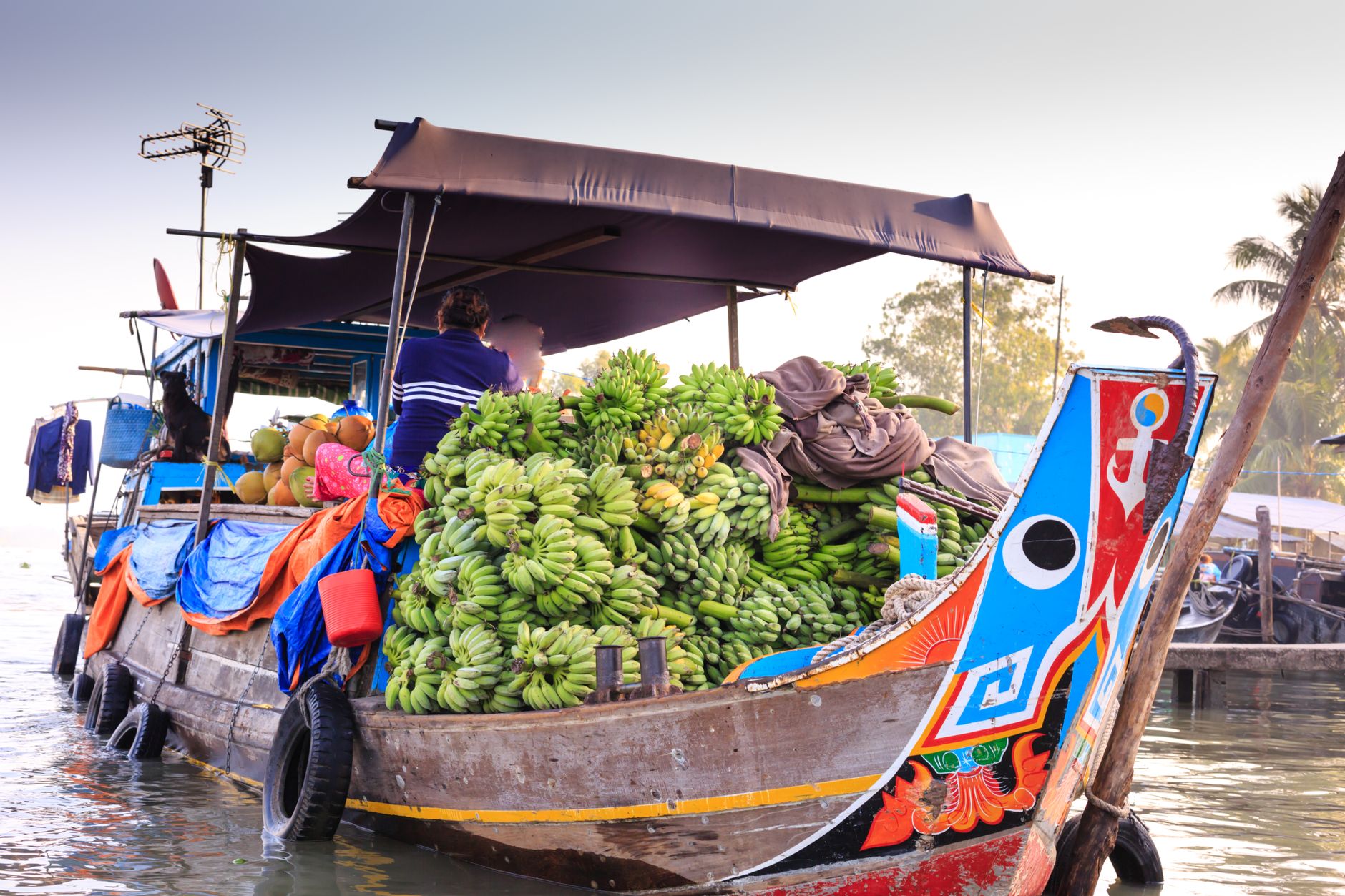
This is the part of the Delta that photographs can’t quite catch. The famous images show the floating markets at their most curated — boats piled high with pineapples and dragon fruit, the vendors’ poles displaying produce like flags. Those markets exist, and they’re worth seeing. But the thing that lingers is the noise. Not the chaos, which is real but manageable. The noise. At the Cai Rang floating market near Can Tho, which starts around five in the morning, the engine sounds are layered: the low rumble of the big cargo boats carrying rice, the higher putter of the family sampans ferrying breakfast, the occasional roar of a speedboat belonging to someone who is clearly late. Vendors shout prices across the water in a dialect that sounds like a melodic argument. Kids in small skiffs row up to your boat with bowls of noodles, and the transaction — lowering a bowl down on a rope, raising it back up with cash tied to the handle — happens without either boat stopping.
We had been told to arrive at four-thirty. The guidebooks say this is when the market is most active. In reality, four-thirty was when the wholesalers were finishing. The real action — the retail vendors, the breakfast boats, the tourist boats jockeying for position — peaked closer to six. We had woken up early for the wrong hour, stumbled around in the dark trying to find our boat, and ended up sitting on the pier for forty minutes watching a dog sleep on a pile of plastic crates. It wasn’t a disaster. It was a reminder that the Delta operates on its own schedule, not the one printed in a Lonely Planet.
A woman named Renata, who runs a small bicycle-tour operation out of a café in Cai Be, wiped a glass with a rag that had been white sometime in the previous decade. “Tourists always want to know what time the market starts,” she said. “They want a number. But the market doesn’t start. It’s just happening. Some days it’s busy at four, some days at seven. The weather, the season, the price of fruit — everything matters. You can’t schedule it, or something like that.” This was the closest we came to a guiding principle for the week: let go of the schedule, and the Delta will show you things that aren’t on the itinerary.
The bicycle part of the trip was supposed to be the easy section. We had rented bikes from a shop in Can Tho — basic Chinese models with baskets and one gear, the kind of bike that feels indestructible because it has nothing to break. The plan was to ride through the orchards of Cai Be, following the small roads that run parallel to the river, stopping at fruit farms and family-run homestays. The reality was that the small roads were paved about sixty percent of the time. The other forty percent was dirt, sand, and the occasional stretch of mud that had been churned by motorbikes and water buffalo. We spent a good portion of the first afternoon pushing our bikes up a slope that turned out to be a levee, sweating in heat that felt like a wet blanket, while a group of local children watched from a porch and laughed with the kind of pure, non-malicious joy that only children can produce.
The fruit orchards were worth the effort. We stopped at a small farm run by an elderly couple who grew rambutan, mangosteen, and something the man called “milk fruit” — a pale, sweet custard of a thing that we ate straight off the branch. The couple didn’t speak English, so we communicated through gestures and the universal language of eating. They brought out a plate of fruit, then another, then a pot of tea. When we tried to pay, the man waved his hand and said something that sounded final. We left the money under the teapot anyway, and we think he pretended not to notice. These moments don’t make it into the marketing materials for the Delta, but they’re the reason anyone should go.
There was one genuinely bad afternoon. We had taken a ferry across a branch of the river to reach the island of An Binh, which is known for its homestays and quiet cycling paths. The ferry was a flat wooden barge that carried motorbikes, bicycles, and the occasional cow. The crossing took maybe ten minutes. On the other side, we found a road that was being repaved — fresh asphalt, still steaming in the heat, with a worker holding a red flag who motioned for us to wait. We waited. Then we waited longer. The worker disappeared, then reappeared with a different flag, then disappeared again. An hour passed. The asphalt cooled enough to walk on, and we crossed on foot, carrying our bikes, because nobody had told us when the road would be open. It was frustrating at the time. In retrospect, it was just Tuesday in the Delta.
The homestay on An Binh was run by a family whose house sat on stilts above a canal. The main room had concrete floors, a hammock, and a television that played Vietnamese soap operas at a volume that seemed aggressive even by local standards. Dinner was prepared by the grandmother — a woman whose age we couldn’t guess, who moved through the kitchen with the economy of someone who had been cooking since before we were born. She made caramelized pork in a clay pot, morning glory stir-fried with garlic, and a fish soup with tamarind that was sour and hot and exactly right after a day of sweating. We ate on the floor, on mats, with the family. Nobody spoke much. The television played. A gecko on the ceiling made its clicking sound. It was not a tourist experience. It was just life on the river, and we were lucky to be sitting in it.
The last day was a boat trip back toward My Tho, passing through a section of the Delta that felt completely different from the rest — wider channels, bigger boats, less vegetation. A man on our boat, a German named Ingrid, pointed out that the water had changed color. He was right. The greenish-brown of the upper Delta had given way to something more opaque, more like stirred mud. We were getting closer to the coast, and the river was carrying the weight of the entire Mekong before it met the sea. It was a strange thing to feel: the sense that we had been traveling through one system, only to realize at the end that the system was far larger than we had understood. The Delta doesn’t end. It just opens out.
The packing list matters less than people think. We brought insect repellent that never got used, a waterproof phone case that leaked, and three changes of clothes when two would have sufficed. What we couldn’t pack was the thing that mattered most — the ability to sit still while a boat drifted, to eat what was offered without asking what it was, to accept that the ferry would come when it came.
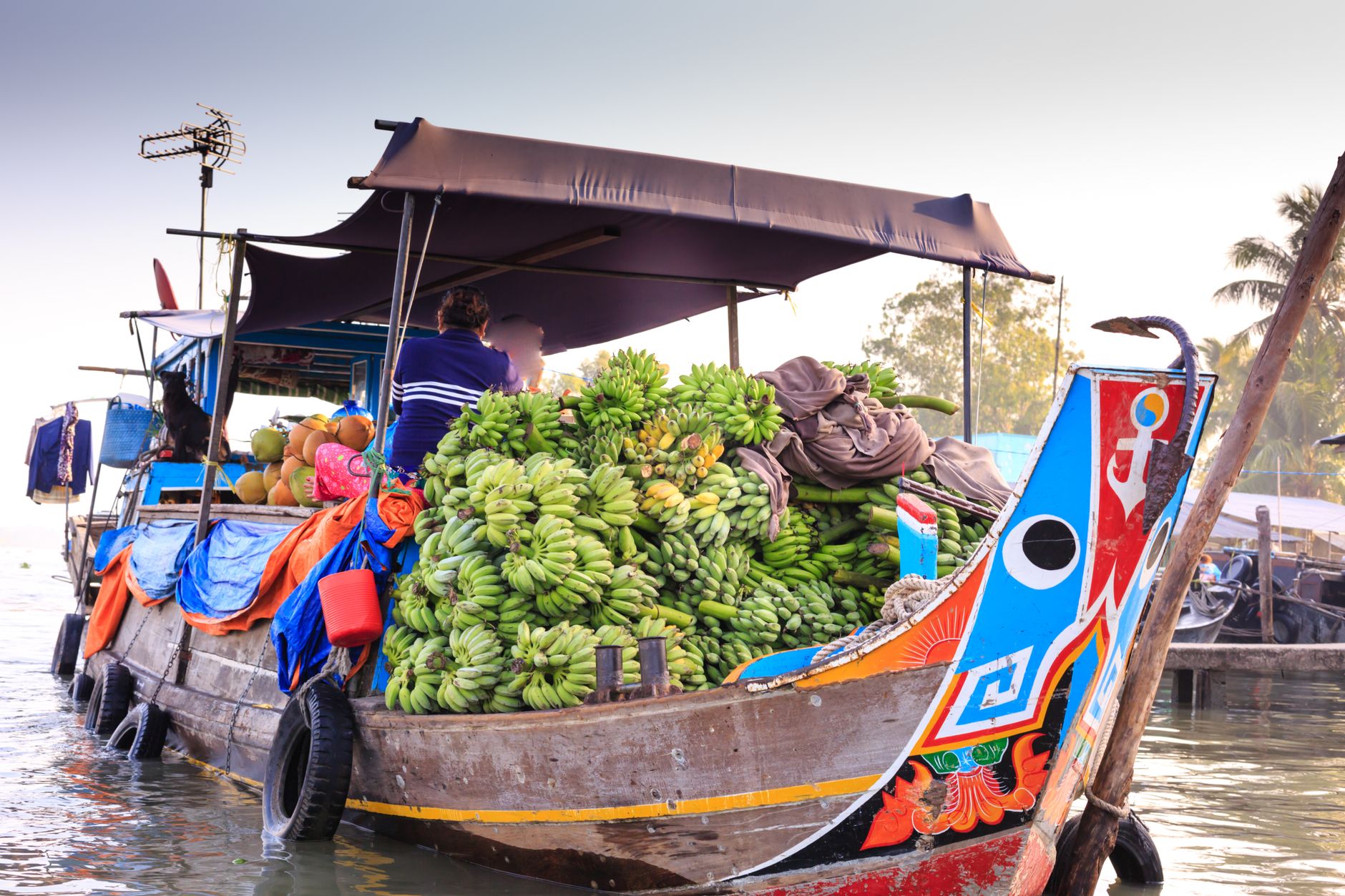
📷 Photos: Quang Nguyen Vinh (Pexels), Quang Nguyen Vinh (Pexels)