The alarm went off at 4:15. Not the phone’s gentle chime — the kind of alarm that sounds like a fire drill, because anything gentler wouldn’t have penetrated the fog that settles over Cameron Highlands around midnight and doesn’t fully lift until late morning. We were staying at a small guesthouse in Tanah Rata, the kind of place where the hot water runs for exactly seven minutes before turning tepid, and the walls are thin enough to hear your neighbor’s cough. The room was cold — colder than Malaysia has any right to be — and the bed was warm, and for a full minute we lay there negotiating with ourselves about whether dawn actually needed to be photographed.
It did. We knew it did. The Blue Mists of Cameron Highlands — that specific atmospheric condition where the morning light hits the tea terraces at such an angle that the whole valley appears to be smoking, the plants themselves turning a shade of green so deep it borders on blue — is the kind of thing that gets described in tourist brochures and then rarely delivers. But a taxi driver the evening before, an older Malay man named Azman, had told us the past week had been dry enough and cold enough that the mist had been sitting low. “Tomorrow morning,” he’d said, shaking his head as if he couldn’t quite believe it himself. “Maybe you see something special.” That maybe was all we had to go on.
The drive up to the tea plantations takes about twenty minutes from Tanah Rata, though at that hour it felt longer. The road twists through small settlements that are still dark and shuttered, past a mosque where the first call to prayer hadn’t yet started, past a row of stalls selling strawberries and corn that wouldn’t open for another five hours. The rental car — a Proton Saga with a gearbox that crunched going into third — struggled on the steeper sections. We passed two other vehicles heading in the same direction: a van that might have been carrying plantation workers, and a motorcycle with a single headlight that flickered like a pulse.
There are three main tea estates in the Cameron Highlands region. The most famous is the Boh Tea Plantation, which has a visitor center and a café and a viewing platform with actual railings. That’s where the tour buses go. We’d visited it the afternoon before, along with perhaps seventy other people, standing at the rail and watching the tea pickers move through the rows at a pace that seemed unhurried until you noticed how much ground they covered. The tea there is good, and the view is wide, and there is nothing wrong with it. But we weren’t heading there at dawn. We were heading to a smaller estate further north, one that doesn’t appear on most of the guided tours, where the road ends at a gate and you have to walk the last kilometer up a gravel track that the plantation workers use.
That walk, at 5:10 in the morning, was the part nobody warns you about. Not the cold — that was manageable, with a fleece and a windbreaker. Not the dark, which the headlamp handled well enough. It was the silence. The tea plantations at night are profoundly, unnervingly quiet. No bird calls, no insect noise, no rustle of animals in the undergrowth. Just the sound of your own breathing and the crunch of gravel underfoot, and the occasional drip of condensation from the leaves of the shade trees that line the track. It felt less like walking through farmland and more like walking through a space that was holding its breath, waiting for something to release it.
The gate was locked, as we’d been warned it might be. But the fence beside it had been patched and repatched so many times that there was a gap near the hinge post, wide enough to step through if you didn’t mind catching your sleeve on the barbed wire. We did mind, briefly, when the wire snagged the cuff of a jacket, but by then we were through and standing at the edge of the first terrace, and the sky was just beginning to lighten.
The mist doesn’t roll in — it rises out of the valley floor itself, as if the earth were exhaling. At first it’s just a faint haze between the rows of tea bushes, barely visible in the pre-dawn gloom. Then, as the light shifts from black to grey to a pale, watery blue, the haze thickens and separates into distinct layers. The lowest layer hugs the ground, moving slowly downhill between the terraces. The next layer floats at about waist height, caught between the bushes. The third layer — the one that gives the phenomenon its name — hovers at eye level and above, turning the distant hills into shapes as indistinct as thoughts.
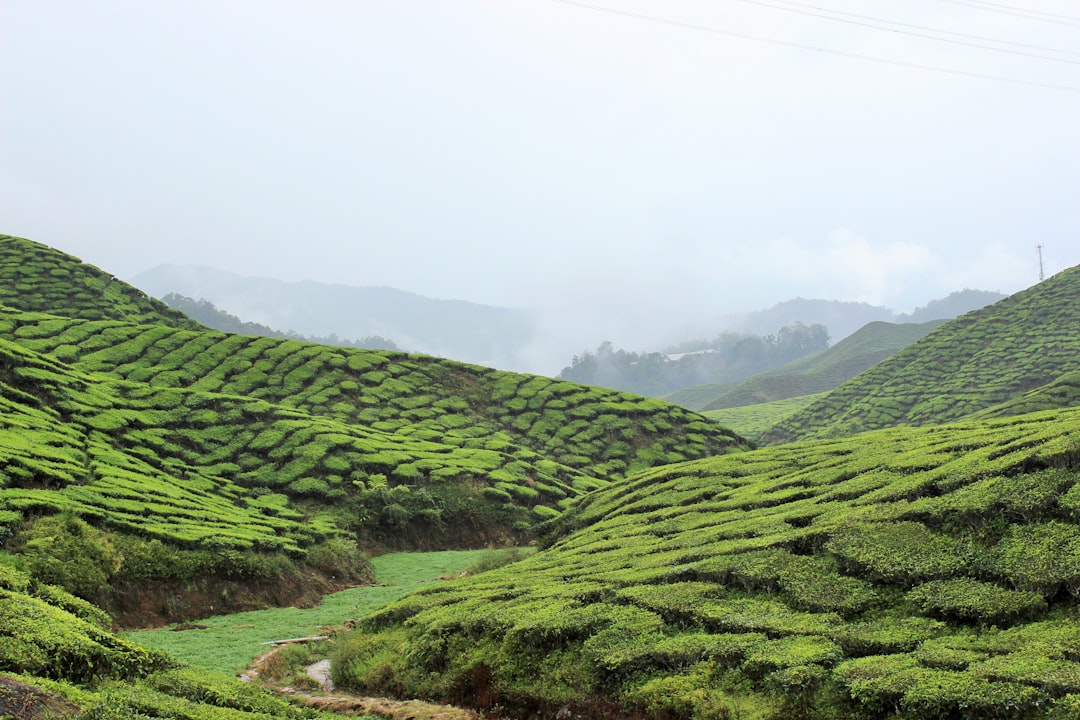
We set up the tripod at the edge of a terrace, careful not to step on the tea plants themselves. The rows are planted on contours cut into the hillside, each one perhaps a meter wide, with drainage channels between them. The soil is dark and loose, and it crumbles underfoot in a way that makes you conscious of every step. The tea pickers who work these slopes move through them with a practiced economy of motion, their baskets slung across their backs, their fingers finding the right leaves without looking. We, by contrast, stood there fumbling with lens caps and trying to keep condensation off the filter, a pair of amateurs pretending we belonged there.
The light changed slowly at first, then all at once. One moment the valley was grey and featureless, the mist a wall of cotton. The next, a seam of gold appeared at the eastern horizon, and the mist caught it and turned it into something that looked almost solid — a curtain of blue-gold that hung between the rows of tea bushes, backlit and luminous. We shot for maybe thirty minutes, though time moved strangely. A single frame required waiting for the mist to shift into the right position, for the light to clear a particular terrace, for a bird to cross the frame at exactly the wrong moment and ruin the shot and then not return. The camera’s shutter sounded absurdly loud in that quiet space, a mechanical click that seemed to belong to a different world.
Somewhere around 6:30, a truck came up the main road below, its headlights cutting through the mist in two parallel beams. It stopped at a small shed we hadn’t noticed, and a man got out and began unlocking a padlock. We watched him from the terrace above, not wanting to intrude, but he must have seen us because he waved. A few minutes later, he walked up the slope toward us, carrying a metal thermos and two small plastic cups.
“You are here early,” he said, in the careful English that many Malaysians speak. His name was Kamal, and he was the foreman for this section of the plantation. He’d been working here for fourteen years, he told us, since he was twenty-three. He poured something from the thermos — a dark, sweet tea, hot enough to burn the tongue, with a flavor that was stronger and less refined than anything sold in the shops. It tasted of smoke and sugar and something else we couldn’t name. “You take photo of the mist,” he said, not a question. We nodded. He looked at the valley for a long moment, then said: “This is the best time. After seven o’clock, the tour bus comes, and everyone takes the same photo — or something like that.”
We stayed until the mist fully dissolved, which happened around 7:45. It didn’t fade gradually — it lifted, like a curtain being raised, and suddenly the valley was sharp and clear and ordinary. The blue was gone. What remained was green: the deep, uniform green of tea bushes planted in rows that follow the contours of the hillside, each one trimmed to the same height, each one with the same glossy leaves. A beautiful landscape, certainly. But not the one we’d been photographing an hour earlier.
On the walk back to the car, we passed the first tour van of the day, a minibus with tinted windows and a driver who looked bored. It pulled up at the gate just as we reached it, and a dozen people in matching windbreakers stepped out, cameras already raised. They hadn’t seen the mist. They would take photos of the green hills in the morning light, and those photos would be good — the kind that gets liked on social media and printed for living room walls. But they would not have seen what we saw, and they wouldn’t know they’d missed it. You have to arrive before the idea of arriving occurs to most people, and you have to be willing to climb a fence in the dark and stand still in the cold and wait for something you’re not entirely sure exists.
The last thing Kamal said to us, as we were leaving: “Come back in November. The mist is better then.” He said it with a small smile, the kind that suggests he knew we wouldn’t be back, but that it was polite to say so anyway. We told him we would try. We meant it when we said it, and we’d stopped meaning it by the time we reached the main road.
We drove back to Tanah Rata and found a kopitiam that was already serving breakfast — roti canai and pulled tea and nasi lemak wrapped in banana leaf. The roti was crisp and the curry was hot and the tea was nothing like what Kamal had poured from his thermos, but it was good in its own way. The tables were plastic, the floor was sticky, and the owner was arguing with a delivery driver about a missing crate of eggs. We sat there for an hour, eating too much and drinking too many cups of tea, letting the warmth creep back into our fingers. The photos on the camera were a problem for later. For now, there was only the taste of coconut milk and anchovy sambal, and the memory of a valley that had been blue for exactly forty-five minutes before turning green again.

📷 Photos: Amélia Blondin (Unsplash), TONY SHI HOU TANG (Unsplash)