The driver’s assistant slapped the side of the jeepney twice—a sharp, flat sound that meant we were full and he was done collecting fares. I was wedged between a woman holding a rooster upside down by its feet and a teenager whose elbow kept finding my ribs on every curve. The road from Cebu City’s South Bus Terminal to Oslob takes about three and a half hours on a good day, and this was not a good day. We stopped in the middle of nowhere for a flat tire, and someone produced a bag of boiled peanuts that made its way around the cabin. I ate three before I realized I had no idea whose hands had been in that bag before mine. The whole thing cost me 180 pesos, which is roughly what a decent cocktail costs back home. That thought stayed with me longer than it should have.
I had read the guidebook advice about booking a private van. I had seen the blog posts recommending pre-arranged transfers from the airport. But showing up at a bus terminal with no reservation and letting the schedule sort itself out felt like the right way to start. It was not comfortable. The seats were narrow, the air conditioning was a vague suggestion, and every pothole transmitted directly through the frame into my lower spine. But the landscape shifted in ways a van window would have softened into a blur. Sugar cane fields gave way to limestone hills, then to coastal stretches where the sea was the exact green of old glass bottles. By the time we turned into the driveway of a small pension house in Oslob, I was sore and tired and in no mood to be up before dawn, which was exactly when the whale shark boats were scheduled to leave.
The pension house was owned by a woman named Tess, who took my payment in cash—1,200 pesos a night, two nights upfront—and showed me to a room with a ceiling fan that wobbled on its mount and a bathroom where the showerhead dangled from a broken bracket. “The water is hot sometimes,” she said, which turned out to mean that the hot water worked for exactly ninety seconds before turning lukewarm, then cold. I slept with the windows open because the fan was too loud and the breeze off the water was cool enough to make up for it. Around midnight, someone down the road started playing karaoke, a slow and slightly off-key version of “My Way” that went on for what felt like forty minutes. I lay there and listened, not annoyed exactly, just aware that I was somewhere far from my own routines.
I was on the beach by six the next morning. The whale shark operations in Oslob have been controversial for years—feeding the animals to keep them close to shore, altering their natural migration patterns, turning what should be a wild encounter into something closer to a theme park attraction. I knew all of this before I arrived. I had read the arguments from marine biologists, the position papers from environmental organizations, the angrier comments on travel forums. I still wanted to see them. I’m not proud of that compromise, but I’m not going to pretend I didn’t make it.
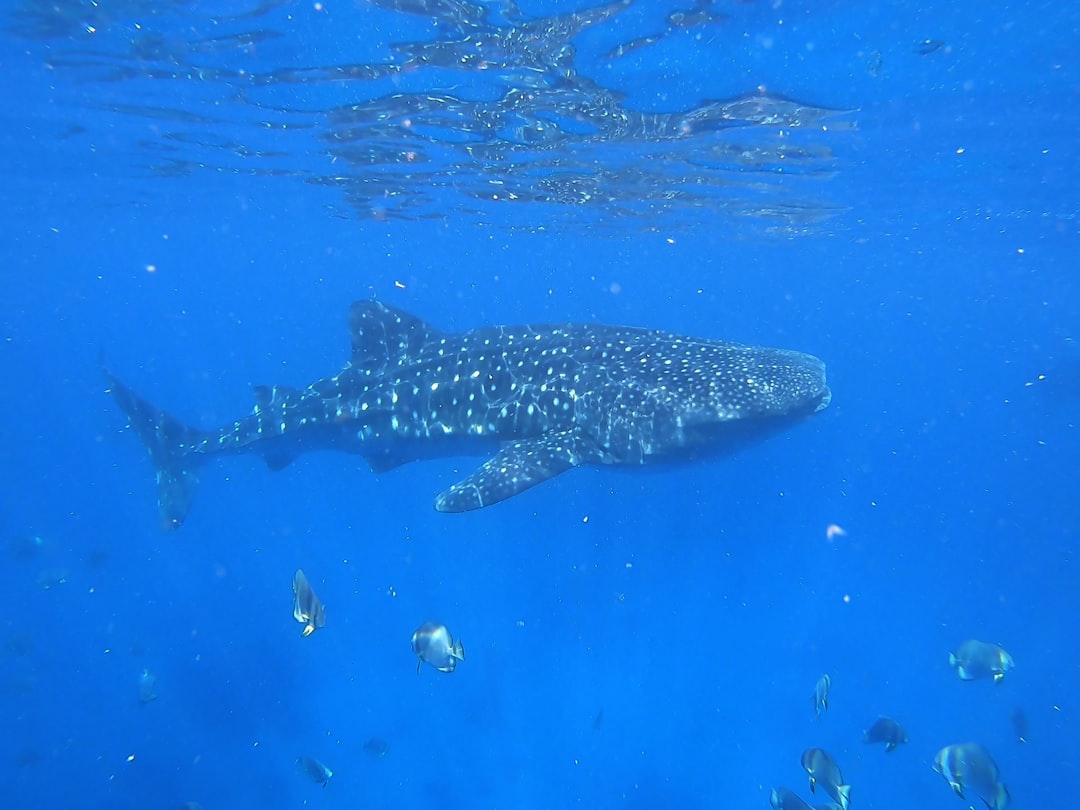
The process was efficient and strange. You check in at a registration table, get assigned a number, watch a short safety video in a room with fifty other people. Then you’re loaded onto a small outrigger boat with six others and motored maybe a hundred meters offshore. The water is murky, visibility maybe ten or twelve feet. The guides tell you not to touch the whale sharks, not to get too close, not to use flash photography. Then they spot one—a dark shape moving through the green—and everyone in the water starts swimming toward it. The whale sharks are enormous, somewhere around fifteen to twenty feet long, with mouths that look like they could inhale a small child. They don’t seem to care about the people. They swim in slow, patient circles, filtering plankton through their gills, and the swimmers paddle alongside them, legs kicking, cameras extended on selfie sticks. It is immersive and surreal and I could not shake the feeling that I was part of something slightly wrong.
I asked a local guide named Diego, who had been working the boats for six years, what he thought about the controversy. He shrugged. “The sharks have been coming here longer than the rules,” he said. “Before the feeding, they still came. Just less predictably. Now the tourists come too, and the town has money for a new school and a health clinic. I know the scientists say it’s bad. But the scientists don’t live here.” It was not an argument that settled anything. I spent forty minutes in the water, surfaced, and felt a kind of low-grade guilt that didn’t go away until lunch.
I found a small food stall near the shore that sold grilled squid and rice for 95 pesos. The woman cooking it worked over a charcoal grill that sent smoke into my eyes and left a thin layer of grit on everything I ate. The squid was tough and slightly burned and tasted better than it had any right to. I ate it with my fingers, cross-legged on a plastic stool that was too low for the table. A stray dog settled at my feet, and I gave it the last piece of squid, which it swallowed without chewing. I drank a bottle of water that was still warm from sitting in the sun and watched the whale shark boats shuttle back and forth in the distance, a parade of small vessels carrying people toward an experience they’d already paid for, most of them probably feeling the same conflicted pull I had felt an hour earlier.
The karaoke started again that evening. Same voice, same key, same song. I sat on the pension house’s concrete patio and watched the light fade over the water. The mosquitoes came out in force around seven, and I retreated to my room, where the ceiling fan had begun to make a new noise—a rhythmic clicking, like a bicycle wheel with a playing card in the spokes. I lay on the bed and let it become part of the background. Somewhere nearby, someone laughed, a full and unguarded sound that carried across the courtyard. I fell asleep before nine and did not wake until the fishing boats started their engines in the dark, just before dawn.
“Just Step Off”
Day three was canyoneering at Kawasan Falls, a three-hour drive north from Oslob through the interior of the island. The road climbed into the hills, where the vegetation turned thicker and the air smelled of damp earth and a sweet, almost overripe floral scent I couldn’t place. My driver, a man named Hassan who had been ferrying tourists for eleven years, told me he did this route four or five times a week. “The same road every time,” he said. “You would think I would get bored. But the road changes. There are new potholes, new landslides, new dogs sleeping in the middle. It’s never the same.” I liked the way he said it, as if the road itself was a living thing with its own unpredictable habits.
The canyoneering operation at Kawasan is well-organized in a way that feels almost industrial. You pay 1,500 pesos at the registration booth, which covers a guide, a life jacket, a helmet, and a pair of water shoes that have been worn by approximately eight thousand people before you. The guide’s name was Jun, a wiry man in his late twenties who moved through the canyon with the kind of confidence that comes from doing the same route every day for years. “Follow me,” he said, “and don’t touch the rocks where they look wet. The wet ones are slippery. The dry ones are also slippery. Just don’t touch the rocks.”
The canyon itself is a sequence of turquoise pools and limestone walls, connected by waterfalls that range from gentle slides to fifteen-foot drops into water so clear you can see the bottom twenty feet down. The jumps are optional. I stood at the edge of the first big one, looking down, and felt my body resist—a tightness in the chest, a voice that said this was not something a person should do voluntarily. Jun waited below, treading water, patient. “Just step off,” he called up. “Don’t jump. Just step. Your body will do the rest.” I stepped. The fall lasted maybe two seconds. The water was cold and soft and I came up gasping, grinning in a way I hadn’t expected. Jun nodded. “Good. Now we do the next one.”
The canyon took about three hours to complete. There were parts where we had to swim through narrow passages, parts where we scrambled over rocks, parts where the water was shallow enough to stand and deep enough to float. At one point, Jun pointed to a small cave behind a waterfall and said a local legend claimed it was a portal to another world. I asked if he believed it. He laughed and said, “I’ve never been bored enough to try.”
By the end, I was exhausted in a way that felt earned. The shuttle back to the parking area dropped me off at a series of food stalls where I bought a stack of grilled pork skewers—three sticks, 50 pesos each—and a plastic cup of shaved ice with condensed milk and purple yam. I ate standing up, watching other people head into the canyon with fresh life jackets and clean helmets, their day still ahead. Mine felt like it had already contained more than most days do.
The fourth day I took a bus back to Cebu City, a four-hour ride that was mercifully uneventful. The plan was to visit the Temple of Leah, a relatively new structure built in 2012 by a wealthy businessman in memory of his wife. I had seen photos online: a grand staircase, Roman-style columns, a panoramic view of the city. What I hadn’t expected was how empty it would feel, not of people but of intention. “He built it for his wife,” said the security guard at the entrance, a man named Ingrid, of all things, which I checked twice to confirm. “She died young. He wanted to give her something that would last. So he made a palace.” The palace sits on a hill in the residential neighborhood of Busay, overlooking the city and the sea beyond. It is made of marble and granite and gold accents, and it is utterly still. There are no priests, no rituals, no designated purpose except to be looked at. I walked through the halls and felt the weight of something that had been built not for the living but as a refusal to let go. It was beautiful and sad and slightly too grand for its own story.
I took a taxi back down into the city and wandered through the Colon district, the oldest street in the Philippines, where the sidewalks are crowded with vendors selling phone cases and knockoff sneakers and grilled bananas on sticks. I bought a bag of dried mangoes from a woman who told me her family had been selling them for thirty years. “My mother did this before me,” she said. “My grandmother before that. The mangoes are from the same farm too. Everything changes except the mangoes.” I ate the whole bag on a bench outside a 7-Eleven, watching the traffic jam build and then dissolve, the jeepneys belting out their improvised horn music, the tricycle drivers weaving between cars with the practiced indifference of people who have stopped being afraid.
On the last morning, I went back to the Temple of Leah. I don’t know why. There was no unfinished business, no detail I had missed. I just wanted to see it one more time, in the early light, before the heat settled in. The guard recognized me and nodded. I sat on the steps and looked at the view. A container ship was moving slowly across the horizon, too far away to make any sound. The city below was waking up, the first traffic beginning to hum. I stayed until the sun got hot, then caught a taxi to the airport, ate a cold sandwich in the departures hall, and waited for a plane that left exactly on time.

📷 Photos: Olga ga (Unsplash), Jeremiah Del Mar (Unsplash)