The flat was on the seventh floor of a tong lau in Sham Shui Po, and by the time we reached the fourth landing we had already stopped to catch our breath twice. The building had no lift, which we had known from the listing, but knowing and climbing are different things when you are also hauling two bags and a small suitcase up a stairwell that smells of old cooking oil and damp plaster. By the fifth floor we were past caring about appearances. By the sixth we had stopped pretending we were fine. The door at the top opened onto a narrow hallway so tight that the first person through had to press themselves flat against the wall to let the others pass with the luggage.
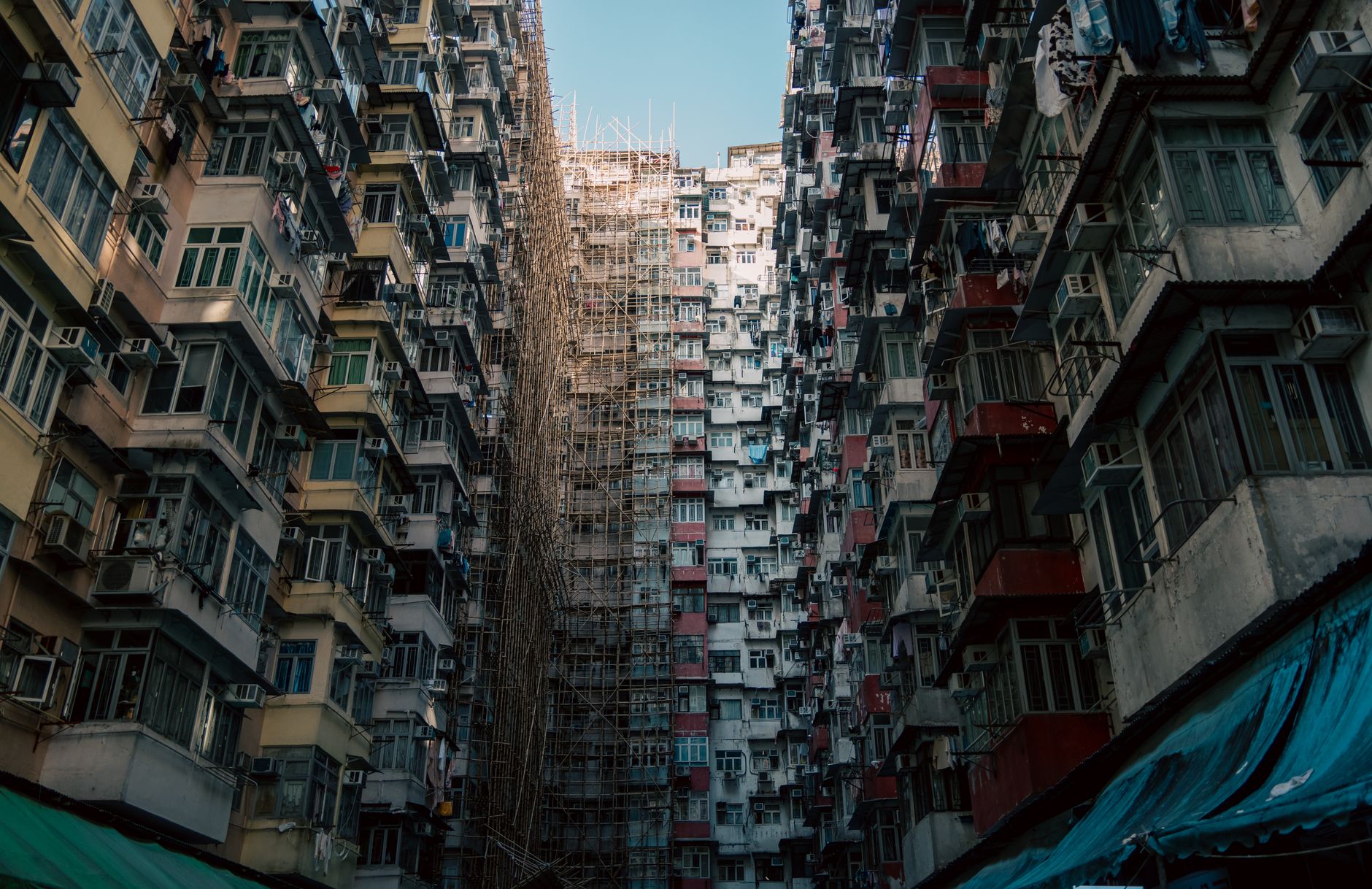
The flat itself was smaller than the photos had suggested, which should not have surprised us. It was a converted 1960s tenement unit, maybe three hundred square feet if you counted the bathroom, arranged in a single long room with a kitchen counter at one end and a mattress on a platform at the other. The real selling point, the thing that had made us book in the first place, was the window. It faced the back of the building, and through it you could see the bamboo scaffolding that had been erected against the neighbouring structure — a whole latticework of green poles and black zip ties rising maybe fifteen storeys, so close that you could have reached out and touched one of the horizontal struts if you had been willing to lean far enough. We stood there for a while, not watching a worker in a red hard hat walk along a plank three storeys above the street as if it were the most natural thing in the world.
Sham Shui Po does not feature in glossy Hong Kong travel brochures with any frequency. It is not the Peak, not the harbour, not the sort of place where tourists take the Star Ferry and then walk around holding egg tarts. It is a working-class district in Kowloon, dense and loud and functional, where the streets are lined with electronics stalls and fabric shops and the kind of restaurants that serve you a bowl of congee and don’t bother with an English menu. The tong lau buildings here were built in the postwar decades, when the city was growing faster than its infrastructure could keep up, and they show it: narrow, tall, pressed together like books on a shelf, with laundry hanging from every window and air-conditioning units dripping condensation onto the pavement below. Walking through the neighbourhood at ground level, you get a sense of a place that has its own internal rhythm, one that does not pause for visitors.
We had chosen the flat specifically for the bamboo scaffolding view. It was not a rational decision. We could have stayed in a hotel in Tsim Sha Tsui for less money and had a lift and a proper shower and a bed that did not require you to sit down carefully to avoid hitting your head on the ceiling beams. But the photos of the flat had shown a room that looked like it had been decorated by someone who loved the idea of Hong Kong more than Hong Kong itself — vintage neon signs on the walls, a red plastic stool that could have come from a dai pai dong, and that window, with the scaffolding rising like a second skeleton against the sky. We had imagined ourselves sitting there with coffee each morning, watching the city work, feeling like we were part of something real.
What we had not imagined was the noise. The flat was directly above a market street that started humming around five in the morning, when the delivery trucks arrived and the stallholders began unrolling their tarpaulins and the first customers of the day started shouting prices at each other. There was no double glazing, no soundproofing, no buffer between the street and the mattress on the platform. The first night we lay awake until well past midnight, listening to a karaoke session from a bar two doors down — a man whose voice cracked on every high note singing Cantopop hits at a volume that seemed designed to reach the mainland. The scaffolding workers showed up at seven the next morning, and the sound of bamboo poles being slotted into place was less a noise than a vibration, a rhythm that travelled through the walls and into the floor and up through the mattress until it felt like the whole building was breathing.
The bathroom was a separate challenge. It was a wet room, which in Hong Kong terms means the entire floor is the shower drain and you have to stand in the toilet area to dry yourself unless you want to flood the hallway. The water pressure was unpredictable — sometimes a strong stream, sometimes a thin dribble that took ten minutes to rinse the shampoo out of your hair. The hot water ran out exactly once per shower, and that once happened at the four-minute mark, which we timed with some irritation after the second morning. We learned to shower fast, then to shower faster, then to accept that a cold rinse was part of the authentic Sham Shui Po experience and that the people who lived in these buildings full time had been making do with worse for decades.
The neighbourhood itself was worth the discomfort, at least during the daylight hours. There is a market on Pei Ho Street that sells dried seafood and medicinal herbs and things we could not identify even after asking: dark, wrinkled roots in plastic bins; sheets of what looked like pressed seaweed but turned out to be something else entirely; jars of pickled plums stacked to the ceiling. The fabric district on Fuk Wing Street is a block of shops selling bolts of cloth in every color and texture imaginable, and the proprietors sit out front on plastic chairs and watch you walk past with the same expression of mild curiosity that you might give a dog that had wandered into a hardware store. We bought a length of indigo-dyed cotton from a woman who communicated mostly through gestures and a calculator, and she wrapped it in newspaper and tied it with string and handed it over with a nod that seemed to say she had seen our kind before and our kind always bought the same thing.
There was a moment on the third afternoon when we were walking back from the market and the rain started, the kind of sudden tropical downpour that turns streets into shallow rivers in less than a minute. We ducked into a covered walkway that ran between two buildings, and from there we could see the scaffolding through the rain — the bamboo poles slick and dark, the workers still moving along the planks with the same unhurried steadiness, their yellow raincoats bright against the grey. A woman selling fried tofu from a cart had taken shelter in the same walkway, and we bought two portions from her and stood there eating them, hot and oily and perfect, while the rain hammered on the corrugated roof above us. The tofu came with a sweet chilli sauce that burned the lips in a pleasant way, and the woman refilled our paper cups with hot tea from a thermos without being asked.
The building’s landlord, a man in his sixties who spoke English with a British accent that suggested boarding school, stopped by on the fourth day to check on a leak in the bathroom. He told us he had grown up in a tong lau very much like this one, in a flat half the size with eight people sharing two rooms. “You get used to the noise,” he said, inspecting a patch of damp on the ceiling. “The noise becomes the silence, eventually. When I moved to a quiet place for the first time, I couldn’t sleep at all — or something like that.” He fixed the leak with a piece of tape and a bucket and left, and we stood there feeling slightly foolish about the four-minute showers and the early-morning delivery trucks. The flat was not a hotel. It was a seventy-year-old building doing its best to stay upright, and we were guests in something that had been someone else’s home long before it became a rental listing.
On the final morning we woke early, before the trucks arrived, and sat by the window with two cups of instant coffee from a packet we had bought at the 7-Eleven down the street. The scaffolding was quiet at that hour, the workers not yet arrived, the bamboo poles casting long shadows across the neighbouring wall. The light was soft and grey, the kind of light that makes the city look like an old photograph. We could see into the windows of the building opposite — a kitchen where a woman was washing rice, a living room where a man sat reading a newspaper, a bedroom where a child was still asleep under a thin blanket. None of them looked at us. They had no reason to. We were just the people in the window, the temporary ones.
We checked out by ten and walked downstairs one last time, past the fourth-floor landing where the neighbour’s cat had taken to waiting for us each morning, past the third-floor door that had a paper lantern hanging crookedly above it, past the smell of cooking that got stronger as we descended. The landlord had told us that the building was scheduled for renovation sometime in the next year — new plumbing, new wiring, perhaps even a lift. The scaffolding outside the window would come down eventually, and the view from the flat would change, and the tong lau would get a little more comfortable and a little less like itself. We were glad we had seen it when we did, with all its flaws and its noise and its four-minute showers, because there is a difference between knowing that a building is old and actually living inside its age for a few days.

📷 Photos: 分 参 (Pexels), terry narcissan tsui (Pexels)