The last of the neon signs dimmed around 1:30 AM. Temple Street was still slick with the night’s runoff — not rain, but the dilute soupy water that gets sluiced across pavement when a thousand stalls start packing down at once. We stood at the northern end, near the old Tin Hau temple, watching men in rubber boots roll tarps over metal frames and stack plastic crates with the weary precision of people who’ve done this every night for decades. The air smelled like oil smoke, wet cardboard, and the faint, clean ghost of jasmine from a stall that had already closed.
Most people think Hong Kong’s late-night eating scene peaks around midnight and then fades. They’re wrong. There’s a whole second shift that starts after the market-clearing crews have finished, and it doesn’t announce itself with a sign. We’d been told about it by a fishmonger’s son at the Chungking Mansions who said, “You want real food? Go when the buckets are empty, or something like that.” It took us several trips to understand what that meant. It didn’t mean any specific hour. It meant: when the last person who needed to make money for the night finally gave up and went home.
We drifted away from the main market drag, past the shuttered gold shops and into the narrow weave of streets between Jordan and Yau Ma Tei. A few taxis idled at the curb, drivers leaning against their doors, smoking. At this hour, the city belongs to people who work while others sleep: the cleaners, the bakers, the newspaper distributors, and the cooks who feed them. Somewhere around 2:15 AM, we noticed a single door open in a block that had otherwise pulled its metal shutters tight. A fluorescent light bled out onto the pavement. No sign. Just steam.
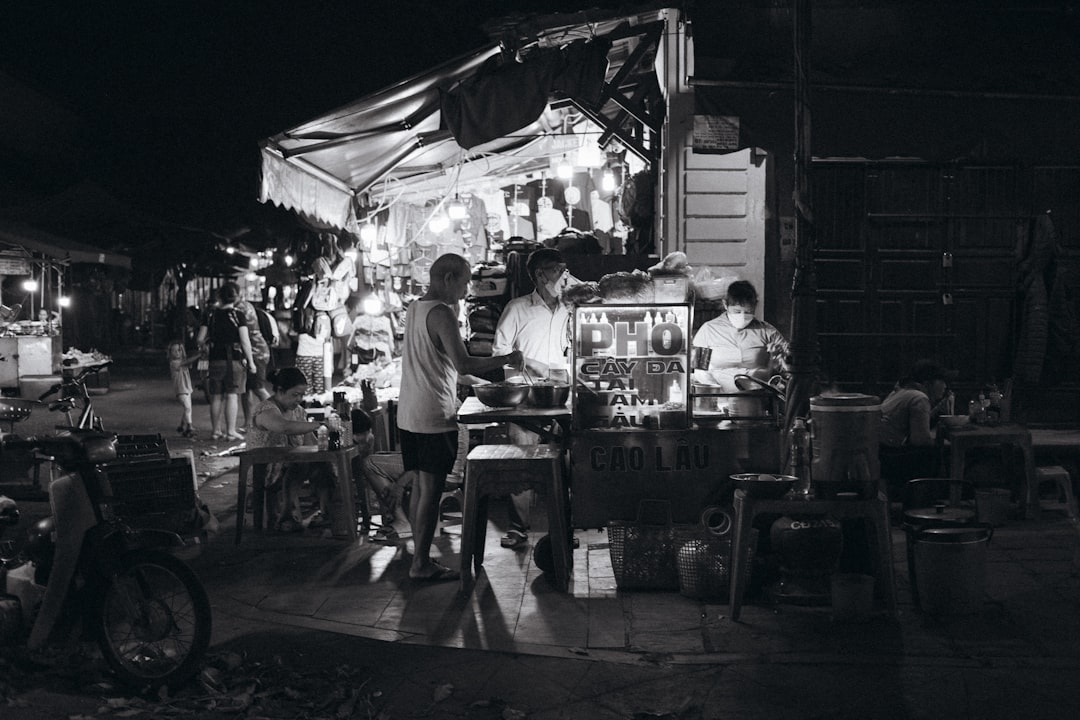
The room inside was maybe fifteen feet wide and twice as deep. Six tables, most of them occupied by men in reflective vests or polo shirts with company logos worn faint. A woman in her sixties worked a wok station near the back, her face lit up by a blue gas flame that threw no shadows — the only light in the room came from the wok burners and the single fluorescent tube overhead. Nobody looked up when we walked in. We found a table near the door, its laminate surface polished to a soft gloss by decades of elbows and bowls.
A younger man — her son, we guessed — came over with a paper menu and a pencil. The menu was curled at the edges and covered in handwritten amendments. Most items were crossed out; a few had new prices taped over the old ones. He waited without any particular urgency. We pointed at three things: an item listed as “beef rice roll,” something called “chive cake,” and the only soup still available, which was described simply as “fish ball.” He wrote nothing down, just nodded, and turned back toward the wok.
The food came all at once, the way it does at places that don’t bother with courses. The beef rice roll arrived as a kind of folded cylinder, the rice noodle translucent and slippery, filled with a coarse mince that had been seasoned with five-spice and fermented bean paste. It came with two dipping sauces, one dark and sweet, one pale and sharp with vinegar. The chive cake turned out to be a pan-fried disc the size of a tea saucer, dense with chopped chives and tiny dried shrimp, its surface crisp in patches and chewy in others. The fish ball soup was the simplest thing on the table: a clear, peppery broth with four bouncy fish balls and a scatter of chopped spring onion.
It was the kind of food that makes no claims for itself. Nothing was plated, nothing was garnished. The broth stained the bowls, the chive cake sat on a piece of waxed paper. But every bite had the weight of someone knowing exactly what they were doing — not creating, but executing, the way a musician runs scales after twenty years until they stop being scales and become something else entirely. The fish balls had a texture we’ve never found replicated: a dense springiness that gives way without ever feeling mushy, as though the paste had been beaten against a countertop until the proteins tightened into a kind of muscle.
By 3:00 AM, the room had settled into a low, steady rhythm. The men in reflective vests finished and left, replaced by a pair of women in nurse’s scrubs who ordered congee and a plate of fried dough sticks. The son had put a small television on a shelf near the ceiling, tuned to a Cantonese opera channel with the sound barely audible. The woman at the wok never stopped moving, but her pace was unhurried — she worked like someone whose body had memorized the choreography so completely that thought was no longer required. She would ladle broth, drop noodles, lift a wok, toss its contents, scrape, pour, wipe — all in a continuous flow that seemed to ignore the existence of time altogether.
We ordered again. This time, a plate of cheung fun — the wide, slippery rice noodles that most tourists eat with sweet soy sauce from a cart in the morning. Here, they came drizzled with sesame paste and hoisin, topped with a spoonful of fried shallots. It was nothing like the version sold from stainless-steel carts. The noodle itself had a chew that suggested freshly ground rice, not the reconstituted flour slurry of the mass-produced kind. The sesame paste was thick enough to coat the tongue, and the hoisin carried a deep, almost smoky sweetness that felt aged rather than manufactured.
Around 3:45, a delivery driver came in with a cardboard box and set it on the counter. The woman wiped her hands on her apron and opened it: live shrimp, still moving, packed in wet newspaper. She took them straight to a sink in the back, and within ten minutes, a bowl of shrimp dumplings appeared on a nearby table for two men who had arrived without ordering — regulars, clearly, who knew that if you showed up early enough, you could eat what just arrived. We watched one of them pick up a dumpling between his chopsticks, bite it carefully, and close his eyes for a second. Not a performance. Just a reflex of satisfaction.
We paid at the end. The bill came to 74 Hong Kong dollars — less than ten US. The son took the cash without looking at it and slid it into an apron pocket. The woman at the wok finally turned around, saw us leaving, and gave a single, barely perceptible nod. That was it. No receipt, no goodbye, no invitation to come again. We stepped back into the street, and the change of air was startling: cooler now, and quiet in a way that the city never is during daylight. A street cleaner was hosing down the pavement a block away, the water running in silver sheets under the streetlights. Somewhere, a metal shutter rattled as it was pulled up — the first signs of the breakfast trade beginning to stir.
We walked back toward the hotel past bakeries where the ovens were already lit, past men unloading crates of bok choy from trucks, past a woman squatting on the pavement sorting bundles of scallions by the light of a headlamp. The city at this hour doesn’t feel like a city. It feels like a series of discrete moments connected only by the fact that nobody else is watching them happen.
A detail we keep returning to: the woman at the wok had a small radio on a shelf behind her. We never heard it make a sound — she wore earbuds, and the opera on the television was barely audible. But at one point, during a lull, she reached back and tapped the radio’s volume dial, adjusting it by maybe a millimeter, without looking. The gesture was so automatic, so ingrained, that it told us more about how many nights she had spent in that room than any interview ever could. That radio had been there for years. She knew its calibrated position the way a pianist knows the weight of their own keys.
Back in daylight, Hong Kong’s street food is loud, colorful, and photogenic. The Michelin-recommended dai pai dong have laminated menus in three languages and queues that form before noon. That’s a different kind of experience — one that’s been curated for consumption. The 3 AM shift isn’t curated. It doesn’t know you’re there, and it wouldn’t care if it did. There is no Instagram wall, no tasting menu, no story about the family recipe passed down through four generations. There’s just a woman in front of a wok, a son taking orders, a small stack of wet newspapers with shrimp inside, and a room full of people who have to be at work in a few hours and need something real to get them there.
We never learned the name of the place. We never went back — not because we didn’t want to, but because the next time we found ourselves near that block, the door was shuttered and a different restaurant had opened in its place. That happens often in Hong Kong. The city evolves faster than any guidebook can keep up with, and a corner that hosted a 3 AM dim sum counter one year might be a bubble-tea franchise the next. The point isn’t to go back. The point is to have been there at all — to have sat in that room during the hour when the city’s guard is down, eating food that was made for people who work through the night, not for people who write about it afterward.
That radio gesture still surfaces at odd moments: the woman’s hand reaching back, adjusting a volume nobody could hear, in a room full of people who already knew exactly where they were.

📷 Photos: Michael Lock (Unsplash), Arpon Mazumder (Unsplash)