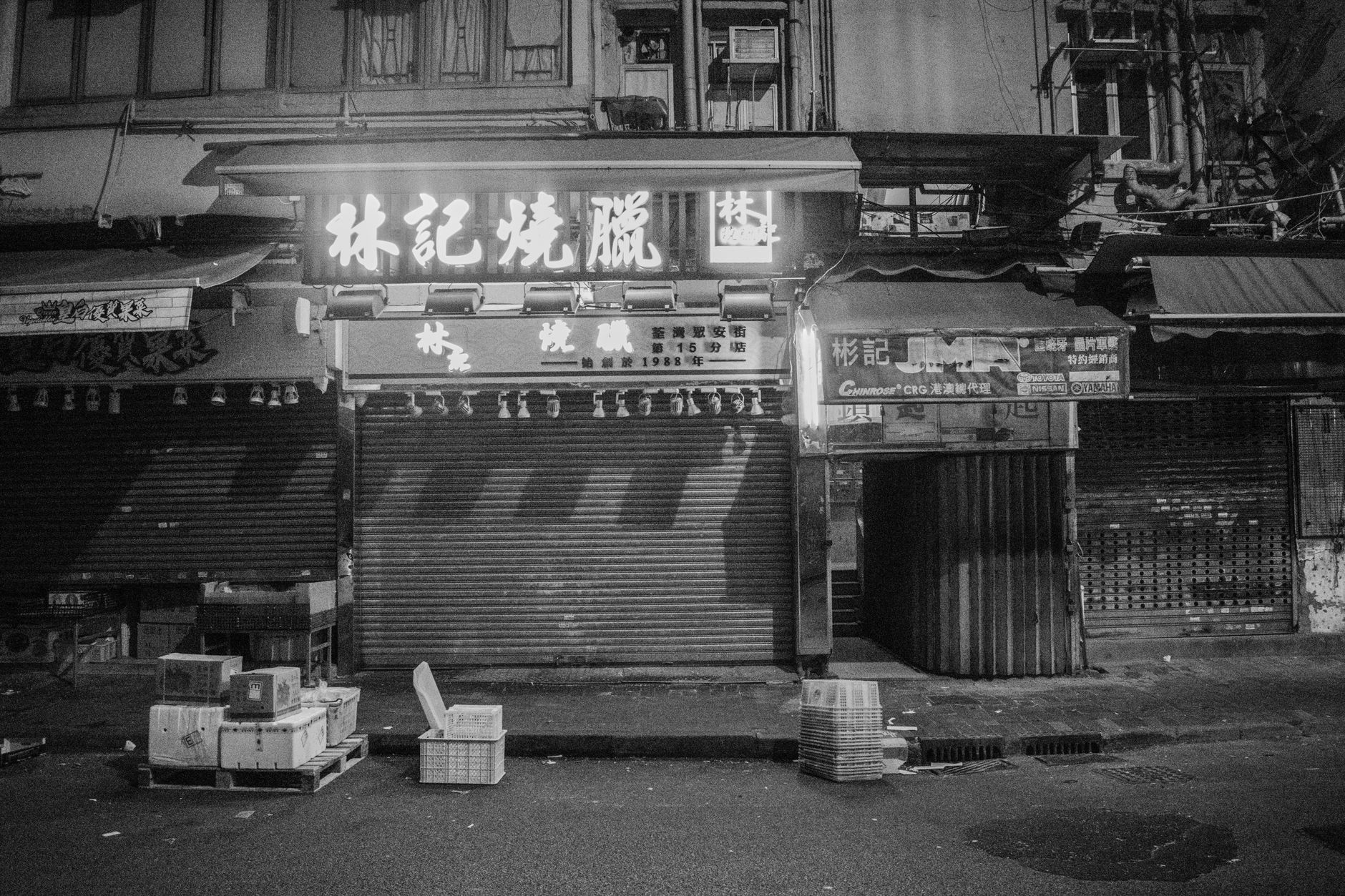
The first thing we noticed about the sign shop on Kweilin Street was not the neon itself but the smell. Not the familiar chemical tang of a workshop — solder and flux and the faintly metallic dust that settles on everything — but something older, more patient. Damp cardboard. The particular mustiness of objects that have been stored for years in conditions they weren’t designed for, waiting for a buyer who may never come. It was mid-afternoon on a Tuesday in late October, and the shop’s metal shutter was pulled halfway up, leaving a strip of shadow across the pavement that made everything inside look deeper than it was.
We had come to Sham Shui Po because the neighbourhood had started appearing in conversations about the city’s vanishing skyline — not in the architectural magazines that chart each new tower’s silhouette, but in the quieter conversations among people who remember a different Hong Kong. The district is not pretty in the way that Victoria Harbour is pretty. It’s a low-rise grid of hardware shops and electronics bazaars and textile wholesalers, where the buildings are stained with decades of rain and the air smells of fried food and air-conditioner exhaust. But it has become, almost by accident, the last refuge for a dying craft.
The shop’s owner was sitting on a plastic stool near the entrance, eating a container of rice with one hand while scrolling through something on his phone with the other. We asked, in the kind of Cantonese that immediately identifies you as a foreigner, whether he had any old signs for sale. He gestured vaguely toward the back with his chopsticks and went back to his lunch.
Inside, the space opened up into something like a warehouse, though that word implies more organisation than what we found. Signs were stacked against every wall, leaning into each other like tired commuters on a late train. Some were complete — the full Chinese characters rendered in glowing tube, the metal frames still intact. Others were fragments: a single character from an old restaurant sign, a decorative flourish that had once belonged to a barbershop, a row of empty sockets where the tubes had been pulled out and sold separately. The floor was concrete, stained with decades of foot traffic, and the light came from a single fluorescent strip that buzzed audibly overhead.
This is not a museum. There are no placards explaining the history of each piece, no preservation society’s seal of approval, no curated narrative about what it all means. The signs are here because they have commercial value — perhaps as raw materials, perhaps as decor for a new restaurant in London or Melbourne or Taipei, perhaps as nothing at all, waiting for someone who will recognise what they are. The owner buys them by weight from demolition crews and shop owners who are clearing out for good. He pays by the kilogram. He sells by the piece. The difference between those two pricing models is the entire reason he has a business.
Neon is heavy. A single sign, the kind that used to hang above a cha chaan teng or a mahjong parlour, can weigh as much as a small person. The glass tubes are fragile inside their metal channels, and the transformers — those big, humming boxes that step the voltage up high enough to ionise the gas — are dense with copper windings. A full truckload of signs might weigh half a ton. The economics of salvage are straightforward: you pay the demolition crew a few hundred dollars for the lot, spend a day with a crowbar and a pair of wire cutters, stack everything in a van, and hope you can sell the individual pieces for enough to cover your time. Most of the time, you can’t.
We spent the better part of an hour in that first shop, picking through stacks, pulling signs out into the grey light of the doorway to see them properly. The quality varied enormously. Some were clearly recent — a bright, uniform typography that spoke to mass production, the kind of sign that had been ordered from a catalogue and bolted up the same year it was designed. Others were older, their tubes hand-bent in ways that showed the maker’s eye: a slight taper at the end of a stroke, a curve that didn’t quite match the blueprint but looked better for having been adjusted in real time. The best ones were Chinese characters we couldn’t read, from shops we would never visit, their meaning lost to us but their form still arresting — the way a word written in calligraphy remains beautiful even when you don’t speak the language.
We bought one. It was a single character, about a metre across, its frame painted a faded maroon that had once been red. The tubing was broken in two places — a clean snap, not a shatter — and the transformer was missing entirely. The owner asked for three hundred Hong Kong dollars, which we paid without haggling, partly because it seemed like a fair price and partly because we didn’t know how to haggle in Cantonese about a broken sign. He wrapped it in newspaper and old bubble wrap and we carried it back to the guesthouse, the frame warm through the paper from the afternoon sun, wondering what we would actually do with it when we got home.
That question — what do you do with a thing like this — turned out to be the real subject of the trip. The signs are not, for the most part, going to new owners who will light them up again. The ones that survive intact are bought by collectors, by interior designers looking for an accent piece, by nostalgia-driven brands in other cities who want to evoke a Hong Kong that no longer exists. The ones that don’t survive intact are sold for scrap: the copper winding reclaimed, the glass crushed and discarded, the metal frame thrown into a recycling bin. Every sign we saw in Sham Shui Po was in a state of transition between those two fates, and the only difference was whether a buyer appeared before the next demolition cycle rolled around.
On our second day in the neighbourhood, we met a man who had worked as a neon bender for forty-two years. He was in his late sixties, with forearms that still carried the muscle memory of a trade that requires strength and precision in equal measure. He was sitting at a folding table in the back of a shop on Apliu Street, drinking tea from a thermos and watching a portable television that was tuned to a horse-racing broadcast. Our friend translated. “There used to be hundreds of us,” he said. “Now maybe twenty. Or something like that. And most of those are retired already.” He paused, then added, “The young ones don’t want to learn. Can’t blame them, I suppose. The money isn’t there.”
The reasons are familiar to anyone who has watched a city modernise. LED is cheaper, more durable, and easier to maintain. The government has tightened regulations on neon signs, citing safety concerns and visual clutter. Building owners prefer the predictable billboards that can be rented out by the month rather than the bespoke signs that belonged to a single tenant. The craft itself is hard to learn and harder to master — a single tube can take hours to bend by hand, and the gas filling process requires equipment that costs more than most small shops can justify. When the old craftsmen retire, they take their knowledge with them, because no one has stepped forward to learn it.
The salvage shops are the intermediaries between two eras. They receive the material remains of the old city and redistribute them to whoever wants them — collectors, tourists, artists, the occasional nostalgic Hongkonger who remembers a particular sign from childhood and wants to keep a piece of it. But the trade is not sentimental. The owner of the shop on Kweilin Street did not wax poetic about vanishing culture. He talked about the price of copper. He told us about a container of signs he had shipped to a buyer in Paris, and how the shipping cost more than the signs themselves were worth, and how he probably wouldn’t do it again because the paperwork was too much trouble.
It’s tempting to see the salvage trade as a form of preservation, but that’s too neat a framing. The signs are not being saved. They are being converted into commodities — objects with a price tag attached, subject to the same market forces that killed the craft in the first place. A sign that hangs in a gallery in Berlin or a bar in Brooklyn is no longer a sign. It is a decoration, stripped of its original purpose and recontextualised as art, or as nostalgia, or as something vaguely exotic that a customer can point to and say “I got that in Hong Kong.” The signs that stay in Hong Kong are increasingly rare. Most of the best specimens — the complete ones, the ones with intact transformers and working tubes — are bought by international buyers who can afford to ship them halfway around the world.
We visited four more shops over the course of the week, scattered across Sham Shui Po and one in the neighbouring district of Cheung Sha Wan. The best one was a single-room operation above a hardware store on Pei Ho Street, accessible only by a narrow staircase that smelled of mildew and old cooking oil. The sign maker — a man in his fifties who still took commissions for custom pieces — had a small collection of vintage signs he kept in a back room, not for sale but for reference, the way a typographer might keep a book of old typefaces. He showed us a piece he had made thirty years earlier, for a now-closed restaurant in Causeway Bay. The character was a stylised version of the family name, rendered in a script that mimicked brush calligraphy. He had bent the tubes himself, by hand, using a gas torch and a template drawn on a piece of plywood. He still remembered the measurements.
He asked if we wanted anything made. We said we were just looking. He nodded, seemed unsurprised, and went back to the desk where he was working on a small sign for a local tea shop — a modern piece, designed to be backlit by LED strips, the letters laser-cut from acrylic rather than hand-bent from glass. It was the kind of sign that would last for years without maintenance, could be replaced for a fraction of the cost, and would never, under any circumstances, end up in a salvage shop. He was building it.
The last shop we visited was on Fuk Wing Street, a few blocks from the MTR station. It was closing down. The owner had sold the building — or rather, the building had been sold out from under him — and he was clearing out the inventory at steep discounts. We walked in to find him standing in the middle of the space, surrounded by a lifetime’s worth of accumulated stock, with a notebook in his hand and an expression that suggested he was trying to decide whether to give up entirely or start over somewhere further from the city centre. The signs on the walls were priced to move: fifty dollars for a complete piece, a hundred for something with a transformer still attached. We bought another one — a small sign, the size of a suitcase, that had once advertised a photographer’s studio. The character was a stylised camera. The glass was intact.
On the street outside, we asked a young couple walking past if they knew what the sign had said. They were university students, and they looked at it for a long moment before one of them hazarded a guess: something about light, she thought. Or maybe about memory. Neither of them was sure. The word for camera, she explained, had changed in their lifetime — replaced by a newer, more casual term that spread through social media rather than through tradition. The character on the sign was old-fashioned. She had seen it before, in photographs of her grandmother’s studio, but she had never used it herself.
We carried the sign back to the guesthouse, past the shops selling phone cases and charging cables and cheap plastic toys, past the market stalls where fish and vegetables were laid out on tarps, past the construction site where a new residential tower was rising on the site of what had been a row of post-war tenement buildings. The skyline of Sham Shui Po is changing, block by block, the old three-storey walk-ups giving way to thirty-storey towers that block the afternoon sun and cast the narrow streets into permanent shadow. The neon signs that remain — and there are still a few, hanging above old tea houses and hardware stores — look smaller than they used to, dimmer, pinned between the blank glass faces of buildings that were built without any provision for a sign that projects out from the wall.
The piece we bought from the shop on Fuk Wing Street now sits on a shelf in a friend’s apartment, unlit, its transformer gone, its frame showing the first signs of rust. It doesn’t say anything anymore, because there’s no one left to read it, and because whatever it said is no longer true about this city or any other. But the shape of it — the curve of that stylised camera, the way the glass catches the light at a certain hour of the afternoon — still holds something that a photograph can’t quite capture.

📷 Photos: Costa Karabelas (Pexels), sl wong (Pexels)