
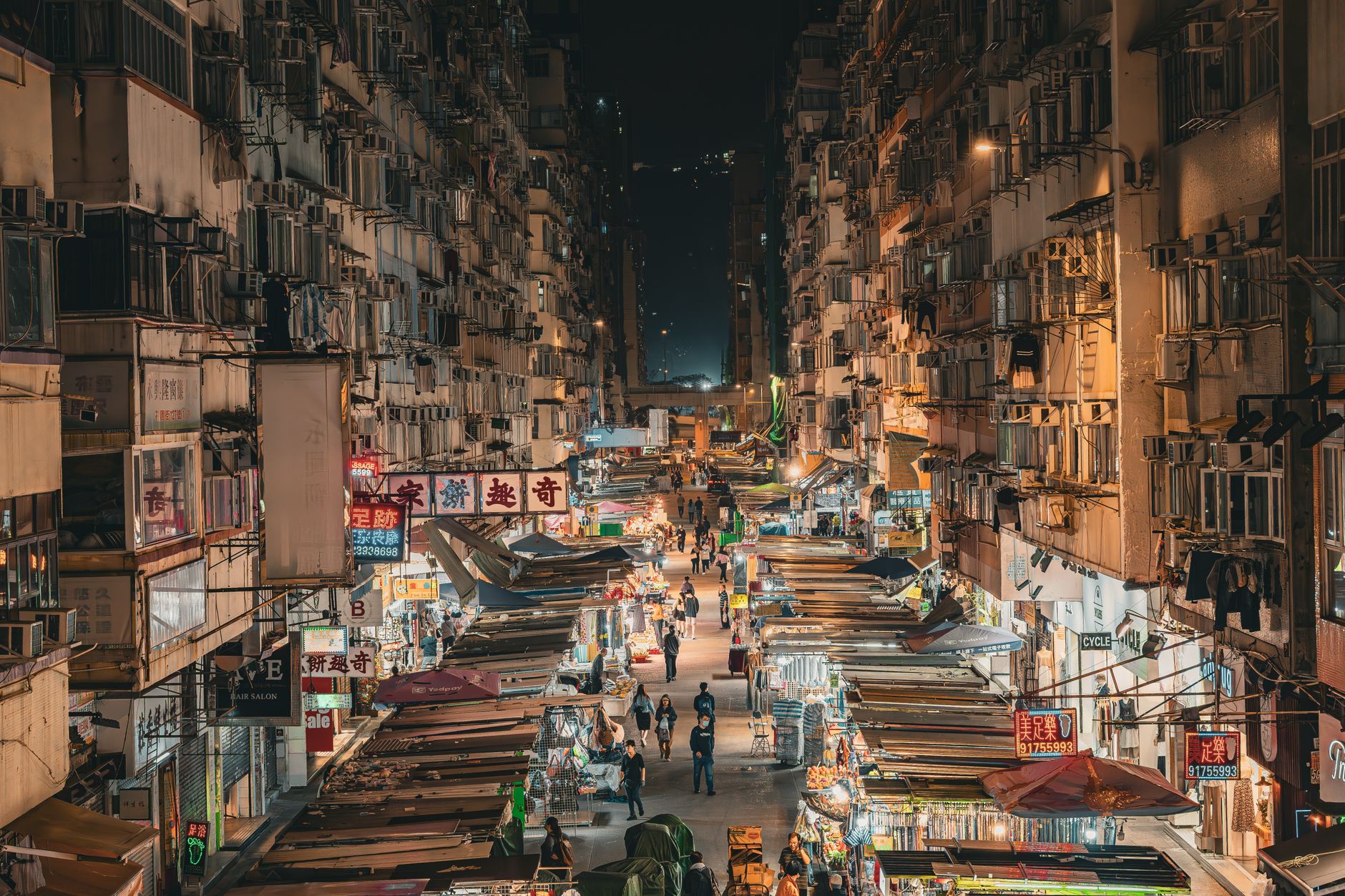
The oil stain on the pavement is how you find it. Not a sign, not a queue that snakes around the block, but a dark, glossy patch of concrete that has absorbed years of dripping marinade and pork fat. By the time we had walked past it three times, we realized that the people sitting on the low plastic stools scattered across the footpath were not waiting for anything. They were already eating.
Mong Kok at street level is a negotiation. The pavement is a shared resource between pedestrians, the overflow from electronics shops, and the men who sell live frogs and turtles from Styrofoam boxes. Navigating it requires a certain kind of attention that most visitors never develop, because they are usually looking up at the neon signs. The best things in this neighborhood happen at eye level or below. The stools were bright red, the kind that come in stacks of twenty outside wedding banquets and school assembly halls. On each one sat a person holding a styrofoam box or a paper plate, working through a portion of char siu with the focused efficiency of someone who has done this a hundred times before.
The first time we ate there, we almost didn’t. It was late afternoon, and the air had that heavy Hong Kong quality that makes you feel like you’re breathing through a wet towel. The shop itself was barely visible behind the grills and hanging racks of meat — a narrow opening in the facade, maybe two meters wide, with a single fluorescent tube buzzing somewhere inside. A woman emerged holding two plates of char siu over rice, both glistening, and handed them to a man who had not spoken a word to her. He paid, sat down, and began eating within seconds. No exchange beyond the transaction itself. This was not a place for lingering.
The char siu that comes from these tiny, street-facing roasting operations is different from what you find in the famous barbecue restaurants. The difference is in the surface. At a proper restaurant, the char siu arrives with a glaze that has been carefully applied in layers, sometimes torched at the end for effect. It looks beautiful. What you get from a plastic stool in Mong Kok has a surface that is slightly tacky, almost rough to the touch, because it has been hanging in the open air while the fat slowly renders and the exterior dries out just enough to concentrate the flavor. It is, in its way, more honest meat. The sweetness is there, but it hits the tongue after the salt and the smoke, not before.
The cut matters more here than anywhere else. In a restaurant, the chef can hide a mediocre piece of pork under a thick layer of honey glaze and caramelization. On a stool, with nothing but a paper plate between you and the meat, the quality of the cut becomes the entire experience. The best char siu we had came from the shoulder end, where the fat is distributed in thin seams rather than in one solid cap. The woman who ran the shop that afternoon — she looked to be in her late fifties, with the kind of hands that had not been idle in decades — pointed at a particular section of hanging meat before she cut it. She did not explain why. She did not need to. The meat had a dark rim where the marinade had concentrated during roasting, and the interior was just pink enough to indicate it had been cooked through but not dried out. The texture was the thing: it pulled apart along the grain without any effort, each strand coated in its own thin layer of rendered fat.
We asked her, through a combination of Cantonese that was barely functional and gestures, how long she had been working this spot. She held up three fingers, then four, then three again. Twenty-three years. The same grill, the same stools, the same position on the sidewalk. The address does not matter because the shop does not exist in the way most addresses describe. It is a sliver of commercial space between a phone repair stall and a shop that sells dried seafood. The building itself looks like it was never designed to hold a kitchen. But the exhaust fan that vents onto the street has left a dark, greasy film on the wall above it, and that film has been building for over two decades.
The rhythm of the place only becomes visible after you have watched it for an hour. There is a small window between three and four in the afternoon when the first batch of the day has been sold and the second batch is still in the oven. This is the only time you will see the stools empty. The workers use this window to clean the cutting boards with boiling water and to prepare the next load of pork for marinating. The marinade itself is kept in a plastic bucket that looks like it was originally used for something else. We never saw the full recipe, but the smell that came off the meat as it was being handled was heavy on rose wine, soy, and something floral that we could not identify. Regulars, when asked, just shrugged and said “sweet” or “the usual.” Nobody seemed curious about the exact composition. The food was good.
What most coverage of Hong Kong street food misses is that the experience of eating char siu from a stool is not about the char siu alone. It is about the context that surrounds it. The traffic on the nearest main road produces a constant low drone, but the side street itself is quiet enough that you can hear the slicing of the meat on the board. The woman who runs the shop has a system: she cuts the char siu to order, never in advance, and she uses a cleaver that has been worn down to a curve from years of sharpening. The motion is fast and repetitive, and the sound of the blade hitting the board has a particular rhythm — three or four quick chops, then a pause while she arranges the pieces on the plate, then another round of chopping. It is the sound of someone who has done this so many times that the motion has become unconscious.
The temperature of the char siu when it arrives matters more than any other variable. If it is too hot, the fat has not had time to settle and the texture feels greasy rather than rich. If it is too cold, the surface hardens and the sweetness turns cloying. The sweet spot — and we tested this across multiple visits — is when the meat has been resting for roughly three to four minutes after coming out of the oven. The woman seemed to know this instinctively. She would cut the meat, plate it, and then wait an exact amount of time before calling the customer over. We timed it once. It was four minutes and twelve seconds from the moment she picked up the cleaver to the moment she handed us the plate.
The clientele is a study in itself. There is no tourist trade worth mentioning. The people who eat here are delivery drivers, shop assistants on their break, elderly couples who live in the nearby public housing blocks, and the occasional person who has clearly come from an office job, still wearing a lanyard or a name badge. Nobody takes photographs of their food. Nobody posts anything to social media while eating. The focus is entirely on the plate in front of them. We watched a man in a uniform from a local courier service eat an entire portion without once looking up from the meat. He finished, crumpled the paper plate into a tight ball, stood up, and walked away. The whole interaction, from sitting down to leaving, took under eight minutes.
A small unplanned detour came on our fourth visit. We had intended to go straight to the stool spot, but we passed a tiny shop two streets over that was selling what looked like the same kind of char siu from a very different setup — a proper glass display case, a digital scale, a cash register with a card reader. The char siu there was fine. It was technically correct. The glaze was even, the meat was tender, the seasoning was balanced. But it lacked something that we could not name at the time. It was not until we walked back to the stool spot and ordered a portion there that we understood what the difference was. The char siu from the glass case had been cooked with precision, but the char siu from the stool had been cooked with repetition. The woman running the stool spot had made this exact same product somewhere around ten thousand times. She knew, without thinking, when to rotate the meat, when to adjust the heat, when to pull it out. That knowledge is not a recipe. It is a muscle memory that takes decades to develop.
The hours are irregular. The shop does not keep a posted schedule. On some days, the grill is lit by ten in the morning and runs until eight at night. On other days, the woman does not appear until noon and closes by five. The only reliable signal is the smell. If you are within a hundred meters of the street and you catch the scent of roasting pork mixed with exhaust fumes and the damp concrete of a Hong Kong afternoon, then the shop is open. If the air is clean, there is no point waiting.
We asked a regular — a man who had been eating there for what he claimed was fifteen years — whether the quality had changed over time. He thought about it for a moment, chewing slowly, before answering. The char siu was better now than it had been ten years ago, he said, because the woman had gotten better at controlling the temperature of the oven. But the rice was worse. She used to buy a more expensive brand, he explained, and at some point in the last few years she had switched to something cheaper — like, a different supplier or whatever. It was a small detail that most people would not notice. But he noticed. And he continued to eat there anyway, because the meat was worth forgiving the rice.
There is a phenomenon that occurs when you eat char siu from a plastic stool in Mong Kok. The street around you does not stop. People walk past, sometimes brushing against your shoulder. A man selling phone cases sets up his display two meters away. A woman walks by with a cage of live chickens. The noise and the heat and the humidity are all present, but they recede into the background because the char siu demands your attention in a way that polite restaurant dining does not. You are not being served. You are receiving food that has been made for people who know what they want. The experience has no hospitality component in the traditional sense. There is no smile, no greeting, no small talk. There is only the exchange of money for meat, and the meat is excellent.
On the last visit, we sat on the stool for longer than usual. It was early evening, and the light had changed from the harsh white of midday to something softer and more yellow. The woman was preparing to close. She wiped down the cutting board with a rag that had been washed so many times it was almost translucent. She covered the remaining pork with a cloth and carried it inside. The stools were stacked and carried into the shop one by one. The pavement where they had stood was marked by four shallow indentations, worn into the concrete by years of the same legs pressing into the same spots. By the time we got up to leave, the only evidence that the shop had been there at all was the oil stain on the ground and the faint smell of roasted pork that would linger in our clothes for the rest of the night.

📷 Photos: Ehsan Haque (Pexels), Ehsan Haque (Pexels)