We were on our third coffee by nine in the morning and the ceiling fan above Giảng Café was doing almost nothing. The room was narrow and warm and full of steam from a dozen small kitchens working behind a counter, and the old man at the table next to us was spooning the yellow foam off his egg coffee with the careful patience of someone who had been doing this since before the city changed its name. We had read the same listicles everyone reads — Try the original egg coffee at Giảng, the one that started it all in 1946 — and the advice was correct, in the same way that telling someone to see the Mona Lisa is correct. It is accurate and it does not prepare you for the actual experience.
The egg coffee arrived in a small glass cup sitting inside a bowl of hot water, so the coffee stayed warm through the whole slow process of drinking it. The foam on top was thick enough that the spoon stood upright for a moment when we set it down. It tasted like something between a dessert and a breakfast and a dare — the sweetness was real but not cloying, the coffee underneath strong enough to cut through it. We watched a woman at the next table add a splash of condensed milk to hers, which seemed almost reckless, and then she drank it and looked satisfied, so maybe we were the ones being timid.
The address at 39 Nguyễn Hữu Huân is easy to find because there is usually a line of people with cameras standing outside. The trick, if you can call it that, is to walk past them and up the stairs. The ground floor is for takeaway orders and tourists who haven’t figured out that the real seating is one floor up, where the balconies overlook the street and the old tile floors are uneven in a way that makes every table wobble slightly. We wedged a folded napkin under one leg and watched motorbikes stream past below, their drivers balanced with cargo that ranged from a single baguette to a dismantled sofa tied to the back with bungee cords. None of this is part of the official coffee experience. But it is the part that stays.
By ten-thirty the heat was beginning to settle into something heavier. The Old Quarter at that hour is a negotiation between what you planned to do and what the heat and the traffic and the sheer number of people actually allow. We had intended to walk directly to the next stop — a place called Loading T, which we had heard served a very good coconut coffee in a building that used to be a photography studio. What happened instead was that we walked for about four blocks, stopped to buy a can of iced tea from a woman who had set up a cooler on the back of her bicycle, and ended up standing in the doorway of a silk shop for five minutes because the air conditioning from inside was spilling out onto the street and we were not ready to leave it.
The silk shop owner, a woman named Hạnh who had been running the place since the early 1990s, did not seem bothered by two foreigners lingering in her doorway. She asked where we were going, and we explained about the coconut coffee, and she laughed in a way that suggested she had heard this exact explanation many times before. “It’s on the same street,” she said. “But you’ll miss it if you look at the numbers. Look for the green door and the dog — something like that.” She was right about the dog — a small rust-coloured mutt that was lying in the sun outside a green-painted door about halfway down the block, fast asleep in a posture that suggested it had no intention of moving for anyone’s coffee pilgrimage.
Loading T is at 8 Ngõ Tràng Tiền, which sounds specific on paper and is almost invisible in practice. The entrance is a narrow alley that opens into a courtyard, and the courtyard opens into a two-storey building with high ceilings and exposed brick walls. The coffee here is served in ceramic cups that have the heft of something made to last, and the coconut coffee — a blend of strong black coffee and coconut cream, served over ice — is the kind of drink that makes you reconsider what a coffee drink can be. It was sweet but not syrupy, cold without being watery, and the coconut flavour was present without overwhelming the coffee underneath. We sat at a table near the window and watched the light change as clouds moved past, and for a while we did not talk much. The place was quiet in the way that a good coffee shop is quiet — not empty, but full of people who were not trying to be heard above each other.
A young man at the counter, who introduced himself as Pieter, said he had been coming here for about three years, ever since a friend brought him during his first week in Hanoi. He was from the Netherlands originally. “I thought I understood coffee,” he said, “and then I came here and realised I understood almost nothing.” He pointed to the menu, which was handwritten on a chalkboard. “They don’t have milk the way we think of milk. It’s all condensed, or egg, or yogurt, or coconut. The first time I ordered a black coffee here I felt a little smug, you know, like I was being authentic. And then I drank it and it was the strongest thing I’ve ever tasted, and I had to ask for sugar. So much for authenticity.”
We stayed longer than we had planned. The plan, such as it was, had been to visit three or four places in a loop through the Old Quarter, hitting the well-known spots and maybe one or two that were less documented. By noon we had only made it to two, and the heat was now enough that the idea of walking to a third felt like poor planning dressed up as diligence. We decided to take a taxi to the next stop — a café called Đinh, which is famous for serving egg coffee in a slightly different style than Giảng — and it was there that a small mistake became a useful detour.
The taxi driver dropped us at 13 Đinh Tiên Hoàng, which is the address listed online, but the café is not marked from the street. We stood on the pavement for a few minutes, looking at a row of shopfronts that did not appear to include a coffee shop, until a man selling fried spring rolls from a cart next to us pointed up. The café was on the second floor, accessible by a staircase so narrow we had to go up single file. The sign was small and easy to miss from the street, which is apparently deliberate — the owner, we later heard from a regular, prefers customers who are willing to look for it. The egg coffee here was thicker than Giảng’s, almost pudding-like in consistency, and served in a smaller cup. It was good, and it was different, and it was worth the trouble of finding the staircase, but it was not the revelation that the first cup had been. That is the thing about a city with this many coffee options: the first great cup sets a standard that the second can only approach, not match.
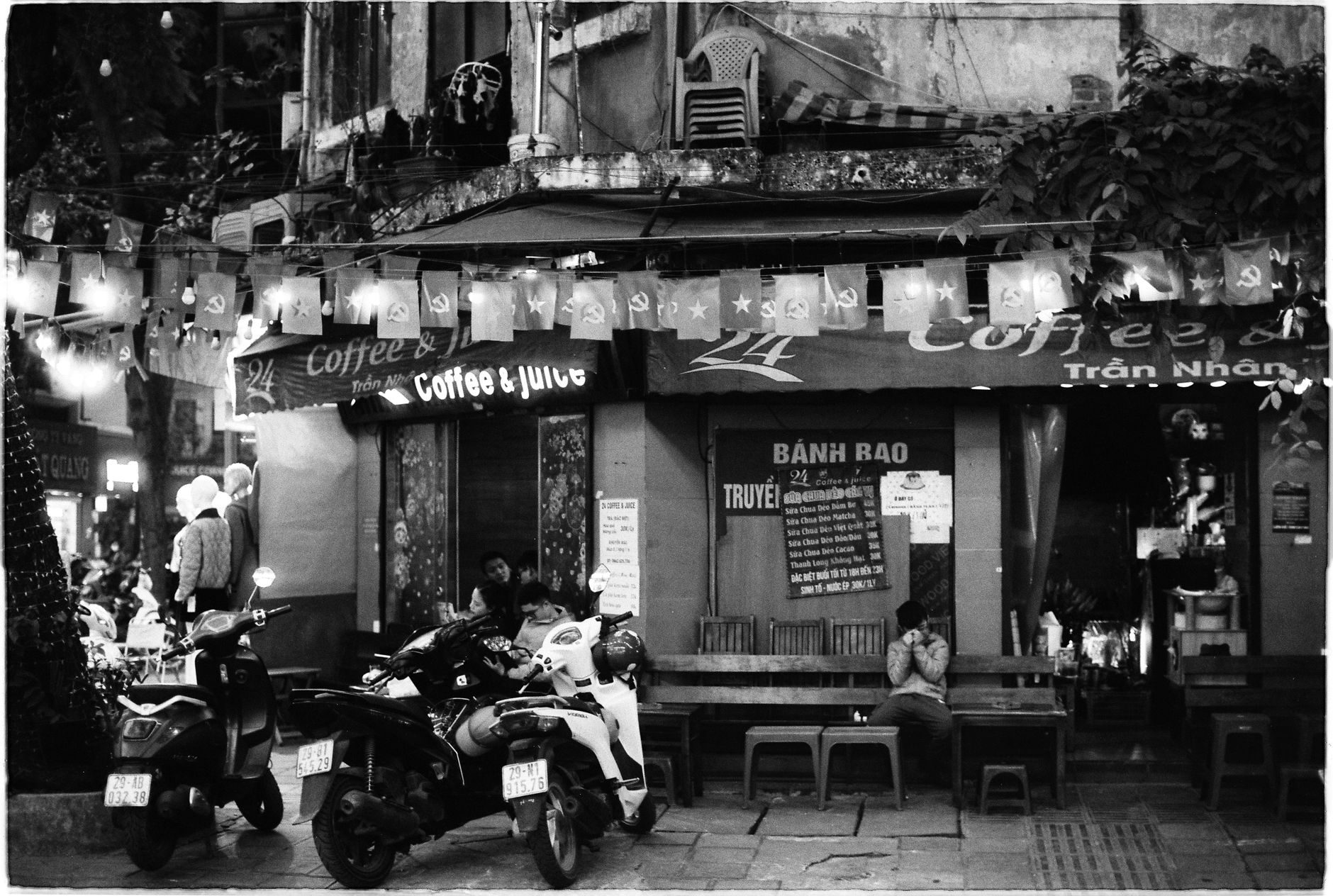
Somewhere around the fourth cup — we had lost count by then, and the caffeine was beginning to accumulate in a way that felt less like energy and more like a low hum under the skin — we ended up at a stall in the Old Quarter that did not have a name we could identify. It was a small cart on the corner of a narrow lane, run by an older woman who was cracking coconuts with a cleaver while her daughter worked the espresso machine. The coffee here was coconut-based, served in a plastic cup with a straw, and it cost 15,000 Vietnamese dong — roughly 60 US cents. We ordered two, and the woman handed them over without smiling, and we stood on the corner drinking them while motorbikes and bicycles and pedestrians moved around us in patterns that felt chaotic until you watched long enough to see the rhythm underneath. The coffee was good — better, honestly, than the coconut coffee at the photography-studio place — and it was the kind of discovery that does not happen if you stick to the list.
That is the tension in a coffee itinerary like this one. The famous places are famous for a reason — Giảng’s egg coffee is genuinely original and genuinely good, and Loading T’s atmosphere and drink quality are both high enough to justify any recommendation. But the nameless stall on the corner, the one that you would never find without getting lost first, is where the city’s coffee culture stops being a curated experience and starts being something you participate in. The woman with the cleaver was not trying to be authentic. She was just selling coffee to people who lived nearby, the same way she had been doing for fifteen years, and the fact that we stumbled onto her cart was a piece of luck that no guidebook could have offered.
By late afternoon the caffeine had built to a level that required food. We found a small pho shop near Hoàn Kiếm Lake — no name on the door, just a woman serving bowls from a steel pot on the pavement — and ate while watching the light turn gold over the water. The broth was clean and the beef was sliced thin enough to cook in the heat of the bowl, and it was exactly what the afternoon needed. A Vietnamese man at the table next to us, who had clearly noticed us ordering coffee all day, asked if we were doing a tour. We explained our plan, and he nodded slowly. “You should try the yogurt coffee,” he said. “At a place called Hanoi Coffee Station, near the cathedral. It’s different.” We did not make it there that day — the light was fading, and the legs were tired, and the cumulative effect of four coffees and a bowl of pho was a strong desire to sit still for a while. But we wrote it down.
Walking back through the Old Quarter as dusk arrived, the streets took on a different character. The heat had eased, the lights were coming on in the narrow shopfronts, and the smell of cooking oil and lemongrass drifted out of doorways. A group of schoolchildren in white shirts and red scarves walked past, laughing at something one of them had said. A woman selling fried bananas from a basket balanced on a bicycle called out as we passed, and we bought one, still warm, dusted with sugar, and ate it standing on the corner. The banana was good, and the sugar was the right amount, and it cost 10,000 dong — maybe thirty cents. It was not on the itinerary.
Back at the hotel that evening, we tried to reconstruct the day on a map and realised we had walked a total of maybe three kilometres, spread over eight hours. The coffee itinerary, as it turned out, was less about the coffee than about the pauses between cups — the silk shop doorway, the sleeping dog, the man who pointed up at an unmarked staircase, the woman who cracked coconuts with a cleaver. We had found the famous egg coffee and the famous coconut coffee and a few things that were not famous at all. The fourth cup — the nameless one from the cart on the corner — cost less than a dollar, and it was the only one we finished completely.

📷 Photos: Ama Journey (Pexels), Đào Minh Tự (Pexels)