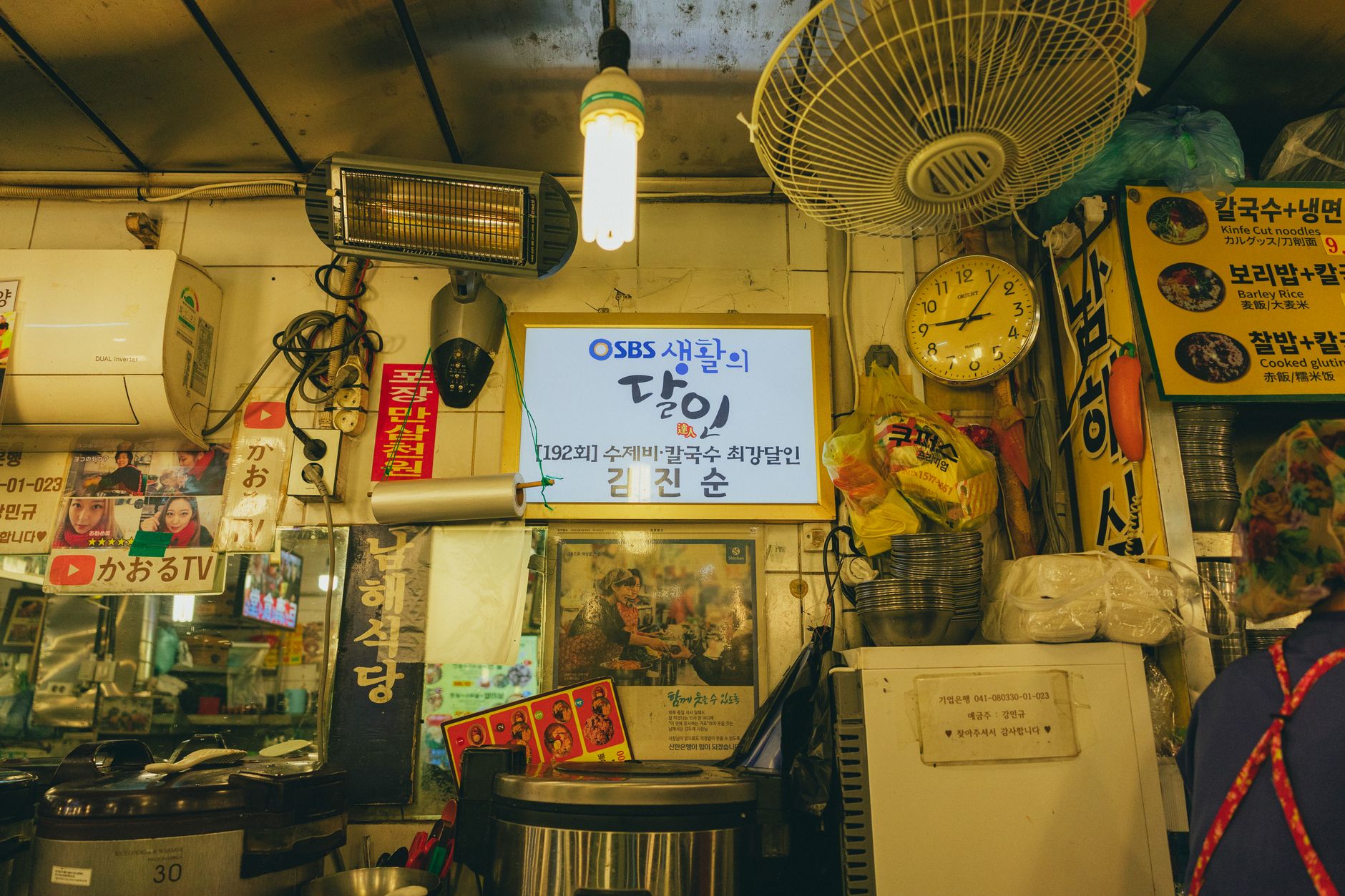
Gwangjang Market on a Tuesday afternoon smells like sesame oil, burning rice cake, and the particular must of old paper that has been stored in a plastic crate for a decade. A woman in her late sixties sits behind a table stacked with VHS tapes, their covers faded to a uniform beige. She is eating soup. A visitor from Japan, hunched over and squinting, is pulling out tape after tape, checking the labels, putting them back. He has been at it for forty minutes. The woman does not look up from her soup. This is not a place that performs nostalgia for a customer. It simply contains it.
The hunt for vintage Korean pop culture memorabilia in Seoul does not begin with a map or a blog post. It begins with a willingness to ask for directions to things that do not exist anymore — and then to follow those directions anyway. The flea markets that carry the real material culture of 1990s and early 2000s K-pop, of the drama boom, of the pre-digital entertainment industry, are not the ones listed in English-language guides. They are the ones that share a building with a fish stall or exist as a single table under a stairwell, tended by someone who remembers when the items on display were current, not collectible.
Hwanghak-dong Flea Market, east of the Han River, is where many serious buyers start. It sprawls across several blocks under the shadow of the Cheonggyecheon Expressway, a landscape of tarps and folding tables and metal carts. On a Saturday morning, it is loud. A man sells hand drills from a blanket. Another sells only eyeglass frames, hundreds of them, arranged by color. In the far corner, near a stall selling used bicycle parts, a collection of old Korean movie posters is pinned to a clothesline. Most are from the 1980s. A few are from the early 2000s, their edges curled from sun exposure. The asking price for a poster of the 2003 drama Dae Jang Geum is 5,000 won — about four dollars. It is not framed. It is not protected. It is clipped to a line with wooden clothespins, flapping in the exhaust of passing trucks.
The memorabilia that draws the most dedicated collectors is rarely the obvious stuff. Official merchandise from major K-pop groups — the photobooks, the light sticks, the limited-edition albums — has a well-organized secondary market online, and prices there are predictable. The real finds are the ephemera that nobody thought to preserve. A promotional calendar from a 1997 Sechs Kies fan meeting. A ticket stub from a 2001 concert at the Olympic Gymnastics Arena, still attached to its perforated cardboard stub. A business card for a talent agency that no longer exists, with a handwritten phone number on the back. These things end up in boxes, in the homes of relatives who are clearing out a storage unit, and from there to a table at a flea market where the seller has priced it all at 1,000 won per item because the plastic bag it came in is worth about that much.
One Sunday in early spring, at the Dongmyo Flea Market near the park of the same name, a collector from Busan spent three hours going through a single stall. The stall was run by two men in their fifties who seemed to have acquired the contents of an entire former entertainment company’s office. There were binders of promotional headshots from the late 1990s — actors and singers whose names have largely been forgotten, faces that appear in no database, printed on glossy paper that had yellowed unevenly. There were cassette singles, still in their shrink wrap, from groups that released exactly one song before disbanding. There was a stack of fan letters, handwritten and unsent, addressed to a singer whose stage name is no longer searchable. The collector bought the entire contents of the stall for 80,000 won. The sellers helped him pack it into cardboard boxes. They didn’t ask what he planned to do with it.
The price of things at these markets follows a logic that is hard to reverse-engineer. A vintage H.O.T. concert T-shirt in decent condition might be priced at 30,000 won or 300,000 won depending on which stall has it, with no obvious relation to its rarity or condition. A seller who recognizes the group can name a higher price; one who does not might sell it for the same as any other used T-shirt. The advantage of hunting at the less tourist-oriented markets — the ones in Nowon-gu, or in the back alleys of Sindang — is that the sellers often do not recognize what they have. The disadvantage is that neither does the buyer’s own eye. A buyer who does not know that a particular Fin.K.L. album had a limited first pressing with a bonus photocard will walk past it. A buyer who does know can buy it for three thousand won.
The geography of the hunt shifts depending on the day of the week. Tuesday through Thursday, the markets are thinner. Fewer sellers, fewer buyers, but those who are there tend to be more serious. A Tuesday buyer at the Seoul Folk Flea Market near the Express Bus Terminal found, buried under a pile of old kitchenware, a complete set of photocards from the 1998 debut of the group S.E.S. They were not in a binder. They were loose in a cardboard box, mixed in with old telephone cards and bus tokens. The seller, an elderly woman whose main inventory seemed to be used shoes, had no idea what they were. She wanted 500 won per card. There are sixteen cards in the set. The buyer paid 8,000 won — roughly six dollars — and left before the seller could reconsider.
Not every find is a bargain, and not every bargain is a find worth making. The markets are also full of things that look like memorabilia but are not — reprints, fan-made items from the late 2000s that have aged to resemble the real thing, promotional materials from brands that used idol faces but have no connection to the music. A careful buyer learns to check the paper stock, the printing quality, the presence of a barcode or a distributor’s mark. The counterfeiters of the 1990s did a brisk business in fake tour merch, and those fakes have now circulated long enough to develop their own patina. Some collectors seek them out deliberately. A fake 1999 g.o.d tour shirt, its screen-printed logo cracking in a pattern identical to the real one, tells a story about how deeply the demand exceeded the official supply. It has its own value.
At the Bangsan Market, a woman who sold only old magazines had organized her inventory not by date or title but by which idol appeared on the cover. At the Yongsan Electronics Market, in a basement stall that looked like it had not been rearranged since the 1990s, a man kept a handwritten ledger of which K-pop albums he had sold and to whom, dating back to 2002. The names in the ledger were in Korean and Japanese and, in a few cases, Cyrillic. He did not speak English. He simply pointed at a row of CDs behind a glass case, and the buyer pointed back.
One afternoon, in a narrow alley behind the main drag of the Insa-dong antique district, a door that looked like a private residence opened into a room full of cardboard boxes. The space was maybe ten square meters. A single bare bulb hung from the ceiling. The boxes, when opened, contained VCRs and cassette decks and, at the bottom, a collection of blank videotapes with handwritten labels. The labels named music shows from the late 1990s: Inkigayo, Music Bank, Show! Music Core. A tape dated November 1997 contained a full broadcast, complete with commercials for a brand of ramen that no longer exists and a telecom company whose logo has been retired for twenty years. The seller wanted 10,000 won per tape. He had about forty of them. He said they came from a relative who had worked at a broadcasting station and who had taped everything because the station did not archive its own footage reliably — or so he said. He was not sentimental about them. He was clearing space.
The buyer who takes these tapes home faces a separate problem: how to play them. A VCR is not hard to find in Seoul, but a VCR that can play tapes recorded on Korean broadcasting equipment, with the correct color encoding, is less common. Some collectors buy the tapes just to own them, to hold a piece of a broadcast that otherwise does not exist. Others invest in the hardware, building a small viewing setup in a corner of their apartment. The act of watching a 1997 episode of Inkigayo on its original medium, with its original commercials, is a different experience from watching a compressed upload on a streaming site. The resolution is worse. The color is off. The tape hisses. And the hosts introduce a performance by H.O.T. that has been viewed on YouTube millions of times, but the copy on the tape is the only one that exists in the world in this form. It is, faintly, a different recording — different camera angles, different cuts, a moment of static where the broadcast signal briefly dropped. It is not better. It is just a different recording.
A binder of phone numbers, found in a box of office supplies at a market in Mapo-gu, turned out to belong to a manager who worked for several K-pop groups in the early 2000s. The binder contained contact details for talent agents, recording studios, costume shops, and a handwritten note about a venue booking that fell through. The binder was not for sale as a collectible. It was in a box of miscellaneous office items priced at 2,000 won. The buyer who found it spent an hour photographing every page, then put it back. It felt wrong to take it. But the information in it — the names, the phone numbers, the small logistical details of a vanished industry — was exactly the kind of thing that no official history would ever record.
The markets close early. By six in the evening, most tables are being packed up, tarps folded, boxes loaded onto handcarts. A buyer who has spent the whole day moving from market to market will have a bag that has gotten heavier, a phone battery that has gotten lower, and a memory of specific, unrepeatable moments: the sound of a cassette being pulled from a plastic case, the weight of a stack of magazines from 1998, the way a seller shrugged when asked the price of something rare. The best finds do not come from a list. They come from showing up on a Tuesday, when the soup is hot and the seller does not look up, and the tape of a 1997 broadcast is waiting at the bottom of a box, priced at 10,000 won, and nobody else has asked for it all day.

📷 Photos: Theodore Nguyen (Pexels), Markus Winkler (Unsplash)