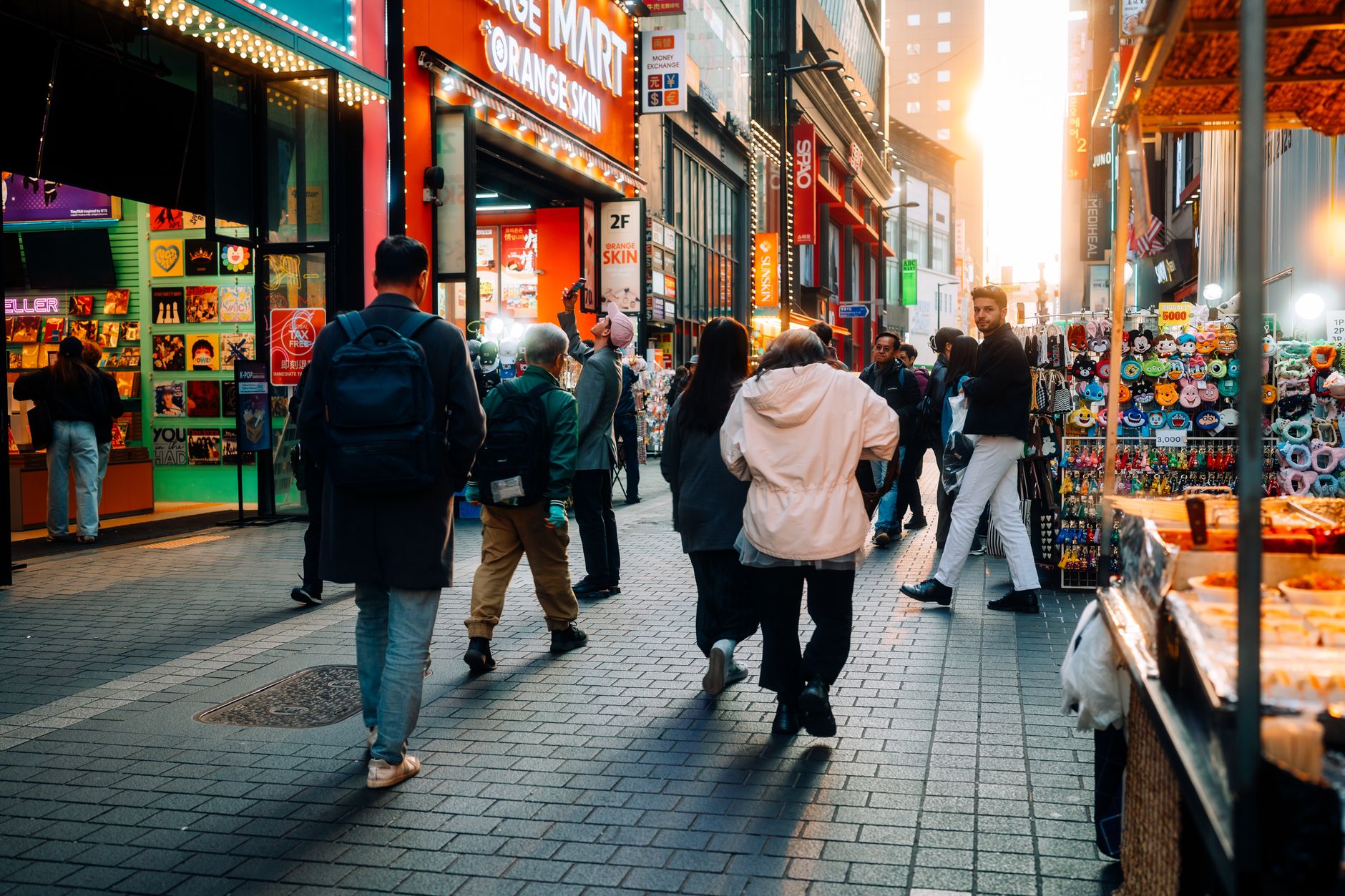
The elevator at Myeongdong Station opens onto a corridor that smells like fried chicken and old vinyl. This is not the Myeongdong that appears in travel guides. Above ground, it’s neon-bright, face-mask-toting, constantly being photographed by phone cameras held at precisely the right angle. The Myeongdong below ground—the one connected to the subway system—has different instincts. It hums. It doesn’t advertise. And it is where the K-pop merchandise that serious collectors actually care about lives.
I found the first stall by accident, which is how most worthwhile discoveries happen in this part of Seoul. Mid-afternoon on a Tuesday, I had taken the wrong exit out of habit and ended up in the underground shopping arcade that connects Myeongdong Station to Euljiro. The arcade itself isn’t special—fluorescent lighting, tiled floors worn smooth by decades of foot traffic, the occasional waft of exhaust from a delivery bike that has somehow made its way down the stairs. But there, wedged between a shop selling phone cases and a stall that seemed to sell only keychains shaped like cartoon characters, was a small plastic table covered in photocards.
Not the official ones. Not the ones that come packaged with albums, sealed in foil, designed to be traded on Instagram. These were different. The paper was slightly thicker, the colors marginally off, the edges cut by hand rather than machine. I picked one up—a promotional photocard for a BTS fanmeeting that had taken place in 2017, featuring a member in a jacket that I recognized from a single blurry fancam. The stall owner, a woman in her fifties with glasses that magnified her eyes to twice their normal size, watched me turn it over. “Limited,” she said in English. “Only for fanclub members.” She named a price that made me put the card back down immediately, then smiled as if she had expected exactly that reaction.
The underground market operates on a specific kind of scarcity. The merchandise here was never intended for sale. It was given out at events, mailed to official fanclub members, pressed in small batches for sponsorship deals that lasted exactly one promotion cycle. The people who sell it are not part of any official distribution network. They are fans who bought extras, former staff who pocketed a handful, or—in the case of one stall I visited later—a retired couple whose daughter had worked at a broadcasting station and brought home boxes of promotional materials that no one had asked for.
The underground arcade at Myeongdong Station runs for about 600 meters, branching into smaller corridors that lead toward exits numbered in the teens. Most tourists pass through it on their way to the surface, heads down, looking at phone screens, missing everything. The stalls that sell K-pop merchandise are not clustered together. They are scattered, interleaved with shops selling socks, luggage, and roasted chestnuts. I learned to recognize them by their lighting. The official K-pop stores above ground use bright white LEDs that make every album cover look like it’s been polished. The underground stalls use warmer bulbs, sometimes yellow, sometimes the flickering fluorescent of a ceiling fixture that hasn’t been replaced since the 1990s. Under warm light, the metallic sheen on a limited-edition photocard looks different. The holographic elements catch the glow in ways that make fakes easier to spot.
Fakes are a real problem in this market. A stall near Exit 6 had a display of what appeared to be photocards from the 2018 BTS Love Yourself era, including several that I knew for a fact had never been officially released in photocard form. The seller, a young man wearing a baseball cap pulled low, was asking about fifteen US dollars each. The real ones, the ones that were actually issued, go for ten times that. I did not confront him. Nobody in this market confronts anyone. The understanding is unwritten but clear: buyer beware, and the buyer who does not know the difference deserves to learn it through their wallet.
The way to tell a real limited-edition photocard from a fake is not what most people think. It is not the weight of the paper or the sharpness of the print. It is the texture of the back. Official photocards from South Korean entertainment companies all use a specific type of cardstock that has a slightly rough finish, like uncoated paper. Fakes tend to be smooth, almost glossy, because the counterfeiters are printing on standard photo paper that feels different to the touch. A woman at a stall near Exit 9, who introduced herself only as “the one who deals with Blackpink stuff,” showed me the difference without being asked. She handed me a real Jennie photocard and a fake one, both face-down. My thumb knew the difference immediately. “Fans who buy online,” she said, “they cannot feel. They look at pictures. Pictures can lie.”
The market has its own geography of specialization. The stall near Exit 3, run by an older man who seemed perpetually bored, focused exclusively on second-generation groups—Girls’ Generation, SHINee, Super Junior, 2NE1. He had a binder full of SHINee photocards from the 2010-2012 period, including one from the Sherlock era that I had not seen in person before. The asking price for that single card was about ninety dollars, and he did not negotiate. “This one,” he said, pointing at the card without touching it, “only 3,000 were made. For the Japanese fanmeeting.” I asked how he had acquired it. He shrugged. The gesture said everything: that information was not for sale.
The stall that sold SM Entertainment merchandise was run by two women in their twenties who had clearly organized their inventory with the precision of a library catalog. Everything was in plastic sleeves, sorted by group, then by era, then by member. They had a separate binder for EXO, another for NCT, a third for Red Velvet. When I asked about a specific SEULGI photocard from the 2022 “28 Reasons” promotion—one that had been given out only at a single music show recording—one of them pulled out a small notebook and flipped through it. “We had one last week,” she said. “Sold in three hours. If you want, I can message you when we get another.” She meant it. I gave her my KakaoTalk ID, and three weeks later, she sent me a photo of a card that I bought within five minutes of receiving the message. The price was around eighty dollars. I did not hesitate.
The transaction happened while I was in a different country. That is the nature of this market. It is not bound by geography. The underground stalls in Myeongdong are one node in a network that connects collectors in Seoul, Tokyo, Los Angeles, and Jakarta through KakaoTalk group chats, Instagram DMs, and the occasional WhatsApp message sent at 3 AM. I met a collector from Hong Kong who had flown to Seoul specifically to pick up a card he had arranged to buy through a KakaoTalk group. He was standing at the same stall I had visited, paying for a BTS J-HOPE photocard that had been released exclusively at a pop-up store in Busan. The seller, a woman who did not speak English, counted the cash twice before handing over the card in a protective sleeve. The collector slipped it into a binder he carried in his backpack, between pages of other cards that he showed me with the quiet pride of someone who knows exactly what they have.
Not every stall in the underground arcade is worth visiting. Some sell nothing but mass-produced posters and keychains. Others have clearly been stocked with leftovers from the official stores, priced at the same amounts you would pay above ground, with none of the discovery that makes the underground market interesting. The best stalls are the ones that look like they are barely hanging on—a folding table, a single light bulb, a cardboard box of photocards that the owner has not bothered to organize. Those are the stalls where the real finds happen, because the owners do not know what they have, or they do not care, or they have priced everything at a flat rate because the effort of researching each card’s market value is not enough time.
I found a photocard from a 2016 BTS fanmeeting in one of those boxes, priced at about five dollars. The card was loose, unprotected, sitting between a keychain and a pack of gum. I bought it without hesitation, partly because I knew what it was worth and partly because the indifference of its presentation felt like a small act of preservation. In a market where everything is cataloged, photographed, and traded at market rates, a photocard sitting in a cardboard box at a price that had not been updated since 2016 felt like a glimpse of the market before it became what it is now—before the prices went up, before the fakes proliferated, before every transaction required a reference check and a reputation score.
The underground market in Myeongdong is not for everyone. It rewards patience, a willingness to ask questions in broken Korean, and the ability to spend an hour looking through binders of photocards without buying anything. The people who run the stalls are not salespeople in any conventional sense. They are custodians of a collection that happens to be for sale. Some of them will talk to you for ten minutes about the history of a single photocard—where it was distributed, how many were made, which fanmeeting it was from—and then refuse to sell it at any price. Others will sell you something rare without knowing what it is, and you will walk away feeling like you have gotten away with something, which you have.
I spent four days in that underground arcade, going back at different hours to see how the market shifted. Late afternoon was the busiest, with local students stopping by after school. Evening was quieter, the older owners packing up early, the younger ones scrolling through phones until the last customer left. The light changed too. The fluorescent tubes buzzed louder after dark. The warm bulbs in the better stalls cast long shadows across the tiled floor. The smells changed—fried chicken in the afternoon, roasted chestnuts in the evening, the faint chemical smell of new plastic sleeves being opened.
On the last day, I went back to the stall with the woman in the magnifying glasses. She had a new batch of photocards out, arranged in rows on a piece of black felt. I recognized one immediately—a promotional card for a BTS concert in 2015, the year before they broke internationally, before the red carpets and the Billboard awards. The card showed all seven members, young, slightly awkward, wearing casual clothes. It was the kind of card that would not exist today, in the era of curated Instagram feeds and stylized concept photos. I asked the price. She looked at me, looked at the card, and named a number that was lower than I expected. I paid in cash, thanked her, and walked back toward the elevator that would take me up to the Myeongdong that everyone knows. The smell of fried chicken followed me all the way to street level.
📷 Photos: Mohammed Mehdaoui (Pexels), Theodore Nguyen (Pexels)