The first thing I noticed was the cold. Not the kind that bites, but the kind that seeps — damp and persistent, the way it does at altitude. I’d arrived the night before in darkness, following a narrow road that switchbacked through palm oil plantations before giving way to tea. The campervan’s diesel heater had coughed itself into silence somewhere around midnight, and by 5 AM the interior temperature had dropped enough that condensation was running down the inside of the windscreen in steady rivulets.
I’d imagined waking up differently. The fantasy, assembled from a dozen blog posts and an equal number of Instagram reels, involved golden light streaming through the sliding door, a steaming mug of coffee held in both hands, and the famous Cameron Highlands tea plantations unfurling below like a green velvet carpet. What I actually woke to was a wall of white so dense I couldn’t see the next row of tea bushes, let alone the valley. The temperature gauge on the dashboard read 14 degrees Celsius. My breath hung in the air.
The road up the night before had been its own kind of education. From the North-South Expressway near Tapah, the turnoff climbs roughly 50 kilometres, gaining about 1,500 metres in elevation. The last stretch, after Ringlet, is a series of blind corners with no guardrails and drainage ditches cut so deep they’d swallow a wheel. I’d crawled along in second gear, the campervan’s headlights picking out the reflective eyes of a tapir that stood motionless at the roadside for a long moment before disappearing into the dark. No one had mentioned that the road floods in the wet season. No one had mentioned that certain sections are single-lane with passing bays, and that Malaysian drivers treat those bays as suggestions rather than rules.
I’d chosen to park at a spot recommended in a Facebook group — a layby near the Boh Tea plantation’s main gate, described as “quiet, with a good view.” The view part was laughable in the fog, but quiet was accurate. At 5:30 AM the only sounds were the drip of condensation from the canopy and, somewhere below, a rooster that had apparently not received the memo about the altitude.
The fog didn’t lift by 6, nor by 7. I made coffee on the portable stove — a Jetboil I’d bought in Kuala Lumpur two days earlier, which I’d chosen mainly because it was small and cheap, and which I now realised was underpowered for this kind of elevation. The water took an age to boil. The coffee was lukewarm by the time I’d added the creamer. I sat in the driver’s seat, the door cracked open, watching nothing change.
At around 7:30, a Malaysian man in a Proton Saga pulled into the layby, got out, and stood at the edge of the road looking at the fog as if it had personally offended him. I asked him, in my halting Malay, whether the fog usually cleared. He shrugged. “Sometimes by eight-thirty. Sometimes it stays all day. Depends on the monsoon.” He gestured vaguely at the sky. “The tea doesn’t care. It grows anyway.” Then he got back in his car and drove off. I never caught his name.
That was one of the first real lessons: the Cameron Highlands weather doesn’t operate on a tourist schedule. The highlands sit at roughly 1,500 metres, right at the elevation where clouds form reliably, and during the monsoon transitions — late September to early November, and again from March to May — the fog can settle for days at a time. The tea plantations are working agricultural zones, not a curated viewing platform. The workers I saw later that morning, mostly women in wide-brimmed hats and long-sleeved shirts, were harvesting leaves in conditions that would send most photographers back to their hotel room. The harvesting baskets filled regardless.
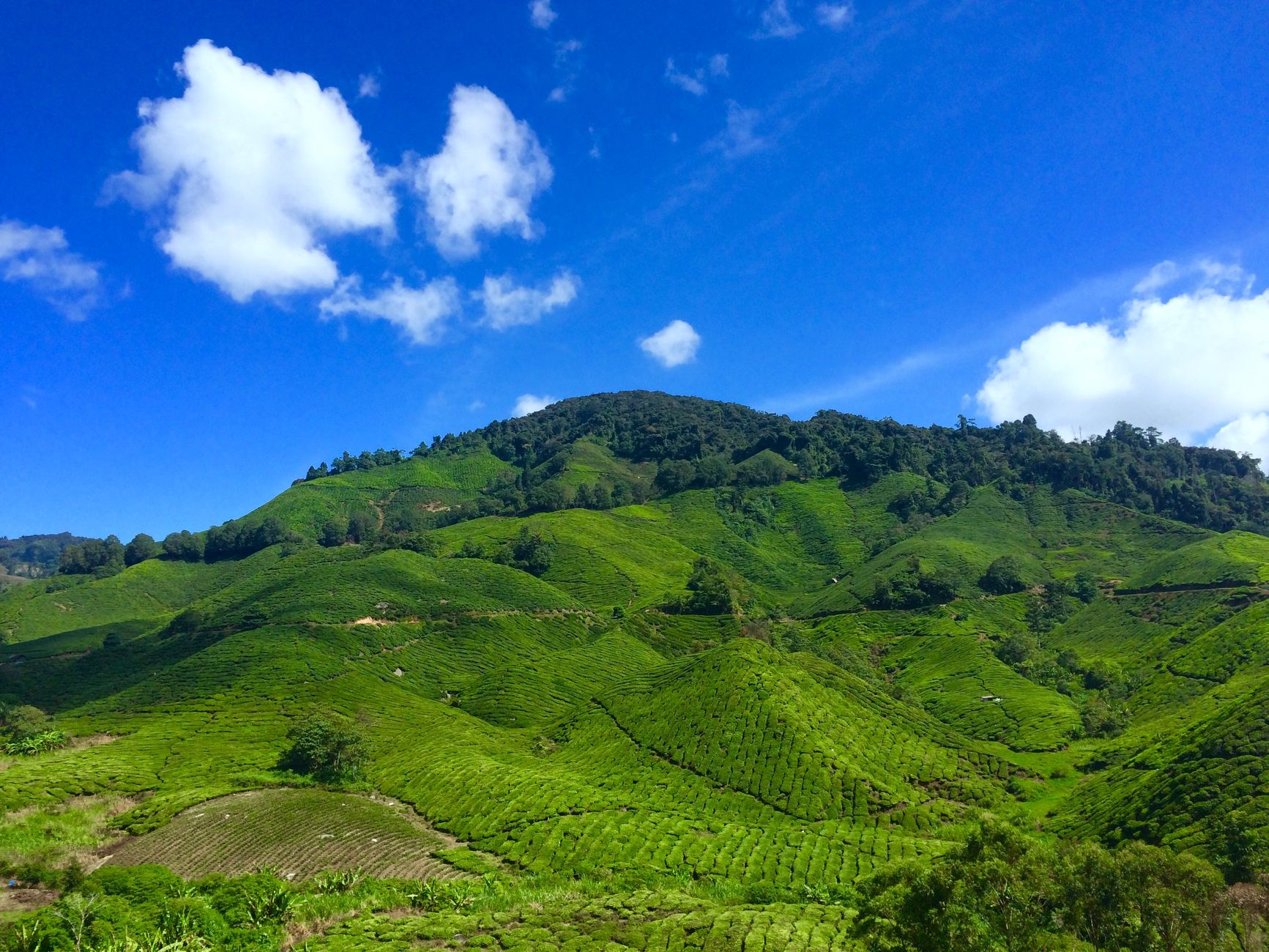
By 8:30, the fog had thinned to a mist, and I got my first real look at where I’d actually parked. The layby overlooked a valley that dropped steeply into terraced rows of tea — Camellia sinensis, specifically the Assamica variety. The bushes were a dark, glossy green, planted in perfect contour lines that followed the hillside’s natural curve. Between the rows, the reddish soil was visible, the colour of rust or dried blood. The mist moved in slow drifts through the valley, and for about twenty minutes I understood why people make the trip. Then the tour bus arrived.
It came up the road at 9:15, a white coach with tinted windows and a driver who clearly knew the corners better than I did. It disgorged about thirty tourists at the main gate, and within ten minutes the layby was full of selfie sticks and the sound of Mandarin. The quiet I’d been chasing evaporated as thoroughly as the fog had failed to.
The road to Boh’s main plantation is a bottleneck by 10 AM, and the car park fills before 11. The idea of an “undiscovered” Cameron Highlands died sometime in the late 1990s, but the marketing hasn’t caught up.
I moved the campervan further down the road, past the main plantation entrance, towards a smaller, lesser-known estate. The road narrowed to a gravel track, and I found a spot where the tea bushes came right up to the edge of the verge, with no fencing and no signage. I pulled over, cut the engine, and sat in the silence. A worker glanced at me from across the field, then went back to her harvesting.
There’s a particular smell to a working tea plantation at this elevation. It’s not the floral scent that tea has in the cup. The plants are harvested every few weeks during the growing season, and the cut ends of the stems release a sap that smells like cut grass left in the rain. I spent the next few hours walking the rows, stepping carefully between the bushes. The soil was soft and black from the constant moisture, and my boots sank in with each step. The workers moved in teams, each person responsible for a set of rows, the leaves filling their baskets at a pace that looked slow but was, I later learned, extraordinarily efficient. A skilled picker can harvest 30 to 40 kilograms of leaf per day. They’re paid by weight.
Around 11, the sun finally broke through properly, and the landscape transformed. The mist burned off in patches, revealing a series of valleys that had been invisible all morning. The tea plantations stretched in every direction, interrupted only by the occasional stand of pine trees — introduced during the British colonial period, incongruous against the tropical green. The light was harsh, the shadows short. I took a few photos, then put the camera down. The photos wouldn’t capture the sound: the constant rustle of leaves, the distant call of birds, the hum of insects. The photos wouldn’t capture the cold either. It never quite left the air.
I’d planned to stay two nights. I stayed one. The decision wasn’t about disappointment — the walk through the mossy forest at Gunung Brinchang the next morning was extraordinary, with trees covered in a thick layer of moss and ferns that felt prehistoric. The decision was about logistics. The campervan, which had seemed like a perfectly sensible idea in the planning stages, was proving to be a pain in the neck in practice. The narrow roads, the lack of designated parking, the cold at night, the condensation that soaked everything — my sleeping bag was damp, my clothes were damp, even the tea bags in the cupboard had absorbed enough moisture to clump together.
The facilities at the designated campsites were minimal. One site near Tanah Rata charged 25 ringgit per night (something like six bucks, I think) but offered only a single tap and a toilet that had been out of order since before I arrived. The owner, a cheerful Indian-Malaysian man who sold me a bag of fresh strawberries from a cooler, told me that most campervan users prefer the free spots on the roadside. “It’s the same view,” he said, “and nobody checks.” He was right about the view. He was wrong about the nobody checks part.
At 6 PM on my second evening, a uniformed officer from the local council knocked on the side of the van. He was polite, almost apologetic. “You can’t stay here overnight,” he said, shining a torch through the window. “This is a plantation access road. If the estate manager complains, I have to issue a fine.” I asked if there was anywhere nearby where overnight parking was permitted. He thought about it for a moment, then mentioned a plot near the Boh Tea factory where several vans had parked the night before. “It’s not officially allowed,” he said, “but no one will bother you there.”
I moved the van. The new spot was flatter, and the view was better — a direct line across the valley to a ridge of tea terraces that caught the last light of the day. But the proximity to the factory meant the hum of machinery was audible throughout the night, a low, constant drone that was just loud enough to keep me from sleeping deeply. I lay in the dark, listening to the factory work, wondering how many cups of tea were being processed from the leaves I’d watched being picked that morning.
I drove out the next morning at 7:30, the fog already beginning to settle back into the valleys. The road down was easier in daylight, the hazards visible. I passed the same tapir spot from the night before — nothing there but a faded warning sign about wildlife crossings. The Proton Saga I’d seen at the layby was still parked in the same spot, or perhaps a different one, and the man was leaning against the bonnet, drinking from a plastic cup. He raised the cup in my direction as I passed. I raised a hand in return.

📷 Photos: Pok Rie (Pexels), Abdelrahman Ismail (Unsplash)