I smelled it before I saw it — a block away, maybe two, carried on a breeze that had nothing to do with the weather and everything to do with what was happening at the far end of Jalan Prawirotaman. Fried tempeh has a particular weight to its aroma, not delicate, not shy, something that lands in the back of the throat before you’ve even decided whether you’re hungry. By the time I reached the mouth of the narrow alley that runs between the warungs and the batik shops, I had already made up my mind about dinner.
The alley itself is not on any of the standard tourist maps of Yogyakarta. I had heard about it from a student on a bus from Borobudur, reading a dog-eared novel and eating something wrapped in banana leaf. She pointed vaguely south when I asked where she’d bought it, said the place didn’t have a name, just a blue awning and a woman who starts frying at four in the afternoon and stops when the tempeh runs out, which is usually before nine. I wrote nothing down. I didn’t need to. The description was specific enough.
Finding it took two evenings. The first night I wandered too far east, into the stretch of Prawirotaman where the guesthouses give way to laundries and motorcycle repair shops. The air there smelled of grease and detergent, not frying soybeans. I ate a perfectly fine nasi goreng at a warung with a flickering fluorescent tube and walked back to my lodgings slightly disappointed, not because the food was bad but because I had built the alley up in my head as something it wasn’t yet proven to be.
The second night, I started earlier, just past three in the afternoon, and I let myself get lost on purpose. This is the only reliable method I know for finding anything in Yogyakarta’s older neighborhoods. The streets don’t follow a grid. They follow a logic of drainage, of old footpaths, of property lines drawn before anyone imagined cars. I took a left at a mosque that looked like it had been painted three different colors over its lifetime, then a right where a woman was selling fried bananas from a cart. The alley revealed itself not as a grand entrance but as a gap between two buildings, barely wide enough for two people to walk side by side. A blue awning, exactly as described, sagging slightly in the middle where rainwater had pooled at some point and never quite dried.
I bought tempeh from the woman under the awning — a small plate of it, maybe six or seven pieces, for 5,000 rupiah. She handed it to me on a piece of brown paper and did not smile, not because she was unfriendly but because smiling at customers was not part of her routine. She was focused on the oil temperature, on the timing of the flip, on the rhythm of a job she had been doing for long enough that it had become something closer to meditation than labor. The tempeh was cut thin, almost translucent at the edges, and it had been marinated in something that stained the batter a deep golden-brown. The crunch when I bit into it was not the brittle crunch of over-fried food but the clean snap of something cooked precisely to the point where the exterior gives way and the interior is still tender.
I ate standing up, leaning against a wall that had been painted white sometime in the previous decade and had since taken on the color of exhaust and cooking smoke. Other people came and went. A man on a scooter pulled up, killed the engine, and held up two fingers without dismounting. The woman wrapped two portions in paper and handed them to him. He handed her a crumpled bill, didn’t wait for change, and was gone. A group of teenage girls in school uniforms clustered around the awning, whispering and laughing, each buying a single piece and eating it right there, holding the paper away from their uniforms like they had done this a hundred times before. Nobody took photographs. Nobody seemed to register that what they were doing might be worth documenting.
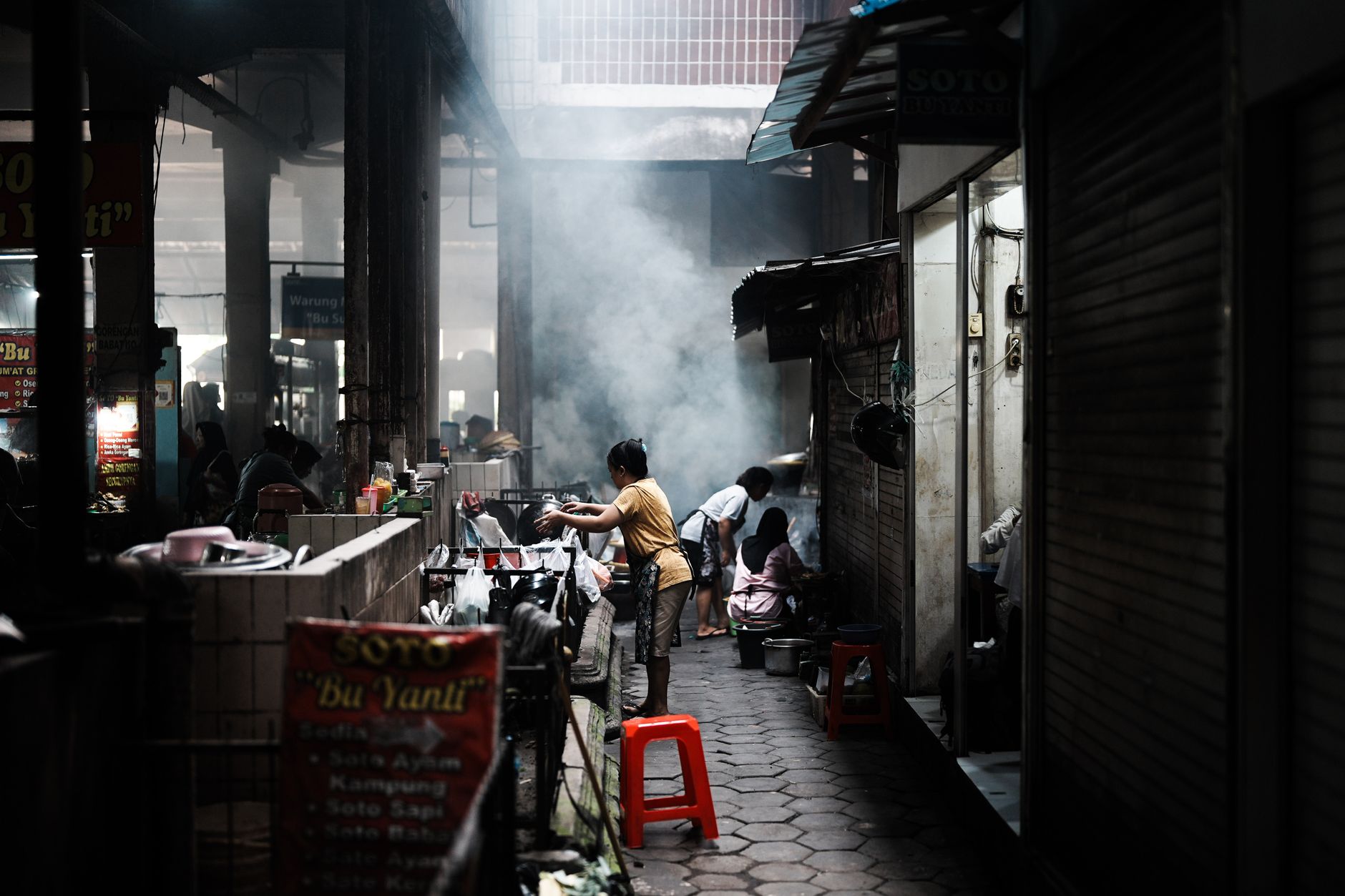
The alley runs maybe a hundred meters before opening onto a small courtyard where three food stalls operate on rotating schedules. By five in the afternoon, all three were lit by propane lamps, the kind that hiss softly and cast a warm light that makes everything look like it belongs in a different century. One stall sold sate, another sold gudeg — the sweet young jackfruit stew that Yogyakarta is known for — and the third sold nothing but variations on tempeh: fried whole, mashed into sambal, stuffed into small rolls of fried tofu. I sat on a plastic stool at the third stall and ordered a plate of tempeh bacem, which is braised in coconut water and palm sugar before being fried, giving it a sweetness that cuts against the savory. The woman running this stall was younger, maybe late twenties, and she spoke English with a confidence that suggested she had dealt with tourists before.
“You came to the right place,” she said, not as a boast but as a statement of fact. “The other stalls, they fry tempeh because they have to. Here, it’s the reason.”
I asked her how long she had been cooking. She said she started helping her mother at this same spot when she was twelve, took over the business four years ago, and had never seriously considered doing anything else. The tempeh came from a producer in Bantul, a district south of the city, delivered every morning by a man who had been supplying her mother’s family for decades. “He doesn’t have a phone,” she said. “He just arrives. If he doesn’t arrive, I know something is wrong — or maybe he’s just late.”
The braised tempeh was unlike anything I had eaten up to that point in Indonesia — not better, exactly, but different in a way that made me reassess what I thought the ingredient was capable of. The texture was firm but yielding, the sweetness of the palm sugar balanced by a hint of tamarind that lingered on the tongue after swallowing. I ate it with steamed rice and a small bowl of sambal that was hot enough to demand respect but not so hot that it erased the other flavors. The total cost for the meal, including a bottle of water and a small glass of sweet tea, was 18,000 rupiah — close to a dollar and a quarter, maybe a bit more.
By seven in the evening, the alley had transformed. What had been a trickle of customers became a steady stream. People arrived on foot, on scooters, in the back of becaks pedaled by men whose calves were as thick as my thighs. The air thickened with smoke from three different frying stations and the scent of kecap manis caramelizing on hot metal. I moved further into the alley, away from the tempeh stalls, curious about what else existed in this narrow corridor that I had nearly failed to find.
A man in his fifties was selling wedang jahe — ginger tea — from a cart fitted with a large brass kettle that steamed in the cooling air. I bought a cup for 3,000 rupiah and stood near his cart, watching the alley work. The ginger tea was sharp and sweet, the kind of drink that seems simple until you taste it and realize there is nothing simple about balancing three spices so that none dominates. He told me, unprompted, that he had been selling tea on this spot for twenty-two years and that the temperature of the water mattered more than the quality of the ginger. “Too hot, you burn the flavor,” he said. “Too cool, you don’t get it out. You have to know the moment.”
Around eight, a commotion near the entrance of the alley drew my attention. A scooter had stalled at the narrowest point, blocking traffic in both directions. The rider, a young man with a delivery bag strapped to the back of his seat, was trying to kick-start the engine while a line of other scooters waited behind him, none of them honking, which struck me as remarkable patience for any Indonesian street. A woman from one of the stalls walked over, said something I couldn’t hear, and handed him a cup of water. He drank it, tried the kick-start again, and the engine caught on the third try. He nodded once and drove off. The alley resumed its rhythm.
I spent three more nights in that alley over the course of a week, each visit slightly different. On the third night, a light rain began falling around six, and the stalls deployed tarpaulins that turned the alley into a tunnel. The rain hitting the tarpaulins created a drumming sound that made conversation difficult, so people ate in silence or shouted single words at the vendors. The tempeh took longer to cook that night because the humidity affected the oil temperature, and the woman under the blue awning looked tired in a way I hadn’t seen before. But she did not stop frying until the last piece was sold.
On the fifth night, I brought a notebook and tried to count how many portions of tempeh she sold in an hour. I gave up after twenty minutes because the pace was too irregular to track meaningfully. Some minutes she sold four. Other minutes she served nobody. It was not the kind of business that could be optimized or predicted. It was the kind of business that existed because the neighborhood needed it to exist, and because the woman under the awning had decided, years ago, that this was what she would do.
Toward the end of my time in Yogyakarta, I went back one last time, not for the food but for the feeling of being in a place that had not been designed for my consumption. The alley had no sign. The blue awning had no logo. The tempeh had no name beyond what it was. I ordered the same plate I had ordered on the first night, paid the same 5,000 rupiah, and ate it standing in the same spot, leaning against the same discolored wall. The woman did not recognize me, or if she did, she gave no indication. She handed me the paper, took the bill, and turned back to her oil. The alley smelled of frying and smoke and damp concrete and the faint sweetness of palm sugar drifting from the courtyard beyond.

📷 Photos: Daneswara Eka (Pexels), Noval Gani (Pexels)