
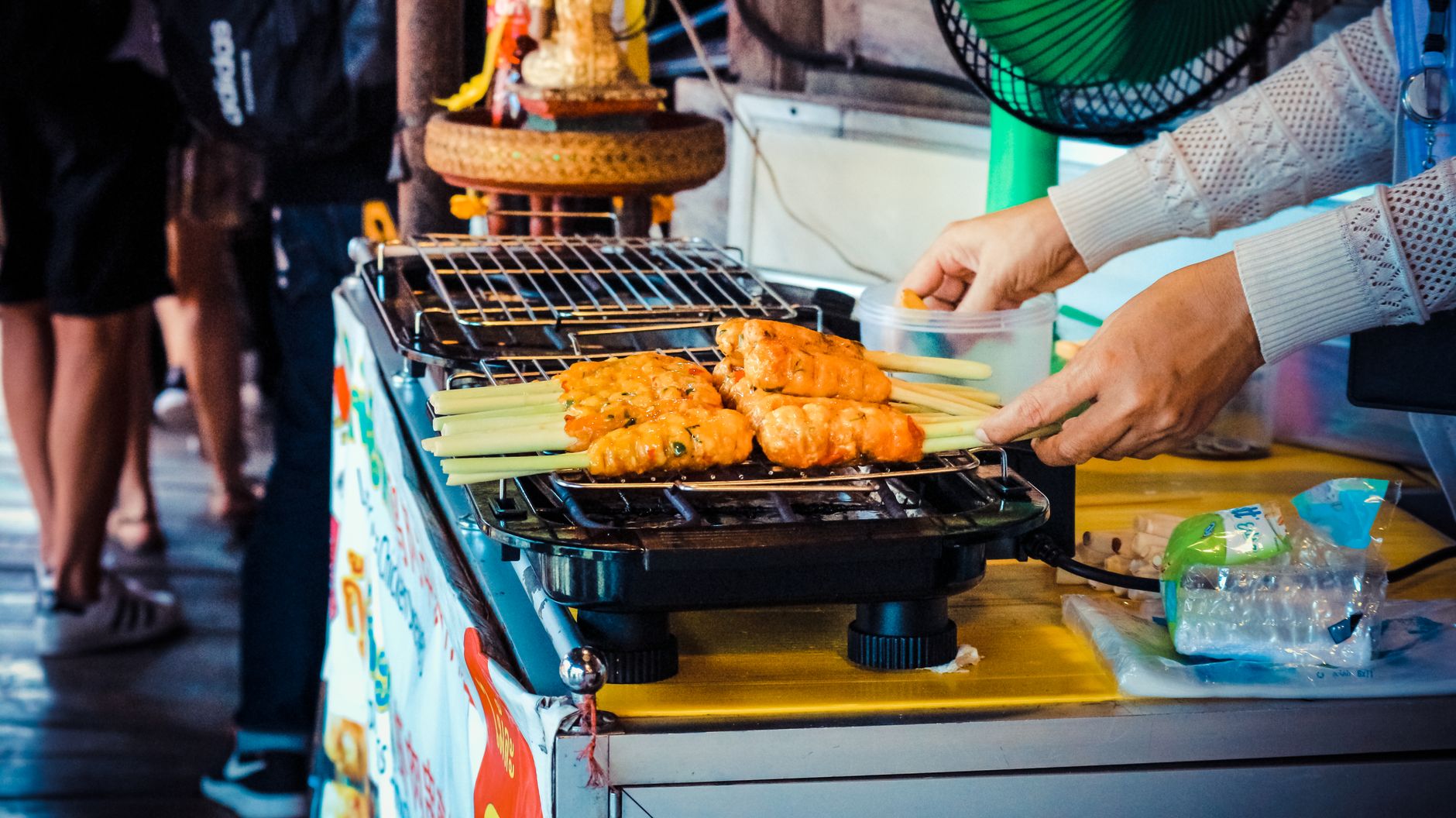
The consensus in my guidebook, repeated by people I trusted, was clear: Bali was for chicken satay and fish satay. The island’s version of the stuff — minced meat or seafood, grated coconut, and a reckless amount of spice, all packed tight onto a lemongrass stalk — was called lilit, and it was built around the flavors of the sea. Pork, the thinking went, was a mainland indulgence. The island was Hindu. It didn’t work like that. So I spent my first few days in Ubud eating chicken lilit that was fine, and fish lilit that was better, and I felt no reason to question the prevailing wisdom. I was wrong.
The stall didn’t even have a name that I could find. It was tucked into a small, irregular courtyard off a side lane behind the Ubud Market — a lane you’d walk past unless you were specifically looking for a place that served lilit in the afternoon, which was not a typical request. A hand-painted sign in Bahasa Indonesia said Sate Lilit Babi and then, in smaller letters, Khas Desa. Pork satay. Village-style. The written premise alone was a small act of defiance against every piece of advice I’d been given.
I sat on a low plastic stool that had been patched with tape, next to a small charcoal grill that was emitting a steady, low heat. The woman running the stall — I never got her name, though I saw her face every day for a week — worked with a kind of focused economy that I recognized from good cooks everywhere. She took a ball of pale pink mince, mixed with what looked like finely chopped shallots and a paste the color of dried brick, and wound it around a flat, broad lemongrass stalk. No skewer. The lemongrass was the skewer, and the flavor of it — sharp, citric, slightly medicinal — would cook right into the meat as the fat rendered.
She didn’t speak English, and my Bahasa Indonesia was limited to greetings and numbers. We communicated through pointing and the food itself. I pointed at the grill, held up one finger, and then sat down. She nodded once, as if this was the only sane thing a person could do at 3:20 on a Tuesday afternoon.
The first taste was a correction. The pork was not dry, which was the thing I had subconsciously braced for. It was impossibly moist, the fat from the mince having been sealed by the fierce heat of the coals into a kind of glaze. The texture was dense but not heavy, and the flavor was a long, slow burn — the sharpness of the lemongrass, the warmth of turmeric, the heavy punch of fresh chili, and underneath it all, the sweet, rich taste of pig that had been allowed to be itself. It was not subtle. It was not polite. It was a pork satay that tasted like it had a point to prove.
I ate three in a row. The woman watched me with the faintest smile, then refilled her basket of lemongrass stalks and started preparing another batch for the evening rush. A man on a scooter pulled up, killed the engine, and ordered ten. He ate them standing up, using his thumb and forefinger to pull the meat off the stalk in one clean motion, then handed the used lemongrass back to the woman who would wash and re-use them. Nothing was wasted. Everything about the transaction was the opposite of the tourist-facing set menus I’d been eating all week.
It raised a question I couldn’t shake: if the pork lilit here was this good, how many other assumptions about Balinese food had I accepted too quickly? The answer, I began to suspect, was most of them. The idea that pork wasn’t a central part of the island’s culinary identity was a convenient simplification for foreign palates. The reality, as I learned over the next several days, was more complicated. Hindu Bali might not slaughter pigs for religious sacrifice the way other parts of Indonesia do, but the island has a long, quiet tradition of babi guling — slow-roasted suckling pig — and the pork for lilit is usually from pigs raised for that same purpose. It’s not a contradiction. It’s a distinction.
The heat of that afternoon was oppressive. Ubud at that hour is a steam room in a green bowl — the humidity from the surrounding rice terraces settles into the town center and does not leave. The air smelled of burning charcoal, damp concrete, and the sweet floral offerings left on every doorstep. It was a smell I’d come to associate with the town, but from this spot, it smelled like dinner.
I made a habit of returning to that stall every afternoon for the rest of my trip. The pattern became part of the rhythm of the days: a long walk up to the Campuhan Ridge in the morning, a rest during the hottest part of the day, and then, around three, a slow walk down to the side lane behind the market. The woman would see me coming and would sometimes already have a stalk on the grill before I’d pointed. She had a name for me, too, but it was just a word — something like Bapak Satay, the Satay Man — and it made me laugh every time.
I asked around about the stall. A few other travelers had found it, mostly by accident. One couple from Melbourne told me they’d found it by following the smell of smoke and lemongrass from the main road. A Dutch backpacker said he’d been directed there by a local who worked at his homestay. “She said it was the only place in Ubud that made it the way her grandmother did,” he told me, shrugging. “I don’t know if that’s true, but it’s good.” That seemed like enough of a recommendation.
The stall became a compass point. Everything else in Ubud — the yoga studios, the art galleries, the cafe with the exposed brick and the $4.50 cold brew — seemed to float in orbit around that single charcoal grill. I stopped eating at the tourist-warung places with the laminated menus. I started eating on the street, from stainless-steel carts and kerbside buckets of sambal. The quality did not decrease. If anything, it went up. The lilit had recalibrated my expectations.
The real test came on my last night. I had heard about a famous babi guling restaurant in the village of Gianyar, about a 45-minute drive east. I had been saving it as a kind of grand finale. I hired a driver for the evening and made the trip — a winding road through dark, terraced hills, the lights of the villages flickering through the palm fronds. The restaurant was a large, open-sided hall filled with families and the smell of roasting pig skin. I ordered the mixed plate, the house special. The crackling was crisp. The meat was tender. The sambal was a deep, fermented red that stained the rice.
And it was good. It was very good. But it wasn’t the lilit. The babi guling was a celebration — a feast, a dish designed for a crowd. The lilit was something quieter, more personal. One person, one stalk, one charcoal fire. It didn’t need a stage. It just needed the right hands and the right hour of the day.
The evening after Gianyar, I went back to the stall one last time. The lane was quiet. The woman was packing up her gear, washing the used lemongrass stalks in a plastic basin. I pointed at the grill. She looked at the clock — a small, battery-powered thing with a cracked face — and shook her head. Then she paused, looked at me, and said something I didn’t understand. She picked up a stalk that was still whole, not yet wrapped, and placed it on the coals anyway. She didn’t charge me. She just nodded, finished packing her remaining ingredients into a cooler, and watched me eat as the last of the coals died to ash.
The meat on that final stalk was a little overdone. The lemongrass had been scorched in one spot and the flavor was slightly bitter, cut with a hint of smoke. It was the best thing I’d eaten in Bali.
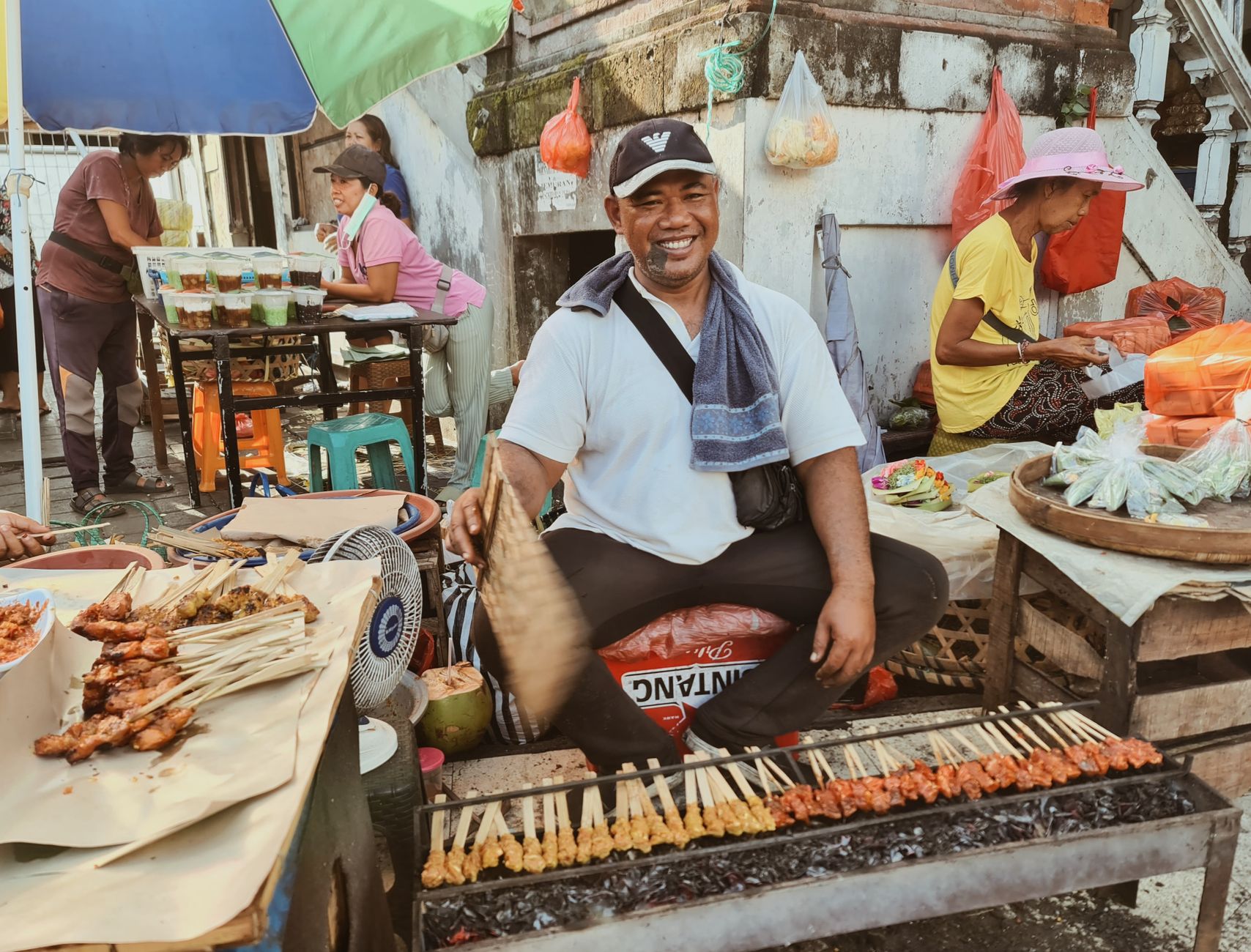
📷 Photos: Nam Phong Bùi (Pexels), G Y (Pexels)