The first sound we heard in the Cameron Highlands wasn’t the forest, or birdsong, or the diesel grumble of a descending bus. It was the van’s engine refusing to turn over at the Ringlet petrol station, two hours after leaving Ipoh, while a woman selling rambutans watched from a plastic stool with the particular patience of someone who has seen this exact scene before. We’d bought the vehicle from a listing in Kuala Lumpur — a 1998 Toyota Hiace with a mattress in the back, a camping stove, and an odometer reading that nobody believed — and for the first hundred kilometres of the Genting Sempah climb, it had hummed along like it had been waiting its whole life for this road. Then, at the first uphill hairpin into the highlands proper, it coughed once, twice, and refused to give more.
The woman on the stool, whose name turned out to be Mei, didn’t get up. She just pointed toward a mechanic’s shack about fifty metres up the road — a corrugated-roof structure with three used tyres leaning against its wall and a handwritten sign that read “Kereta” in faded marker. The mechanic, an older Malay man named Mr Aziz, took one look under the bonnet and said something that took us a moment to parse: “The fuel filter is a liar.” We didn’t know what that meant until he pulled it out, tapped it against a concrete block, and a stream of dark sediment the colour of old engine oil poured out onto the ground. “Your tank was full of this from the start,” he said, wiping his hands on a rag that had long since stopped being white. “The last owner probably let it sit for months. Drives fine on flat ground, but put a hill in front of it and the filter tells the engine there’s no fuel. It’s not the van’s fault.”
The repair cost us forty ringgit and ninety minutes. Mei, who had been selling rambutans at the same spot for twelve years according to Mr Aziz, offered us a bag of them as we were leaving. “Eat them now,” she said, in English that was halting but precise. “Not good for tomorrow. Too hot.” We ate most of them standing beside the van, sweet pink flesh giving way to the seeds, while the air began to cool noticeably — that first shift from lowland humidity to highland chill that marks the real arrival in the Cameron Highlands, even if you’re still only at the edge of them. The rambutans were the best we’d have on the whole trip, and we never saw Mei again.
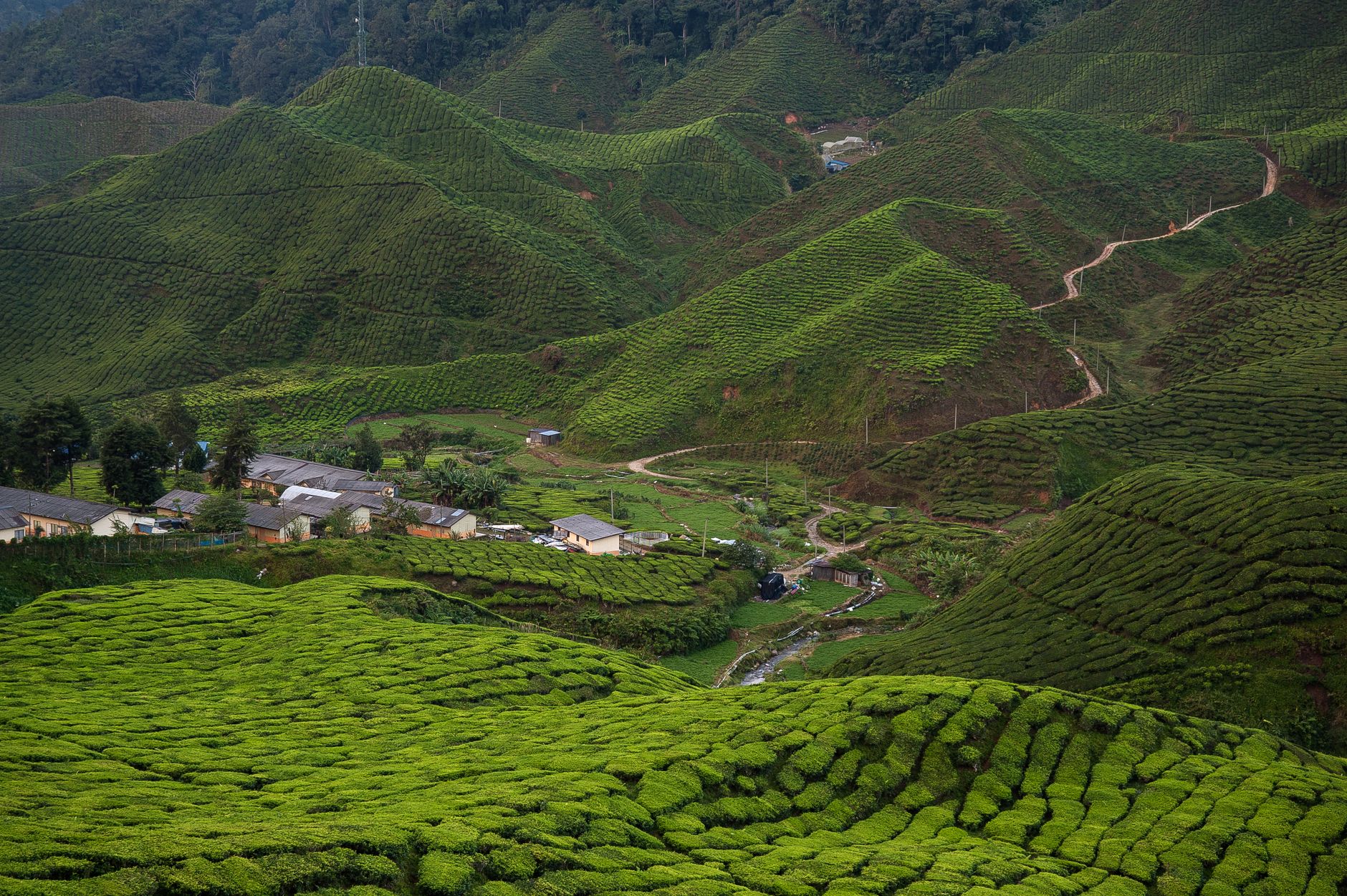
From Ringlet, the road tightens. Not in the sense of becoming narrower, though it does that too — the main route toward Tanah Rata is a constant negotiation between oncoming tour buses and the drainage ditches carved into the roadside. But the road tightens in the sense that the landscape closes in around you. The oil palms of the lowlands give way to something more layered and ambitious: first rubber trees, then bamboo groves, then the first sign of tea — a single row of bushes at the edge of a plantation, then another, then a whole hillside opening up in a way that photographs never seem to capture accurately. There’s a particular shade of green that tea bushes turn under highland cloud cover, and it’s not a colour found anywhere else — not exactly olive, not exactly chartreuse, but something between a de-saturated lime and the underbelly of a leaf that’s been rained on for three hours. The camera makes it look bright and photogenic. In person, it looks slightly wan, slightly tired, which is probably honest given the amount of rain these slopes get.
The night market in Tanah Rata doesn’t start properly until six, but by half past five the stalls are already being erected — metal poles going up, tarpaulins unrolled and tied down with practised speed. We parked the van at a public lot near the police station, a decision that turned out to be strategic only by accident. The lot is free after six, and from there it’s a two-minute walk to the market entrance through a corridor of steam rising from a cluster of mobile food carts that set up on the roadside every evening regardless of market hours. One of them, run by a young woman named Priya, sold nothing but cendol — shaved ice, green jelly noodles, coconut milk, and a pour of palm sugar syrup that was darker and more complex than anything we’d encountered in Penang. “I use Malacca sugar, not the local stuff,” she said, when we asked. “Local is too sweet. It kills the coconut.”
The market follows a pattern that repeats across the highlands but never feels quite the same twice. There are the sections that would be predictable anywhere in Malaysia: the counterfeit hiking sandals, the phone cases printed with tourist slogans, the women selling homemade curry puffs from metal tiffins. But there are also things that feel particular to this altitude. A stall selling nothing but strawberries in various stages of preservation — fresh, dried, turned into jam, dipped in chocolate, folded into crepes, suspended in jars of syrup. Another stall, run by a farmer in his fifties, selling something he called “tea honey” — not a flavoured honey, he insisted, but honey produced by bees that foraged exclusively on tea blossoms. We bought a jar for twenty-five ringgit and it tasted floral in a way that pushed past the word into something more specific, almost tannic, as if the honey had been steeped rather than gathered.
One detail that struck us, and that we wouldn’t have noticed if not for the rain: the market’s rhythm changes completely when the weather turns. The Cameron Highlands receive rain on most afternoons during the monsoon transition months, but it’s not the dramatic tropical downpour of Kuala Lumpur. It’s a fine, persistent drizzle that seems to hang in the air rather than fall from it — the kind of rain you can walk through for fifteen minutes before realising your jacket is wet through. When it comes, the market doesn’t shut down. Instead, the stallholders pull out an additional layer of clear plastic sheeting that drops down from the awning edges, creating a low-ceilinged tunnel that forces everyone to stoop slightly as they move through. The sound changes, too: the plastic muffles the ambient noise, so conversations become quieter, footsteps become louder, and the whole market takes on the acoustics of a greenhouse during a storm. We spent forty-five minutes in that tunnel, eating a bowl of laksa from a stall whose name we never caught, watching the fog roll down the hill past the market’s edge like a curtain being drawn across the scene.
The mossy forest trails are the reason most people come to the highlands, and they are also the part of the trip that resists description most stubbornly. We attempted the trail from the Robinson Waterfall parking area on the third morning, after a breakfast of roti canai from a shop in Brinchang that served it with a bowl of dhal that had clearly been simmering since before dawn. The trailhead is unmarked — a gap in the vegetation beside a concrete drainage ditch, where a single faded sign warns about slippery conditions in Bahasa and English. The trail itself, once you’re on it, is less a path than a negotiation with the root systems of trees that have been climbing over each other for centuries. The moss here isn’t the thin green film of temperate forests. It’s thick, covering every surface in a layer that looks like it has been applied deliberately — bark, rocks, fallen branches, even the occasional fencepost left by some forgotten survey line, all of it coated in that same deep green carpet that squeaks underfoot when the ground is wet, which it always is.
About an hour in, we met a man who appeared to be living in the forest. Not camping — living. His name was Felix, a German in his late sixties who had, according to his own account, been in the Cameron Highlands for “maybe ten years, somewhere around that” after a teaching contract in Jakarta ended and he simply never left. He was squatting beside a small stream with a collapsible stove and a metal cup, boiling water for coffee. “The secret to this trail,” he said, without looking up, “is that nobody knows it connects to the top. They all turn around at the waterfall. But if you keep going, you’ll come out near the tea factory on the other side. It takes four hours, but the last section is the best part — the moss gets so thick you can’t see the ground, just green. Like walking on a sponge.” He was right about the last part. We kept going, and the trail did indeed emerge near the Boh Tea plantation’s northern edge, and for the last hour of that walk, the forest floor was invisible beneath a layer of moss so deep that our boots sank slightly with every step, leaving impressions that held their shape for several seconds before slowly refilling.
The tea plantations themselves present a different kind of challenge: how to experience a place that has been so thoroughly photographed that you already know what it looks like before you arrive. The Boh Tea Estate at Sungai Palas is the most famous example — a hillside of perfectly ordered green rows, a factory that offers guided tours, a café that serves tea and scones to a constant stream of visitors. We arrived at midday, which is the wrong time to be there if you want solitude, but the right time if you want to watch the factory floor in operation. The rolling machines that press the leaves are loud enough to require raised voices, and the air inside is thick with the smell of drying tea — a slightly grassy, slightly smoky scent that clings to clothes for hours afterward. We stood at the viewing platform for twenty minutes, watching the leaves tumble through the machines.
We made a mistake on the fifth day, and it cost us an evening. We had read somewhere — a blog, a forum post, the usual unreliable sources — that the Cameron Highlands’ best night market was in Kampung Raja, on the northern edge of the highlands. So we drove an hour up the winding road from Tanah Rata, past the vegetable plots and the strawberry farms, past the sign for the district’s only roundabout, and arrived at a parking lot where three stalls were set up, one selling grilled corn, one selling counterfeit phone chargers, and one that appeared to be closed. The market, according to a man selling durian from the back of a pickup truck, had been moved two weeks prior to a different location that we had already passed without noticing. “It’s behind the school now,” he said. “But it finishes at eight, not nine. You missed it.” We stood in the parking lot for a minute, feeling the altitude chill settle in, then drove back to Tanah Rata and ate at a nasi kandar shop that was open until midnight and served a fish curry that was worth the wasted drive.
On the final morning, we drove up to the Gunung Brinchang lookout — the highest point in the highlands accessible by road. The drive is steep and narrow, and the last kilometre is a dirt track that the van handled with surprising grace after its fuel-filter betrayal earlier in the week. The lookout itself is a concrete platform at the top of a short staircase. The day was not clear. A thick layer of cloud sat below the peak, turning the view into a white sheet that felt more like being inside a cloud than on top of one. But the temperature at the top was twelve degrees, and the air smelled of wet moss and cold metal, and a group of Malaysian university students were taking selfies with a macaque that had clearly learned that posing for photos earned it scraps of biscuit. We stood there for ten minutes, long enough for the cold to seep through our jackets, then got back in the van and began the descent toward Ipoh, the engine humming at a steady pitch that sounded, for the first time all week, like it trusted us.

📷 Photos: Vincent Tan (Pexels), Pok Rie (Pexels)