It arrives in waves, not all at once.
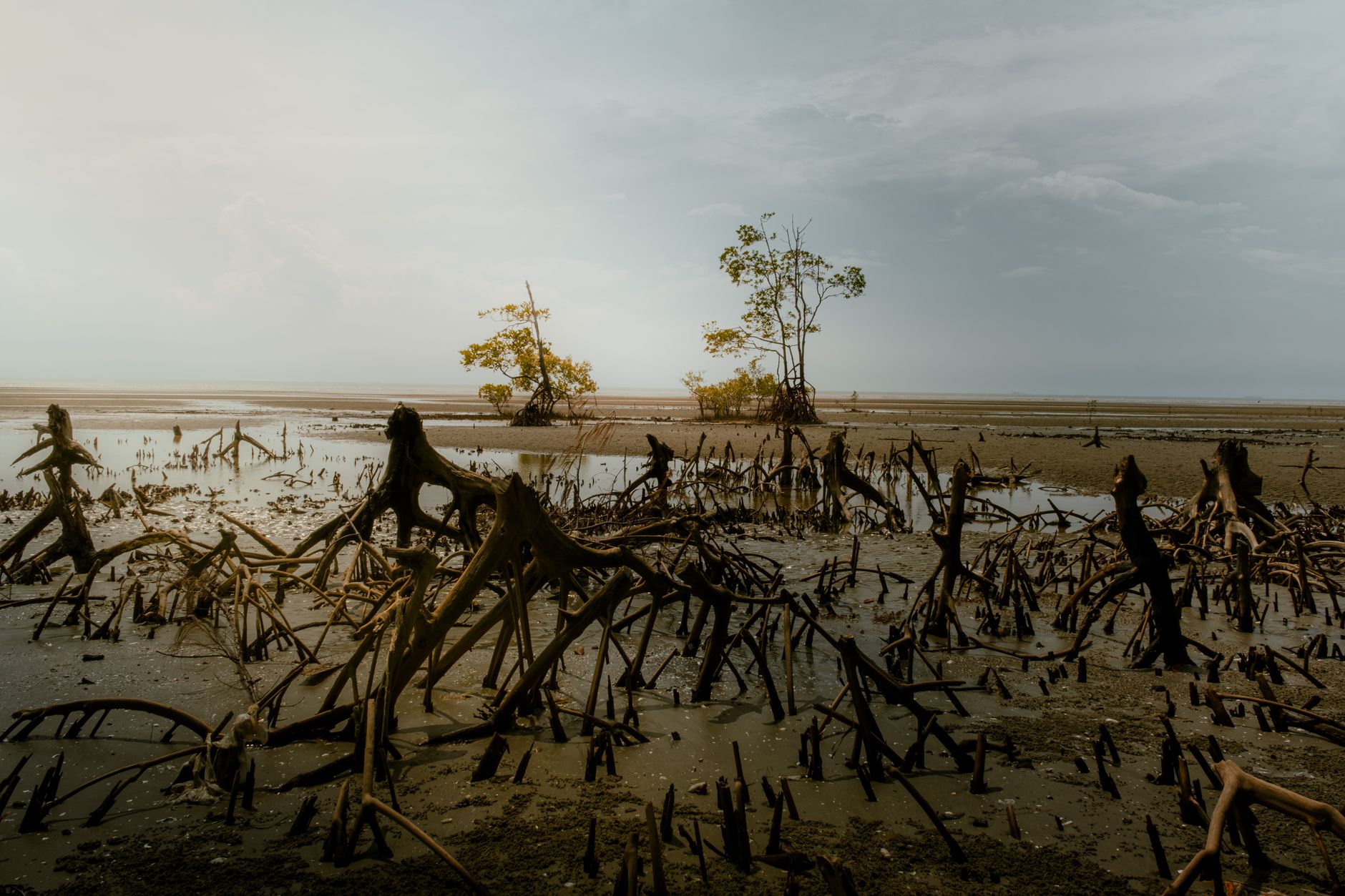
Not the fireflies—those come later, after the sky has finished its performance. What arrives first is the smell of the mangrove mud, a thick, living smell that hits about two hundred meters before the jetty comes into view. It is not unpleasant, exactly, but it is specific: wet earth, decomposing leaves, something faintly metallic that might be the tin mining that built this part of Perak a century ago. The locals who run the boat charters barely notice it anymore. For everyone else, it is the first real signal that this place operates on its own terms.
Kuala Sepetang is a small fishing town about an hour northwest of Ipoh, reachable by a road that narrows from highway to two-lane to something that requires negotiation with oncoming trucks carrying sacks of charcoal. The charcoal is made from the mangroves themselves—Rhizophora apiculata, mainly, harvested on a rotation that the Forestry Department tracks closely. The kilns line the riverbanks, low brick domes with smoke rising from their tops in the late afternoon, and the smell of burning wood mingles with the mud smell until neither can be separated. It is not a tourist town dressed up for visitors. It is a town that happens to have fireflies.
The boat operators gather near the main jetty around five in the evening, when the heat has started to ease. There are half a dozen of them, mostly retired fishermen who know the river the way most people know their own kitchens. No fixed schedule, no online booking system that matters—you show up, you negotiate, you go. The price for a one-hour evening trip, as of late last year, was fifty ringgit per person, cash only, and that included a life jacket that had seen better decades. A small plastic bottle of water came with it, warm from sitting in the boat all afternoon.
What makes the timing tricky is that the fireflies are not the only reason to be on the water. The light itself is the other reason, and it changes every few minutes in the hour before sunset.
The boat pushes off from the jetty around 6:15, when the sun is still high enough to turn the river into a sheet of hammered silver. The outboard motor coughs twice before catching, and then the town slides away behind, the noise of it replaced by the sound of water against a hull that has been repaired in three different colors of fiberglass. The guide—a man in his sixties who has been running these trips for seventeen years—points to a spot where an otter had been seen the week before, though there is nothing there now but a log that looks like a crocodile until it doesn’t.
The mangrove channels branch off the main river like veins. The boat turns into one of them, and immediately everything changes. The canopy closes overhead, filtering the light into a green that seems to come from everywhere at once. The air temperature drops by several degrees. The mud smell intensifies, and now there is a new element: the sharp, clean scent of the mangrove flowers, small and white, which bloom in clusters above the waterline. A bee, or something like a bee, hums past at eye level and disappears into the tangle.
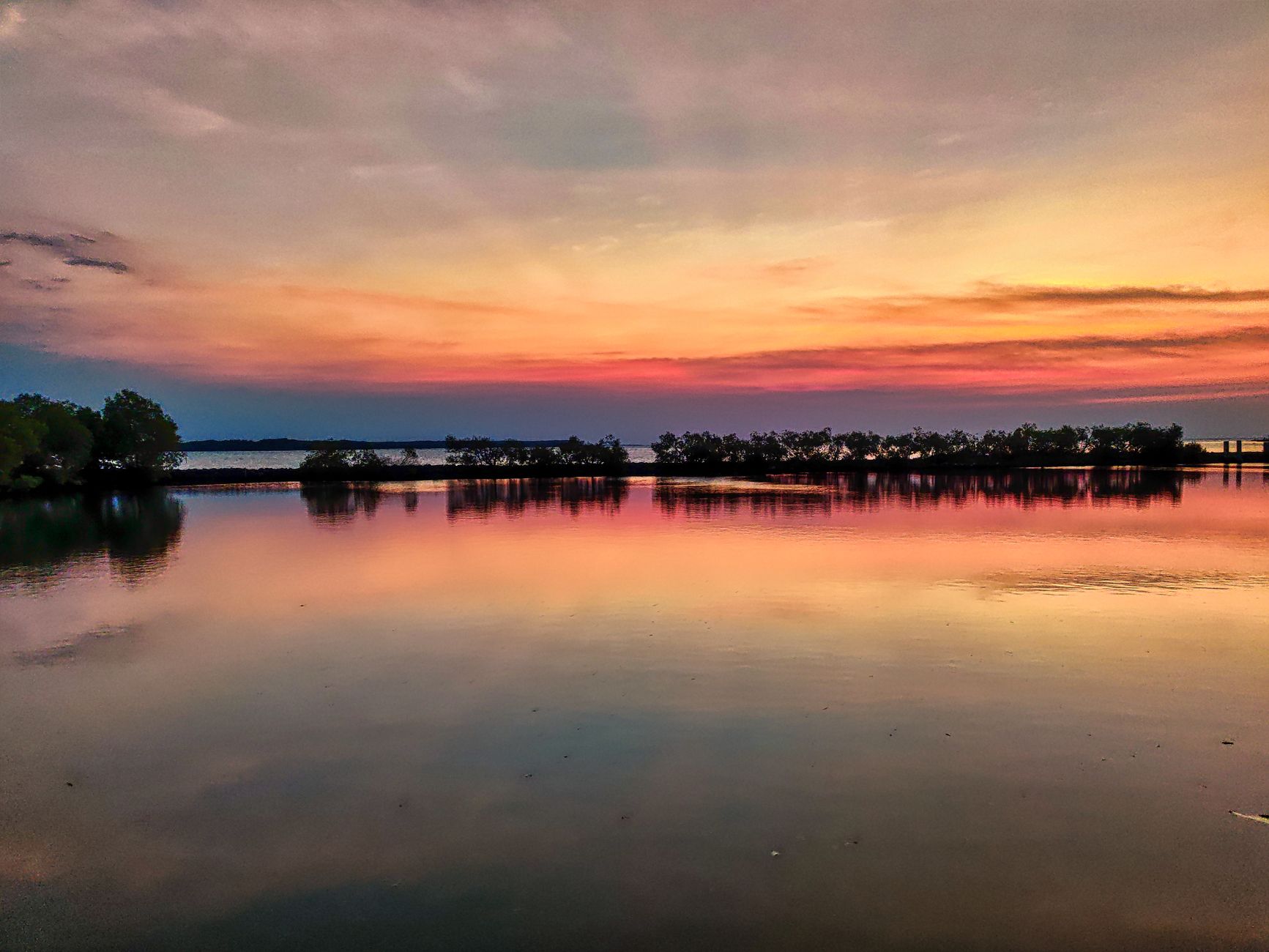
It is in these channels that the reflection photography happens, though it takes some patience to get it right. The water is dark and still enough to act as a mirror, but the boat’s wake takes a full minute to settle after the motor cuts. For that minute, the surface reads as nothing but ripples, and the mangroves on either side remain two separate things—the real ones above, their distorted doubles below. Then the water goes flat, and the reflection snaps into focus so cleanly that the line between the two becomes impossible to find. The green of the leaves against a sky that has started to turn orange dissolves into something that looks less like a photograph than a painting of a photograph. You have to be patient with it.
The guide cuts the engine at three different spots along the channel, each time letting the boat drift until the wake dies. He does not hurry. The other boats—there are maybe four or five on the river at this hour—respect a certain distance, and the only sound for long stretches is the creak of the boat and the high, thin whine of mosquitoes beginning their evening patrol. A kingfisher, electric blue, drops from a branch and comes up with nothing, then flies to a different perch twenty meters upriver.
A wildlife photographer from Penang who had been shooting in Malaysia for over a decade remarked on how early the fireflies started—not at full dark, but while there was still color in the sky. Around 7:15, with the sun fully below the horizon but the western sky still a gradient of purple to deep blue, the first ones began to appear. Not a swarm at first. A single blink, then another, then a third, spaced far enough apart that each one felt like an event. The photographer had been setting up for a long-exposure shot of the mangrove reflections and had not expected to need to switch settings so soon. The fireflies did not wait for full darkness.
They congregate on a specific species of mangrove, the Sonneratia caseolaris, whose leaves are broad and arranged in a way that makes them visible from the water. The fireflies gather on these trees and flash in a synchronized rhythm that researchers still do not fully understand. The leading theory involves chemical signaling and mate selection—males flash together to light up the collective brightness and attract females—but the exact mechanism remains debated. What is not debated is the visual effect: a single tree can hold hundreds of insects, all blinking on and off at the same moment, creating the impression that the tree itself is breathing light.
The guide maneuvers the boat to within a few meters of one of these trees and holds it steady with a paddle. The fireflies are close enough to touch, though no one tries. The flashes come in three-second intervals, a pulsing that feels like a heartbeat translated into light. The reflection in the water doubles the effect: the tree above, its mirror below, and both of them flickering in perfect unison. A camera on a tripod, set to a fifteen-second exposure at ISO 800, captures the scene as a series of overlapping green trails that look nothing like what the eye sees but somehow feel more truthful.
The channel opens into a wider stretch of river, and here the sky becomes the main event. The last light of Kuala Sepetang is not dramatic in the way of a tropical sunset—there are no billowing clouds turning blood red, no long golden beams. The sun sinks behind a low bank of haze, and the sky does what it does: shifts from orange to pink to purple to a deep, exhausted blue, and then it is night. The transition takes about twenty minutes. The fireflies, which had been tentative, become emphatic. They are everywhere now, scattered along both banks, in trees that line the river and in patches of scrub that grow between the mangroves and the charcoal kilns.
Not everything glows. Some of the fireflies are not actually fireflies—the mangrove channels also host a species of bioluminescent fungus gnat, whose larvae produce a steady, non-blinking green light on the mudflats. The effect is a subtle ground-level glow, like embers scattered across the bank, that the adults tend not to notice because they are looking up at the blinking trees. A local pointed it out once, and the guide has been doing the same ever since. It adds a layer to the scene that most visitors never see because nobody tells them to look down.
The boat turns back toward the jetty around 8:15. The channel is dark now, and the guide uses a small flashlight to navigate, its beam picking out the eyes of egrets roosting in the branches. The town lights appear as a dull orange glow ahead, and the sounds of civilization—a television, a motorbike, someone calling to someone else across the water—drift out to meet the boat. The trip is over; the effect takes longer to shake off than the ride itself.
Back on the jetty, the other boats are returning one by one. The operators compare notes in rapid Cantonese—how many trees were active, which channels had the best reflections, whether the tide was right. The tide matters more than most visitors realize. At low tide, the water is too shallow in some channels to navigate, and the exposed mudflats smell stronger. At high tide, the reflections are better because the water reaches farther into the mangrove roots. The optimal time is about an hour before high tide, which shifts by roughly forty minutes each day. The guide keeps a tide table taped to the inside of the boat’s storage compartment, next to a spare spark plug and a packet of salted fish crackers.
A small restaurant near the jetty, called Restoran Sepetang, serves a fish curry that is worth the detour even if the fireflies were not. The restaurant is open-air, with plastic tables and fluorescent lights that attract moths. The fish is ikan siakap—barramundi—caught that morning and cooked in a turmeric and coconut milk gravy that stains the rice yellow. The price, including rice and a fried egg and a glass of iced lemon tea, comes to twelve ringgit. The restaurant owner, a woman in her seventies who has been running the place for thirty-two years, brings the food out herself and checks that everyone has enough sambal before returning to the kitchen.
Back to Ipoh takes just over an hour, and the road is nearly empty. The charcoal kilns glow orange through the trees, their smoke visible as a faint haze in the headlights. A fox crosses the road near the turnoff to Taiping, pauses, and disappears into the palm oil plantation on the other side. The radio picks up a Chinese-language station playing old Cantopop, then loses it, then picks up a Malay station playing something slower. The night is warm and the windows are down and the smell of the mangrove mud has been replaced by the smell of fried fish on the driver’s shirt.
Whether any of this changes how a given trip gets planned is up to the traveler. But the fireflies start before it is fully dark, the mangrove reflections need a still boat and a patient guide, and the most important thing to bring is not a camera but the willingness to sit on a piece of fiberglass in the dark, watching a tree breathe light into the water below it.
📷 Photos: Ihsan Adityawarman (Pexels), Tom Fisk (Pexels)