The first thing I noticed about Ibu Fatmawati’s hands was that they were wet. Not damp from washing — wet from holding fish paste, the kind of wet that comes from standing over a bowl for three hours and letting the proteins bind themselves into something that feels like memory. She was eighty-three when I met her, living in a narrow house in Palembang’s 16 Ilir district, and she had been making pempek since before the Dutch left. Nobody had ever taught her in a formal way. She learned by watching her own grandmother’s wrists.
I had arrived in Palembang two days earlier, fresh off a bus from Lampung, with the vague idea that I wanted to understand pempek — the rubbery, savory fish cakes that are to South Sumatra what rendang is to Padang: a daily food and a point of pride. I knew the basic ingredients: tenggiri mackerel, sago flour, salt, water. What I didn’t know — what no YouTube video had ever shown me — was how the texture changes depending on whether you squeeze the fish paste by hand or let a machine do it.
Ibu Fatmawati’s kitchen was a concrete room at the back of the house, open to the alley on one side, where a neighbor’s cat sat watching with the patience of something that had seen ten thousand fish cakes come and go. There was no mixer, no food processor. There was a wooden mortar that looked older than I was and a stack of stainless steel bowls that had been burnished by decades of use. The smell was not fishy in the way I expected — it was cleaner, more mineral, like the air at a market just after the ice melts.
She began without explaining anything. That was the first lesson. Her hands reached for the bowl of fish paste automatically, and she began to work it the way a potter works clay — pressing, folding, pressing again. I watched for maybe ten minutes before I asked any question. When I finally did, she looked up as if surprised I was still there. “You want to try?” she said. The cat looked at me too, with a similar kind of skepticism.
The fish paste was cold when I stuck my hands in. Cold and dense, like something that had been resting in a riverbed. I squeezed. Nothing much happened. I squeezed harder, and the paste began to seep between my fingers, sticky and reluctant. Ibu Fatmawati watched without comment. Then she reached over, took a handful of the same paste, and worked it with a rhythm I couldn’t replicate — a sort of kneading that involved her palms and the heels of her hands, a slow, circular pressure that seemed to have no beginning and no end.
“Too much air,” she said, after a long pause. “You’re mixing air into it. Machine makes air. Hand makes it flat.” She demonstrated again, and this time I saw what she meant — her movements weren’t squeezing so much as pressing the air out, compacting the proteins into a mass that would hold together when dropped into boiling oil. She had been doing this since she was seven. The knowledge was in her wrists, not in her words.
I spent the rest of that morning working beside her, a small, awkward station on a production line that had been running smoothly for decades without my help. She would shape a batch of kapal selam — the egg-filled pempek that looks like a submarine — in the time it took me to form one lopsided lenjer. I asked how long the squeeze took. She shrugged. “Until it feels right.” There was a price for this kind of knowledge: I learned that day that my hands, which I thought were reasonably dextrous from slicing vegetables and typing, had no idea how to treat fish paste. The paste told them so, repeatedly, by refusing to hold its shape.
Somewhere around the fourth batch, the rain started. It came all at once, a tropical downpour that turned the alley into a running gutter and made the cat retreat inside. The sound on the corrugated roof was loud enough that we stopped trying to talk. It was just the two of us, hands in a bowl, the smell of raw fish and wet concrete, and the rain drowning out everything else. I remember thinking: this is the part of the lesson that doesn’t make it into the recipe.
It costs close to 15,000 rupiah — roughly a dollar — to buy a single piece of pempek from a street vendor in Palembang. That piece will be made from fish paste that was probably mixed and squeezed by machine, extruded into shape, and fried in bulk. It will taste fine. It will have the right texture, more or less. But standing in Ibu Fatmawati’s kitchen, I understood that there is a difference between “fine” and the thing her grandmother taught her. The difference is the squeeze, and the squeeze is not something you can write down. The squeeze is the thing your hands learn when they do the same motion for fifty years.
There is a particular sound that hand-squeezed fish paste makes when it has been worked enough. It is a soft, sucking sound, like a boot being pulled out of mud. I noticed it because Ibu Fatmawati’s hands made that sound repeatedly, as the paste collapsed into itself. Mine made no sound at all. My paste just sat there, inert, unresponsive, a pile of ingredients that hadn’t been persuaded to become a coherent whole. She glanced at my bowl. “Too wet,” she said, and added a handful of sago flour without measuring it. I would learn later that the ratio of flour to fish depends entirely on the fish itself — on how much water it held, on how fresh it was, on the humidity of that specific morning. This is not the kind of detail that appears on a package.
By early afternoon, the rain had stopped and the sun had returned with the wet heat that feels like breathing through a damp cloth. Ibu Fatmawati began frying the pempek she had shaped, dropping each one into a deep pan of oil that had been heating on a two-burner gas stove they’d had since the 1990s. The pempek hissed and bloated, turning from grey-white to a pale gold. She used no thermometer, no timer. She knew by the sound and the color. The ones I had shaped came out lumpy and uneven, cooked in patches where I had left the paste too thin. She ate one without complaint, then gave the rest to the cat.
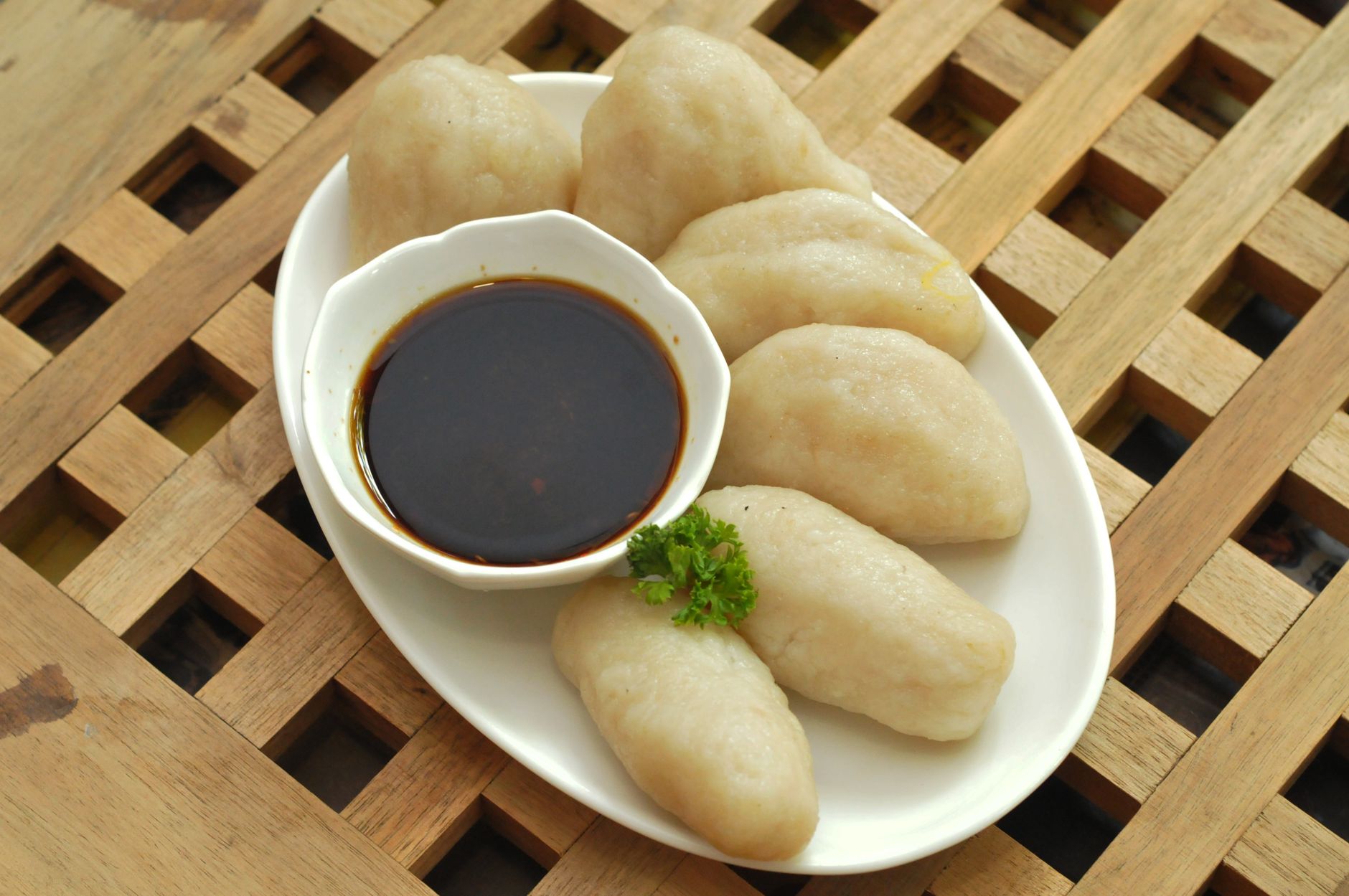
We ate the good ones with cuko — the dark, vinegary dipping sauce made from palm sugar, chili, garlic, and tamarind that is the pempek’s essential partner. Ibu Fatmawati’s version was sour first, then sweet, then hot in a way that didn’t announce itself until after you had swallowed. The pempek itself was springy, almost bouncy, with a clean fish taste that had nothing to do with the kind of fishiness that puts people off seafood. This was the taste of something that had been handled respectfully.
She told me that her grandmother, who had lived to ninety-seven, had refused to use anything but hand-squeezed paste her entire life. She said it like it was an obvious fact, like refusing to color your rice with artificial dye. In the generation after her own, machines had become common. Pempek could be made faster, cheaper, in greater quantities. It could be frozen and shipped to Jakarta, to Bali, to Singapore. But the texture changed. The air got into it. The pempek became something lighter, fluffier, less dense — and for the people who had grown up on the old kind, that lightness was a kind of loss.
I asked her what she thought would happen when she could no longer make pempek. This was not a question she seemed to find unusual. She pointed to a young woman who had appeared in the doorway — a granddaughter, maybe eighteen years old, who had come to pick up a container of pempek for a family dinner. “She learned last year,” Ibu Fatmawati said. “She still makes it too loose. But she will learn.” The granddaughter looked at me with the flat expression of someone being discussed while present, and said nothing. But she had come for the pempek. That was something.
There is no certification program for hand-squeezed fish paste. No government body that tests for authenticity. The difference between a good pempek and a great one exists entirely in the hands of the person who made it, and in the hands of the person eating it, who may or may not remember what a grandmother’s batch tasted like thirty years ago. What Ibu Fatmawati does in her concrete kitchen, with her old mortar and her instinctive ratios, is not a business model. It is not scalable. It is the opposite of scalable. It is one woman and a cat and a bowl of fish paste, making something that will be eaten within the hour.
The palm sugar for the cuko came from a market three blocks away, sold by a man who had been at the same spot since the 1980s. The price was 10,000 rupiah for a small block wrapped in banana leaf — about sixty cents. Ibu Fatmawati broke it with a hammer on a stone step. This is how the whole process works: everything is manual, everything is small-scale, everything depends on the specific judgment of one person. The electricity in the house flickered twice while I was there, and she didn’t even pause. She was working with older power.
I left in the late afternoon, carrying a container of pempek I had not made well, to eat later with rice and a boiled egg. The street outside was drying in the returning heat, steam rising from the asphalt. I walked past a shop that sold pempek from a machine, bright and uniform and perfectly round. It was 5,000 rupiah cheaper and probably 80 percent as good. But the 20 percent that was missing — that was the squeeze. That was the thing that could not be written down, the thing that lived in Ibu Fatmawati’s hands and her grandmother’s before that. I took a detour toward the river, eating a piece of my own clumsy pempek as I walked, and I thought about what it means to learn something that cannot be recorded. You do not learn it by taking notes. You learn it by standing in someone’s kitchen, watching their wrists for an entire morning, and going home with hands that still don’t know the rhythm.
📷 Photos: macarius draftStudio (Pexels), Quang Nguyen Vinh (Pexels)