The smell hit me before I saw the island. I was standing in the bow of a creaking wooden ferry at five in the morning, the KM Tatamailau having just cut its engines, and I was met by something that felt less like a scent and more like a solid object. Sharp, piney, almost medicinal, but with a sweetness underneath that made no sense until someone on deck said, “That’s the nutmeg.”
Bandaneira is the main port of the Banda Islands, a cluster of ten volcanic specks in eastern Indonesia that once controlled the world’s supply of nutmeg and mace. For centuries, that control was absolute. The Dutch East India Company fought wars, displaced populations, and committed what can only be called genocide to hold this archipelago. The nutmeg groves were guarded so fiercely that anyone caught smuggling seeds faced execution. The trees themselves were soaked in lime to prevent propagation. And all of it — every brutal policy, every fleet dispatched from Amsterdam, every treaty signed under duress — was for a spice that most people today encounter only as a fine dust shaken over eggnog or pumpkin pie.
The ferry had departed Ambon the previous evening, a twenty-four-hour crossing that was less a journey than a negotiation with discomfort. The lower deck was packed with cargo — sacks of cement, crates of instant noodles, plastic barrels of fuel — and passengers slept among it on ripped vinyl benches or on mats laid over the deck plating. A family near me had brought a live chicken in a woven basket. The chicken was quiet, which was more than could be said for the generator that hummed beneath the floorboards all night, filling the cabin with diesel fumes and a vibration that worked its way into the bones. Around two in the morning, a crew member walked through with a bucket of hot instant coffee and a stack of plastic cups, and the gesture felt generous out of all proportion to what it actually was.
Dawn revealed the islands slowly — not emerging from darkness but from a haze so thick it seemed solid. The water was the colour of bruised metal. And then the haze broke, and the green appeared. Not the green of postcards, but a deeper, denser green, the kind that suggests centuries of undisturbed growth. The hillsides of Bandaneira were covered in what looked like a single continuous canopy, unbroken by roads or clearings. The fort — Fort Belgica, a Dutch garrison built in the seventeenth century — sat on a low ridge above the harbour, its ochre walls fading into the vegetation.
I stepped off the ferry onto a concrete jetty that was already busy. A woman was selling fish from a blue plastic basin. Two men unloaded sacks of rice onto a handcart. A boy balanced a tray of fried bananas on his head. But what I noticed, what I couldn’t stop noticing, was the air. It was thick with the smell of nutmeg, but not in the way a kitchen smells of nutmeg — that warm, sweet, familiar domestic aroma. This was its raw, unwrapped state: sharp, resinous, with a bitterness that sat behind the sweetness like a warning.
The market in Bandaneira starts before the sun clears the treeline, and by seven in the morning it is essentially over. A man named Yusuf, whom I met on the ferry—he was returning from a visit to his daughter in Ambon, and he carried a plastic shopping bag containing three fresh nutmeg fruits wrapped in newspaper—had said, “You have to go early. By the time the sun is high, the best ones are gone — or something like that.” He unwrapped one to show me.
The fruit he held was nothing like what I expected. A nutmeg fruit, when fresh, looks like a large apricot — pale yellow, slightly fuzzy, split open at one end to reveal a dark brown seed wrapped in a lacy red web of mace. Yusuf snapped it open with his fingers and handed me the seed. I held it in my palm, still warm from the ferry cabin, and the oil from my fingertips had already released a scent so concentrated that I had to hold it away from my face. This was not a spice. This was something closer to perfume, or to medicine. It had depth and persistence. A single seed could scent an entire room.
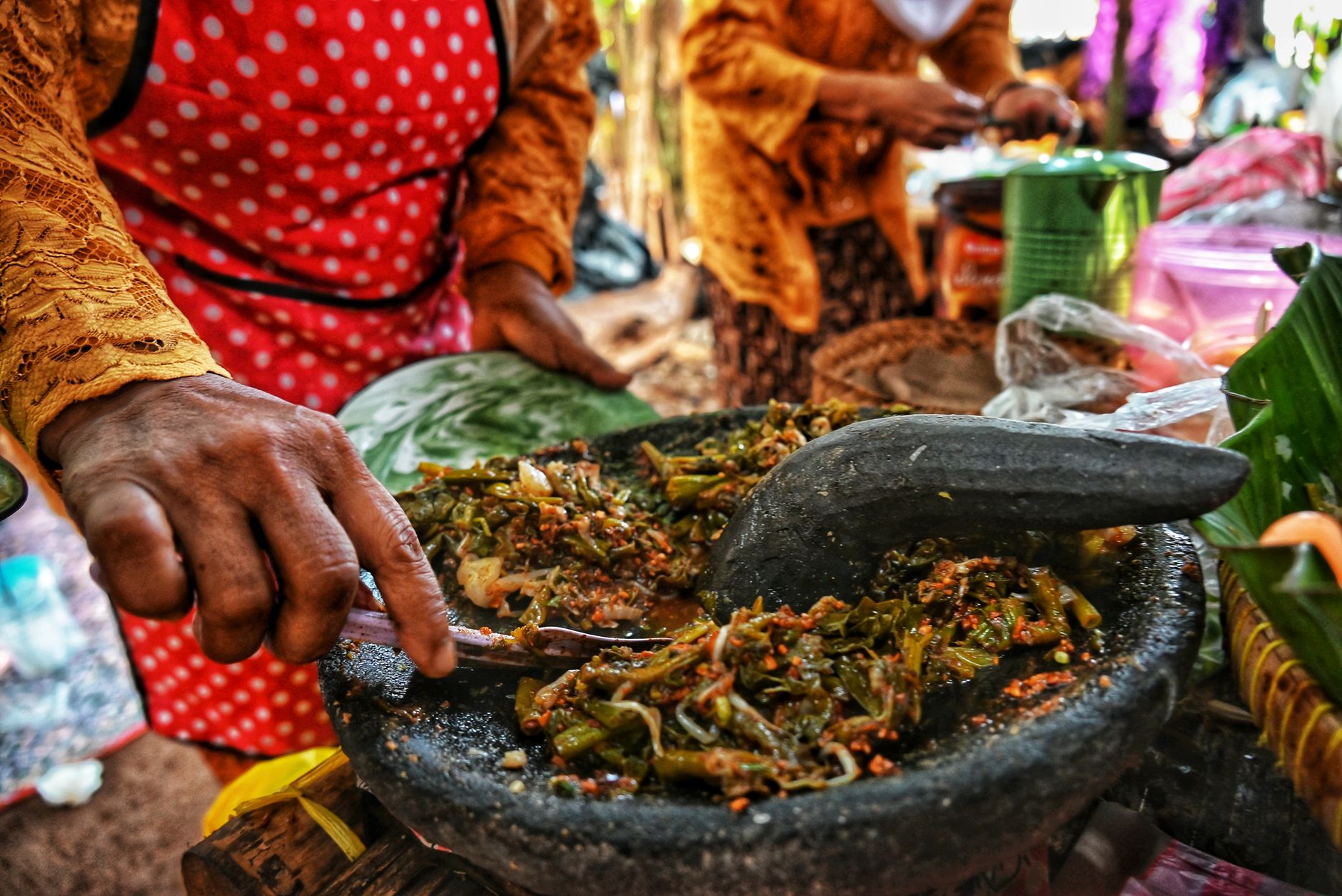
The market occupies a single narrow street behind the main square, a lane that runs between low concrete buildings painted in faded pastels — yellow, blue, a pink that had bleached to the colour of old coral. The sellers are mostly women, seated on low stools behind piles of produce that are arranged with a care that borders on ritual. Bunches of basil tied with banana leaf. Chillies stacked by heat level, the small red ones separate from the long green ones. Lemongrass, galangal, turmeric, ginger — the familiar architecture of Indonesian cooking — and then the nutmeg.
It was sold in several forms. Fresh fruits, still whole, their yellow skins slightly soft to the touch. Dried seeds, brown and wrinkled, sold by the piece or by the string, threaded through with coconut fibre. Mace, the scarlet aril that covers the seed, dried to a brittle orange-brown and sold in small bundles the size of a child’s fist. And nutmeg oil, bottled in recycled glass — medicine bottles, soy sauce bottles, their original labels still visible — sold by a woman who had a small portable scale on her lap and who weighed each bottle before setting a price.
I bought a fresh fruit, a string of dried seeds, and a small bottle of oil. The woman who sold them to me — her name was Ibu Renata, she told me later, after I had stumbled through enough Indonesian to ask — showed me how to test the freshness of a seed. She took one from my purchase, pressed her thumbnail into its flesh, and held it close to my nose. The oil that seeped out had a heat to it, a volatile intensity that burned the inside of my nostrils. She nodded, satisfied. “Minyak masih banyak,” she said. A lot of oil still.
The understanding I had come for did not arrive as a single revelation. It accumulated over the days that followed, in small moments that built into something larger.
The first was in a warung near the market, a simple place with a tin roof and a plywood counter, where I ordered a bowl of the local specialty: ikan kuah pala, fish cooked in a broth of coconut milk and nutmeg. I had expected the nutmeg to be a background note, a subtle warmth that you might taste if you searched for it. It was not. The broth was aggressively spiced, the nutmeg announcing itself in the first sip and persisting through every subsequent one. The fish — a mild white snapper — was almost incidental, a vehicle for the liquid around it. A squeeze of lime cut through the richness; a spoonful of sambal added heat. But the nutmeg was the point.
In Western cooking, nutmeg is used with restraint — a whisper of it in béchamel, a pinch in eggnog, a grating over spinach. The idea that it could dominate a dish, that it could be the loudest flavour on the table, had never occurred to me. But here it was, doing exactly that, and the dish was not subtle. It was direct, demanding, almost confrontational. It tasted like a historical argument being made in broth form: this is what we fought over. This is why.
The second moment came at a plantation outside the town, a grove of nutmeg trees that had been farmed by the same family for three generations. A man named Kofi, the grandson of the original planter, walked me through the grove one afternoon. The trees were tall, thirty metres or more, with dense canopies of dark green leaves. The fruit hung in clusters, each one a yellow sphere no bigger than a ping-pong ball. Kofi picked one, split it open, and showed me the seed inside, still white with the mace wrapped around it like a cage. “We harvest three times a year,” he said. “The tree gives for eighty years. Longer than a man lives.”
He told me the economics of it. A single tree could produce somewhere around five thousand fruits a year. Each fruit gave one seed and a wrapping of mace. The seed, once dried, lost about seventy percent of its weight. The mace, even more. What you sold was concentrated value — a handful of dried seeds representing the work of an entire tree over many months. “People outside don’t understand why this was worth fighting for,” Kofi said. “They think it was a small thing. But you can’t grow this in Europe. You can’t grow it anywhere else. So whoever controls these islands controls the only supply in the world.”
The Dutch understood that. The Banda Islands were the sole source of nutmeg for most of the seventeenth century, and the VOC’s monopoly was enforced with a violence that still echoes in the place names on the map — Fort Belgica, Fort Nassau, the mass graves that lie somewhere beneath the village roads. The original Bandanese population was reduced from an estimated fifteen thousand to under one thousand by the VOC’s campaigns of 1609 and 1621. The survivors were enslaved, exiled, or forced to work the plantations they had once owned. The Dutch brought in slave labour from other islands, and later from as far away as Africa and the Malay Peninsula. The nutmeg trees were planted over the bones of the people who had first cultivated them.
I walked through Kofi’s grove thinking about this, and the thought sat uncomfortably alongside the beauty of the place — the filtered light, the scent, the quiet. It is difficult to hold two things in your head at once: that a place can be beautiful, and that its beauty is inseparable from a history of atrocity. The nutmeg itself does not care. It grows the same way regardless.
The third moment came on my last morning, back at the market, this time at the hour when everything was shutting down. The sun was fully up, the heat had arrived, and the sellers were packing their unsold goods into plastic crates and baskets. Ibu Renata was among them, wrapping her remaining nutmeg in cloth to protect it from the sun. I bought another small bottle of oil from her — it was cheaper than the one I had bought two days earlier, because it was a smaller bottle and the glass had a crack in it — and she gave me a piece of advice.
“When you cook at home,” she said, in Indonesian, “don’t grind the nutmeg. Grate it fresh. And don’t put it in the food. Put it in the oil first. Let the oil take the flavour. Then use the oil.”
I have made ikan kuah pala at home, twice since returning. The first time, I followed a recipe from the internet and was disappointed — the flavour was thin and flat, the nutmeg barely registering. The second time, I did what Ibu Renata had said. I heated enough coconut oil in a pan, grated a whole nutmeg seed into it — the whole seed, which I had brought back from Bandaneira — and let it sizzle for a minute before adding the rest of the ingredients. The difference was not subtle. The oil turned amber, almost brown. The smell filled the kitchen, and for a moment, standing over the stove, I was back on that island, watching the haze lift off the water as the ferry pulled in.
The dried seeds I bought are still in my pantry, in a glass jar with a tight lid. Every time I open it, the smell releases, and it is the same smell that greeted me on the deck of the KM Tatamailau at five in the morning — sharp, piney, sweet, bitter. I use them sparingly, not because I’m afraid of wasting them, but because they are finite, and I know I cannot easily replace them. The tree that produced them is still there, on a hillside in the Banda Islands.

📷 Photos: nourrie zein (Pexels), nourrie zein (Pexels)