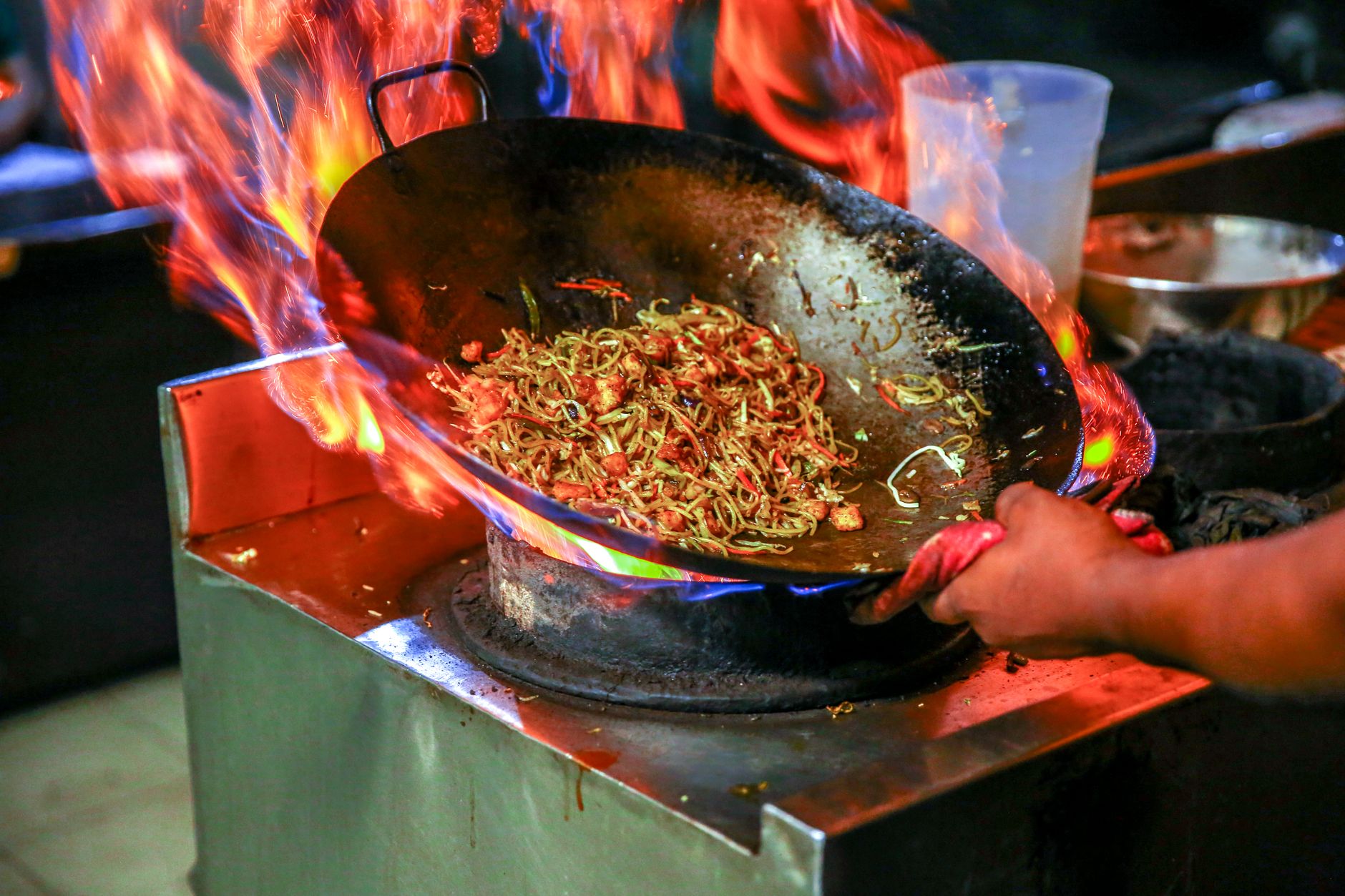
The first thing that hit me was the carbon. Not the wispy, romanticized wok hei you read about in food magazines, but a genuine, unapologetic blast of burnt oil particles that made my eyes water from six feet away. I was standing outside a coffee shop in George Town’s Pulau Tikus district at quarter past eleven on a Tuesday morning, and the man behind the wok — a wiry figure in a sweat-stained singlet who moved like he was conducting a small, furious orchestra — didn’t look up once during the entire five minutes it took to produce my plate. That was the moment I understood that everything I thought I knew about char kway teow was built on polite approximations.
The standard advice, the kind you find in every guidebook and food blog, tells you to look for the blackest wok and the hottest fire. This is true but useless, like saying the secret to a good photograph is good light. The real question is what the cook does with that fire — and more specifically, when they choose to pull the noodles out.
I went to Penang with a spreadsheet. Embarrassing to admit, but true. Over ten days I ate at forty different stalls, sometimes two or three in a sitting, and I logged each one by location, time of day, price, texture of the noodle, level of char, presence of cockles, and whether the cook smiled or scowled when I placed my order. The spreadsheet was a crutch, a way of pretending I was doing research rather than just eating compulsively. But it did reveal patterns that I wouldn’t have noticed otherwise.
The most obvious one was timing. I’d assumed that lunch would be peak quality — high turnover, fresh batches, the wok at its hottest. In practice, the best bowls I ate were all between 4 and 6 p.m., that strange twilight hour between lunch and dinner when the hawkers are cooking for themselves and a handful of regulars. The fire is still banked from the midday rush. The cook is tired, which paradoxically means they’re more likely to fall back on muscle memory than on performance. They’re not trying to impress anyone. The wok hei in those hours had a density, a heaviness on the tongue, that the lunchtime versions never matched.
At a stall in Air Itam, uphill from the famous laksa, I watched an older woman cook her char kway teow with a method I hadn’t seen anywhere else. She used two spatulas — thin, flexible metal ones — and she never stopped moving the noodles, not for a second. Most cooks let the noodles rest against the wok wall for a moment to build char. She didn’t. Hers came out paler than any I’d seen, almost beige, and I nearly walked away without ordering. But the regulars were queuing three deep, so I waited. The first bite tasted nothing like the dish I’d been chasing. There was no burnt edge, no smoke. Instead, the noodles had a silkiness I hadn’t encountered before, a kind of slippery, egg-enriched texture that made the usual versions feel coarse by comparison. The shrimp paste was subtle, almost shy. The whole thing was a counterargument to the cult of wok hei, and it was delicious.
That was the thing about the spreadsheet. It kept trying to rank everything on a single axis — more char equals better — and the data wouldn’t cooperate. The most aggressively wok-fried bowl I ate, a version so dark it looked almost black, came from a stall behind the Chowrasta Market that I found only because I got lost looking for a bookshop. The cook was a young man, maybe thirty, who had inherited the stall from his father and was trying to modernize it. He used a gas burner that roared like a jet engine and he added a splash of dark soy sauce at the very end, something I’d never seen before. The result was almost bitter, in a way that some people would call complex and others would call burnt. I ate half the plate and left the rest, unsure whether I’d found something extraordinary or simply broken.
A week later, I mentioned this to a retired chef I met at a kopitiam in Tanjung Bungah. He was eating his own breakfast, but he pushed his plate aside when he heard what I was doing and spent the next forty minutes explaining the physics of the wok. The gist, as far as I could follow it, was that wok hei is not a flavor you can add. It’s a byproduct of a specific chemical reaction — Maillard browning accelerated by extreme heat — and it only happens when the oil in the wok reaches a temperature above what most residential kitchens can produce. The best wok hei, he said, comes not from the fire but from the metal itself. A cheap, thin wok will scorch the noodles before it chars them. A good one, hammered thin and seasoned over years, distributes the heat evenly enough that the noodles can stay in contact with the metal without burning.
He was the one who told me to go to the stall in Sungai Dua, near the university, that only opens at night. I went at nine, and the queue was already twenty people long. The cook, a man named Chen who had been at the same spot for thirty-four years, worked with a wok that was visibly dented on one side, as if someone had taken a hammer to it. The dent, I later learned, was intentional — it created a small pool of oil that stayed hotter than the rest of the surface, a kind of hot zone that he could drag the noodles through for a split-second char before pulling them back to safety. The bowl he produced was the most balanced I ate on the entire trip. The char was present but not dominant. The noodles had structure, a slight chew, rather than the soft mush that passes for authenticity at most stalls. The cockles were plump and warm, not rubbery and cold. It cost four ringgit fifty.
I asked Chen, through a customer who translated, why he didn’t expand or open a second stall. He looked at me like I’d asked him why he didn’t learn to breathe underwater. The question was so far outside his framework of possibility that it didn’t even register as strange. He just shrugged and turned back to his wok.
The hardest thing to write about char kway teow is that the differences between a good bowl and a great one are almost invisible to photography. You can’t see the texture in a photo. You can’t smell the carbon, can’t feel the slight resistance of a properly cooked noodle against your teeth. This is why, I think, so much coverage of Penang hawker food defaults to the same handful of visual cues: the steam, the fire, the cook’s expression of concentration. These are real things, but they’re the least important things. The important things happen at the level of seconds and millimeters — how long the noodles stay in contact with the wok wall, how much pressure the cook applies with the spatula, whether the lard is rendered fresh or stored from yesterday.
I learned this the hard way at a stall in Gurney Drive that had been recommended by three separate people. The cook was fast, the fire was high, the presentation was beautiful. The noodles themselves were wet. Not saucy — wet, as if they hadn’t been drained properly before hitting the wok. The water bled into the soy sauce, made everything soggy and diluted. I ate three bites and pushed the plate away. The cook, seeing this, shrugged and turned to the next order. He knew he’d served a bad plate. He also knew that the next one, to someone who hadn’t just eaten thirty-three other versions, would probably taste fine.
That was the other thing the spreadsheet taught me. Palate fatigue is real, and it distorts your judgment in ways you don’t notice until you hit a threshold. Around bowl twenty-five, everything started tasting the same — not in a bad way, but in a flattening, gray way where the differences between stalls collapsed into a single note of soy and fat. I had to take a break, eat a completely unrelated meal, reset my tongue with something sour and cold. The next morning, I went back to the first stall I’d visited, the one in Pulau Tikus, and ordered again. It was worse than I remembered. Or better. I couldn’t tell anymore.
What I can tell you is that the best char kway teow on Penang is not the one you’ll find in any guidebook. It’s the one that’s cooked by someone who has been doing it long enough that they don’t have to think about it. The one where the wok has a history, where the oil has a temperature that’s been calibrated over thousands of repetitions, where the cockles are fresh because the cook buys them himself at the market each morning. I found this version, finally, on my last day, at a stall in a nondescript coffee shop in Butterworth, across the bridge from the island. I was there because my ferry was delayed and I had forty-five minutes to kill. The cook was an old woman who moved so slowly I thought she’d forgotten my order. She hadn’t. She was just old. The wok she used was nearly black with seasoning, and she cooked my noodles in a fat that smelled different — deeper, almost nutty. I asked what it was. She didn’t answer. I ate the bowl in six minutes, paid two ringgit, and caught my ferry. I have no way of finding her again.
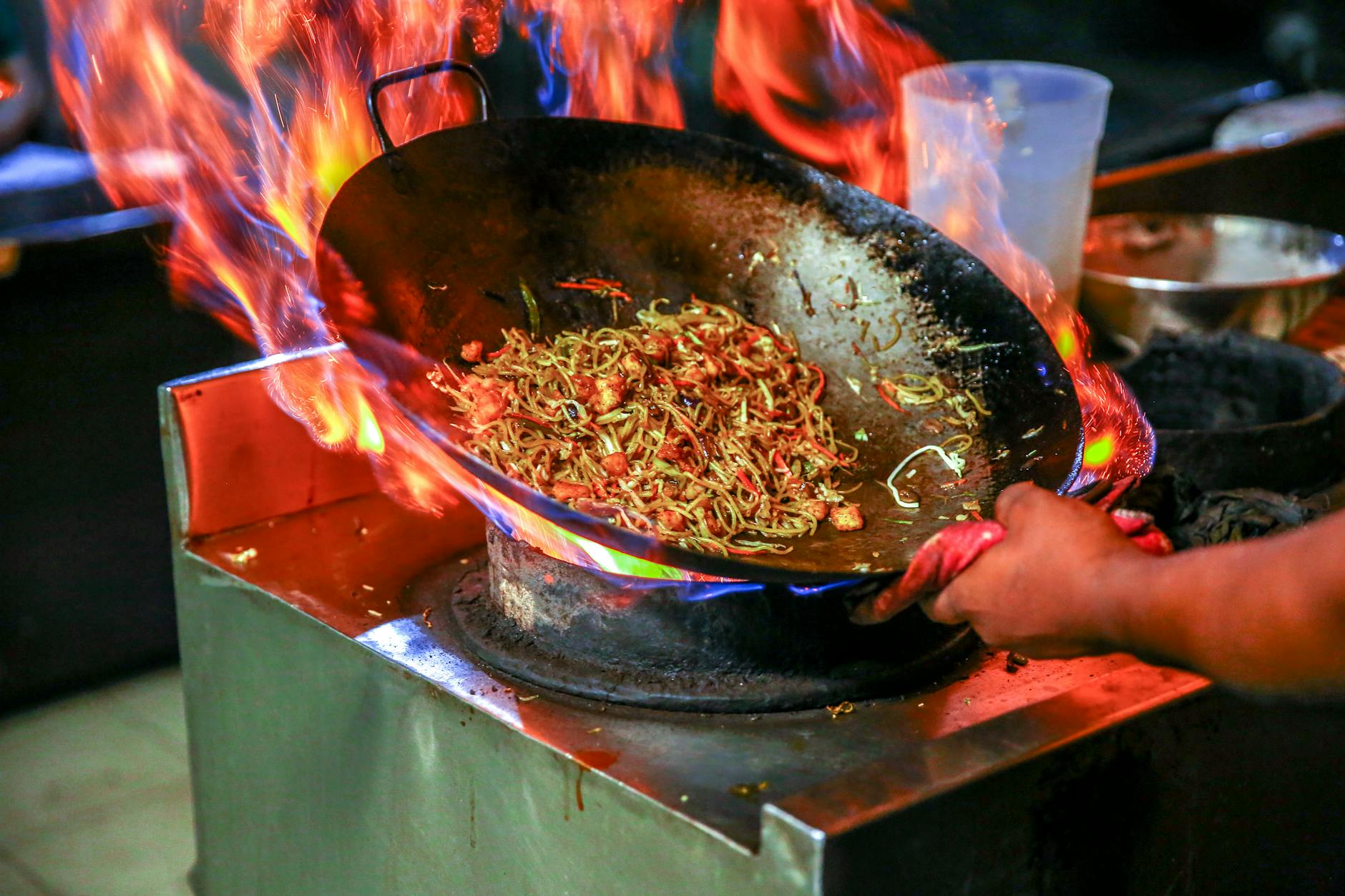
📷 Photos: Aesthos AR. Photography (Pexels), Aesthos AR. Photography (Pexels)