The heat hit us first, before we even got out of the car. It was late February, which in the Philippines means nothing in terms of relief—the dry season had already settled in hard, and the air coming off Manila Bay felt thick enough to drink. We were parked on a dirt access road in Bulacan, about an hour north of the capital, staring at a stretch of fishponds that looked like they’d been abandoned mid-century. Wooden posts leaned at odd angles. A nipa hut at the far end had lost half its roof. The water was the color of weak coffee.
This was where the last of the sugpo were supposed to be. Sugpo—the giant tiger prawn, Penaeus monodon—was once the backbone of Philippine aquaculture, a species so robust and fast-growing that it made small-scale fish farming viable across the entire archipelago. Manila Bay alone used to produce thousands of metric tons annually. That was before the diseases hit in the early 2000s, before the farms switched to whiteleg shrimp, before the bay itself started dying from pollution and reclamation. Now, the sugpo operations that remain are mostly small, family-run, and running out of time.
Our contact was a man named Rico, who’d been farming these ponds for thirty-two years. He met us at the roadside on a motorbike that had seen better decades, wearing rubber boots and a sleeveless shirt that showed a farmer’s tan—dark forearms, pale shoulders. “You’re late,” he said, not unkindly. “The harvest already started.”
We followed him down to the ponds, past a row of mango trees where chickens scratched at the dirt. The harvest method turned out to be less dramatic than we’d imagined—no nets sweeping through roiling water, no shouting workers hauling in a silver cascade. Instead, four men stood waist-deep in the murk, slowly draining a section of pond through a series of sluice gates. The water level dropped inch by inch. As it fell, the prawns began to appear, their antennae breaking the surface first, then their carapaces, dark and striped like old wood. One of the men reached down and picked one up by the head. It was enormous—easily a foot long, its body curving in a defensive arc. “That’s a good one,” Rico said. “Maybe three hundred grams.”
The draining process took most of the morning. We sat on the bank under a makeshift awning of palm fronds, watching the level fall. Rico’s wife appeared with a thermos of coffee so strong it could strip paint and a plate of ensaymada that had probably been bought that morning from the bakery in town. “We don’t get visitors much,” she said. “Everyone wants the white ones now. Faster growing. Less trouble.” She meant the whiteleg shrimp, Litopenaeus vannamei, which had overtaken Philippine aquaculture in the past fifteen years. They grow to market size in three months. Sugpo takes four to five. They’re less prone to the viral diseases that wiped out entire ponds of sugpo in the mid-2000s. And they’re cheaper—significantly cheaper—both to raise and to buy.
“The problem with sugpo now,” a seafood trader named Marilou told us later that week, when we tracked her down at a wet market in Malabon, “is the market doesn’t want to pay for it.” She sat behind a slab of ice stacked with shrimp, most of them whiteleg, all uniformly sized, priced at 450 pesos a kilo. The sugpo—only two trays of them, mixed sizes, some with broken antennae—sat at 850 pesos a kilo. “The hotel restaurants buy it. The Chinese wedding banquets. Sometimes Japanese clients, that sort of thing. But the regular people, they look at the price and walk away.”
The thing about sugpo that makes it hard to justify on a restaurant menu is that it’s inconsistent. Wild sugpo—the ones caught in the remaining pockets of Manila Bay that aren’t completely dead—can reach two kilos or more, but farmed ones top out at around five hundred grams before they stop growing efficiently. The flavor is undeniably better: sweeter, firmer, with a mineral edge that whiteleg doesn’t have. But it’s not the kind of difference most diners will pay double for. We cooked some that evening in a friend’s kitchen in Malolos, just butter and garlic and a squeeze of calamansi. It was the best prawn we’d eaten in years. But we could afford it because we’d paid Rico a favor price, not market price.
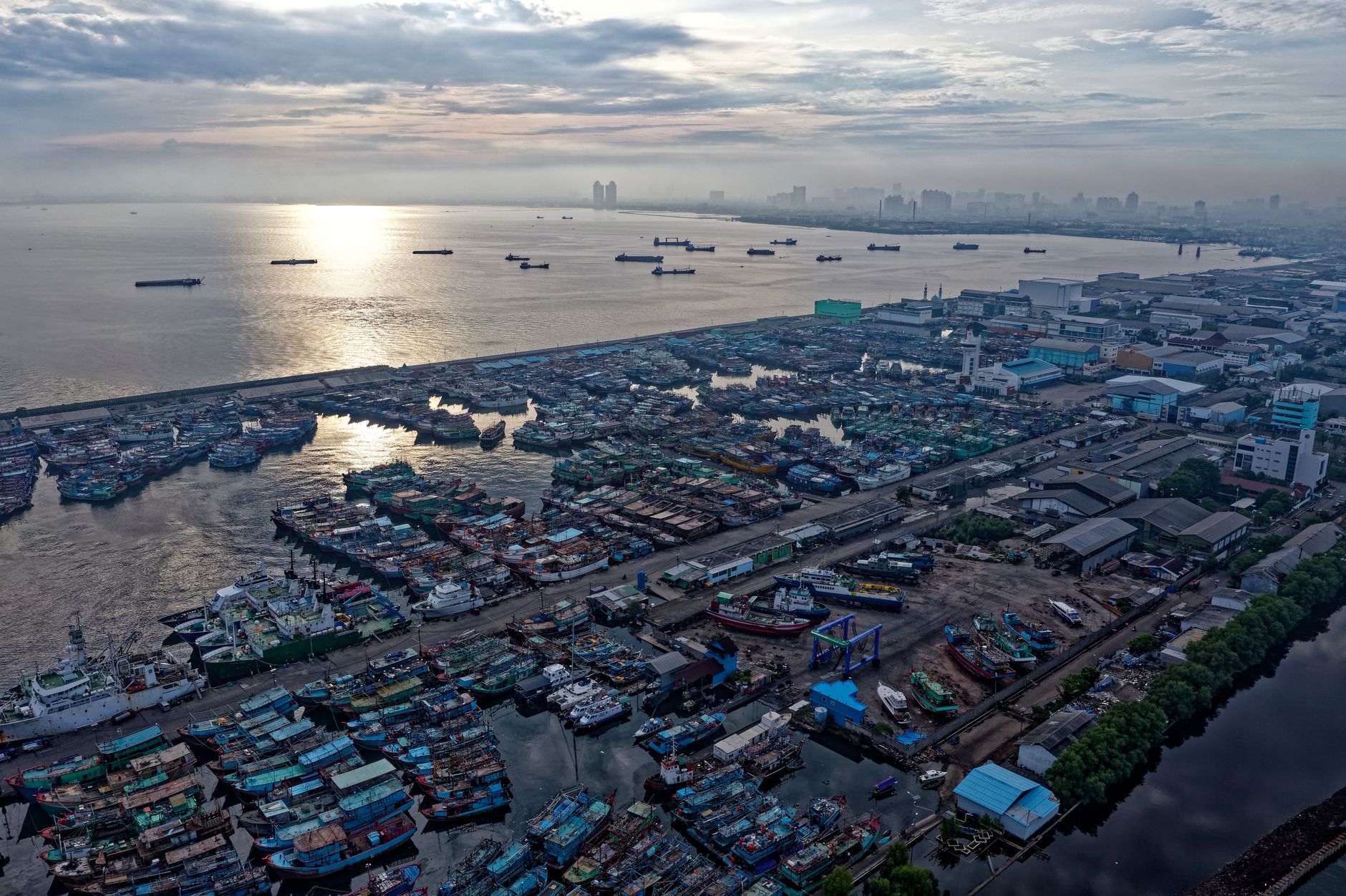
Logistics of this kind of trip are straightforward on paper but messy in practice. The fishponds are scattered across the northern arc of Manila Bay—Bulacan, Pampanga, Bataan—none of them easily reachable by public transport. We rented a car from a friend, but rental agencies in Manila will do it for around two thousand pesos a day if you haggle. Get a vehicle with ground clearance. The access roads are unpaved and flood during high tide, which comes up surprisingly far inland. The ponds are tidal, designed to exchange water with the bay twice daily. It’s an old system, pre-industrial, and it works fine until the bay stops being healthy enough to provide clean water. That’s happening now.
“The water quality is getting worse every year,” Rico said as we watched the last of the pond drain. He pointed toward the bay, invisible beyond a line of mangroves. “There’s a new reclamation project going in, you know the one. They say it’s for development, but what it means is more silt, less circulation. The shrimp feel it. They get stressed. They stop eating.” He wasn’t angry about it, exactly. More resigned. “If it keeps going like this, in five years there won’t be any sugpo farms left on this side.”
One farmer in Pampanga, a man named Johnny whose family had been farming sugpo since the 1970s, told us he’d lost three consecutive crops to disease in the last two years. “I put in juveniles, they grow to maybe forty grams, then they start dying,” he said. “No reason. They just die. The lab says it’s a virus, but the virus was always here. Something is making them weak.”
The harvest we witnessed—the slow drain, the men wading through mud, the prawns lifted one by one into mesh baskets—produces maybe sixty kilos per pond per cycle. Four cycles a year, if the water cooperates. At 850 pesos a kilo farm gate, that’s somewhere around 200,000 pesos annually per pond, before costs for feed, labor, and electricity for the aerators. Johnny’s family used to have ten ponds. Now they have three. “The young people don’t want this work,” Rico said, and it wasn’t a complaint, just a fact. His own son was studying nursing in Manila.
We bought ten kilos of sugpo from Rico, packed on ice in a styrofoam box, and drove back to Manila through the late afternoon traffic. The box sat in the back seat, dripping condensation onto the floor mats. In the city, we distributed it among friends—two kilos here, one there—because there’s only so much prawn two people can eat before it becomes a problem. The flavor, even the next day, was unmistakable. The sweetness cut through the chili and garlic and coconut cream we cooked it in. But we kept thinking about the ponds, about the water level dropping, about the way Rico had looked at the bay as if he was measuring something.
There’s a version of this trip where you come back with a triumphant story about tracking down a rare ingredient. That version is true, as far as it goes. The sugpo exists. It’s still being farmed, against increasingly long odds. But the more honest version is that the trip felt like we were documenting something as it ended. The ponds are still there, for now. The prawns are still growing, slow and big and expensive. But nothing we saw suggested that the trajectory would change. The grouper and the squid boat at the end of the drainage channel sat through the drop, without moving. The clouds moved to cover the sun and the last of the light went out. We stayed watching until the last of the water was gone, then we drove away.

📷 Photos: Tom Fisk (Pexels), Mags Sinohin (Pexels)