Rain has been falling on the Fox Glacier valley for two days straight and the creek behind the holiday park has turned the colour of milky tea. Sandflies work the gaps at my ankles while I wrestle the awning down. It is not a scenic departure. But by the time the van climbs away from the coast and into the Haast Pass, the rain has thinned to something closer to mist, and the road starts doing that thing where every few minutes the bush opens onto a gravel pull-off and the sound of falling water arrives before the water itself does.
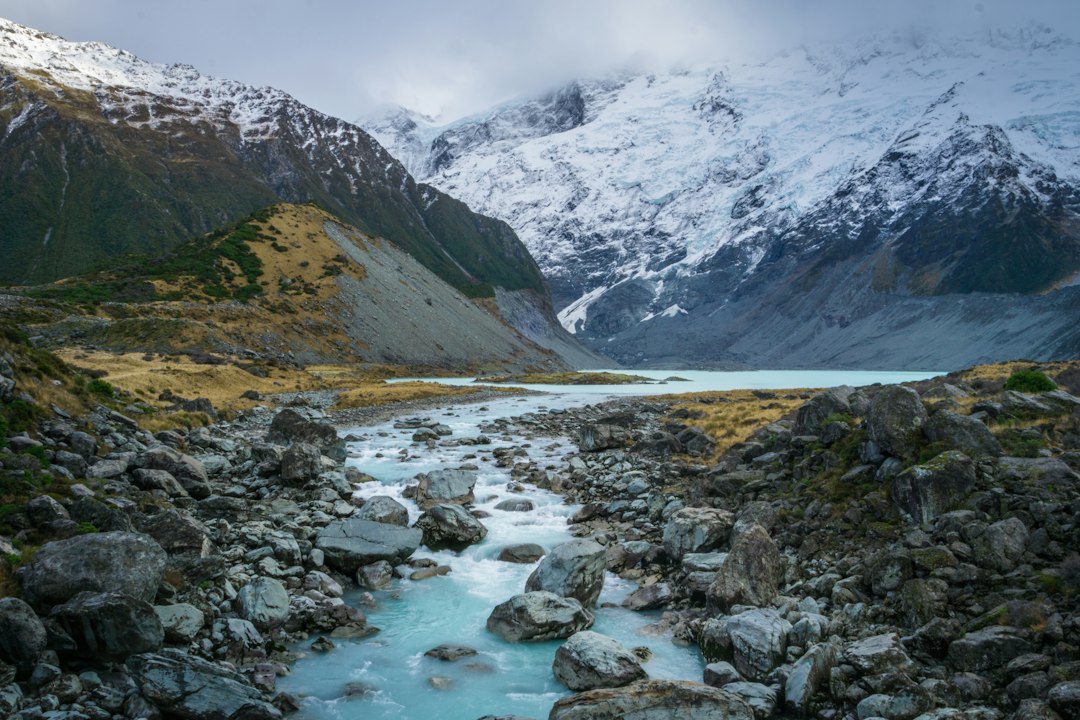
The Haast Pass is not a single pass so much as a corridor — beech forest, then rock faces running with thin white threads, then the wide braided river flats that mean you’re nearly through. I stop at three different waterfalls in under an hour, which is its own kind of greed. Fantail Falls is a short walk from the car park and you can feel the spray from the viewing area. The one that stays with me is Thunder Creek, not because it’s the biggest but because the pull-off is unmarked and I nearly drive past it, and when I walk the few hundred metres to the base there’s nobody else there at all. The water comes down in two tiers over dark rock with a sound like a door slamming somewhere far off.
Camping along the Haast is mostly a matter of choosing which gravel bay to claim. The Department of Conservation sites here are basic — a long-drop, a picnic table, a sign that says no fires — and the night I spend at one of them is the coldest of the trip. The van’s water tank has a thin skin of ice on it by morning. Still, the trade-off is a sky so thick with stars that the Milky Way reads as a smear rather than individual points, and a river sound that keeps up all night like traffic in another room.
Wanaka the next day feels like a different country. The lake is that opaque glacial blue, the kind that photographs badly because it looks fake, and there are actual cafés with actual espresso machines. I pay $7.50 for a flat white and a cheese scone at a place on Ardmore Street and eat it on a bench watching a family argue about whether to swim. The water is about eleven degrees. The father goes in anyway, briefly, and comes out making a noise like a kettle.
Puzzling World is the sort of attraction I’d normally drive past without a second thought, and I’m glad I didn’t. The hologram room and the tilted house are better than they have any right to be — there’s a room where water appears to run uphill and I stand in it for a full ten minutes trying to make my eyes cooperate. The outdoor maze takes me the better part of an hour and I am not the fastest person in it. Somewhere in the middle I end up following a boy of about eight who clearly knows the route, which feels like cheating until he takes a wrong turn and I’m on my own again. Admission is somewhere around $27, which is steep for a family of four but reasonable enough for one person with time to kill.
Mt Iron is the better use of an afternoon. The track up is a steady switchback through tussock and scrub, maybe an hour at a reasonable pace, and the reward at the top is a 360-degree view — Lake Wanaka on one side, the Clutha River flats on the other, and the Southern Alps lined up along the horizon like something drawn with a ruler. I meet a woman at the summit who has walked up with a thermos and offers me tea, which I accept. She tells me she’s been coming up here for twenty years and she reckons the view hasn’t repeated itself yet, though she admits she says that every time. I believe her anyway.
The road to Queenstown from Wanaka is short but not fast — the Crown Range is the highest sealed road in the country and the switchbacks will slow you to walking pace behind a campervan that’s struggling. Coming down into Queenstown the lake appears suddenly and the town spreads along its edge like something spilled. The gondola is worth the $52 return even if the line at the bottom is long and the viewing deck at the top is crowded. What the gondola gives you is orientation — you can see where the lake bends, where the Remarkables rise, where the town sits in the elbow of it all. I ride up in the late afternoon and come down as the light goes gold. On the way down I share a cabin with a paraglider pilot who’s just finished his last flight of the day and smells faintly of canvas and cold air, and he points out the landing zone at the bottom and says the thermals were rubbish today, not worth going up, or something like that.
The lakefront camp at Queenstown is not cheap, and the sites are packed close enough that you hear your neighbour’s radio. It’s the price of being in the middle of things. I walk into town for a burger that costs nearly as much as the camp site and sit on a wall watching the TSS Earnslaw come in with its lights on, steam pouring off it, and I think that this is the most expensive place I’ve slept in so far and I’m not entirely sure it’s worth the premium. The next morning the van’s windscreen is iced again.
Milford Sound is a long drive from Queenstown — three and a half hours on a good day, longer when the road is wet, and it’s the kind of road that punishes you for being in a hurry. The Homer Tunnel is a one-way, unlit, roughly one-kilometre hole in the mountain, and you wait at a red light at either end with a growing queue of other people’s headlights behind you. Inside it drips. When you come out the other side the sound is suddenly there, dark water and the sheer faces of Mitre Peak and the other walls rising straight out of the fiord, and the scale of it is genuinely hard to process. I take the first cruise of the afternoon — around $95 for the nature cruise, which is the middle option, not the cheapest and not the longest, and there’s a whole calculus to picking it that I won’t pretend to have got right — and it’s raining again, which in Milford is apparently the best thing that can happen to you.
The rain brings out the waterfalls. There are hundreds of them, temporary ones that only exist after a good drenching, and they thread down the cliffs in white lines. The permanent ones, Stirling and Bowen, are enormous. The boat goes close enough to one that the spray soaks the front deck and everyone who was standing there scatters, laughing, to the back. Out near the entrance to the fiord a pod of bottlenose dolphins shows up and runs alongside the bow for a few minutes before peeling off toward the open water. Nobody says much. There’s a particular kind of quiet that falls over a boat full of people when something like that happens, and it lasts until someone’s phone goes off and everyone remembers where they are.
The rainforest around Milford is the wettest place in the country, and it shows. Moss grows on everything that holds still. I camp at a DOC site just outside the sound and cook pasta in the van while the rain hammers the roof, and for the first time on the trip the weather doesn’t feel like an inconvenience — it feels like the whole point. The next morning the fiord is glassed over and the reflections are so exact that the photo I take looks like a mirror with a horizon line drawn on it.
Te Anau is the decompression chamber at the end of the trip. The lake is vast and calm and the town is small enough that you walk everywhere. I take the glowworm cave tour — about $135, two hours, half of it on a boat across the lake — and the cave itself is the strangest thing I’ve done in ten days. You’re in a small boat in total darkness, moving by a wire overhead, and the ceiling above you looks like a clear night sky but the lights are alive. The guide asks for silence and the silence is complete enough that you can hear water dripping somewhere far off. No photographs, and my memory of it is already dissolving into a general impression of blue-green points, which I suspect is how it’s supposed to work.
On the last morning I walk a short stretch of the Kepler Track, just the first hour from the control gates and back, because the whole thing is four days and I have a ferry to catch. The track is wide and easy and the beech forest is quiet and the lake shows through the trees in flashes. It’s a sample. Not the meal. The van smells of wet wool and cooking oil and there’s sand in the footwell that I’m not going to get out before I hand the keys back. Rain on the windscreen all the way south, and no waterfalls at all — just the lake, flat and grey and enormous, doing nothing in particular, which is what you want from a lake on the last day.

📷 Photos: Danny Postma (Unsplash), Danny Postma (Unsplash)