
The van smelled of diesel and someone else’s air freshener, a pine thing that would wear off by Invercargill if I let it. I picked it up in Christchurch on a grey morning with the nor’west arch sitting over the Canterbury Plains like a bruise, and the first thing I did was drive it the wrong way up a one-way street trying to find a supermarket. Nobody honked. That’s the thing about this country — the roads are patient with you in a way that takes getting used to.
Christchurch itself is a city still assembling itself. I walked the gap where the cathedral used to stand and then kept walking, past empty lots turned into pocket gardens, past a bar built out of shipping containers, past a man selling coffee from a bicycle who told me the flat white there is better than Wellington’s, which felt like a dangerous thing to say out loud. The plains north of the city are farmland and straight roads, and by mid-afternoon I had pointed the van inland toward the mountains, the Southern Alps growing on the horizon like something being developed slowly in a darkroom.
Lake Tekapo arrived at dusk, and the colour of it — that glacial turquoise, opaque and almost milky — didn’t look real at first. It looked like a swimming pool someone had Photoshopped into a mountain valley. The Church of the Good Shepherd sits low and small on the shoreline, unmortared stone, a tiny building dwarfed by the lake and the peaks behind it. A sign asks visitors not to take wedding photos there, which is either a losing battle or a war already conceded. I stood outside it for a while and watched the light do its slow change, the water going from turquoise to steel, and the whole thing felt less like a sight than a held breath.
That night the sky over Tekapo was clear enough that the Milky Way looked less like a band and more like a spill. The van has a cheap foam mattress and a sleeping bag rated for conditions slightly colder than the ones I actually slept through, and I woke in the dark needing to pee and stood outside in bare feet with the cold coming up through the ground and the stars so numerous I couldn’t find the Southern Cross on my own. After a night like that you don’t need anyone to tell you the dark-sky reserve is worth the drive. You just need a warmer sleeping bag and a headlamp you remember to charge.
The drive to Aoraki Mount Cook the next morning climbs through the Mackenzie Basin, and the landscape does that thing where it keeps getting emptier and grander at the same time — tussock plains, braided rivers, sheep that lift their heads and then go back to the business of eating. I stopped at a look-out and got talking to a woman from Nelson who was on her third trip through in as many years. She said she’d never managed to see the peak itself; every time the clouds came in and swallowed it. “It’s a shy mountain,” she said, and shrugged, or something close to a shrug.
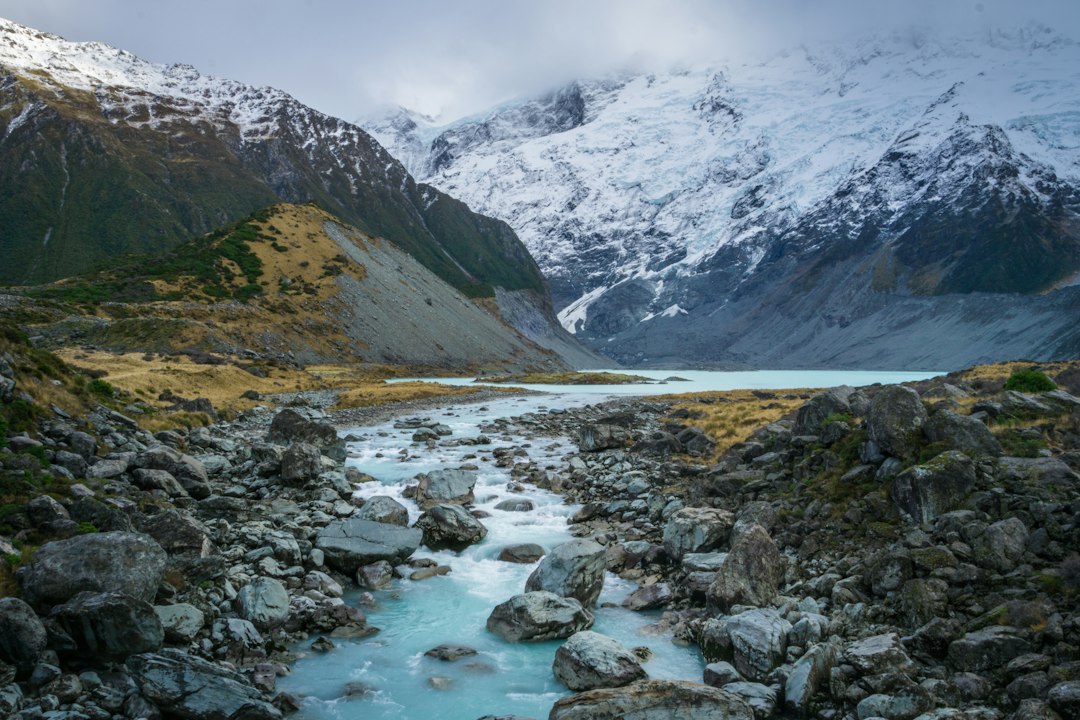
Mount Cook wasn’t shy for me. I got to the village under a clear sky and the Hooker Valley Track was open and I walked it with the absolute minimum of dignity — a steady plod, overtaken by people in their seventies and by children, the track boardwalked through swampy flats and then swinging across three separate swing bridges over water so turbid and grey-green it looked like liquid stone. The valley narrows and the ice cliffs of the Hooker Glacier come into view at the end, and there’s a little alpine memorial on a rise above the water, and the wind up there was cold enough to make my ears ache. I hadn’t brought gloves. I had brought a second cup of coffee, which is not the same thing. The mountain was out the entire walk, and by the time I got back to the van I understood the woman from Nelson a bit better — seeing it feels like a small event, not a guarantee.
The West Coast is where the whole thing changes character. The drive over from Mount Cook toward Fox Glacier goes through the Haast Pass, and the bush closes in, and the temperature drops, and the air gets wet in a way the east side never is. I stopped at a roadside pull-off and the smell hit before anything else — crushed fern and wet stone, and under that something sweet and rot-scented I couldn’t name. The West Coast rainforest is dense enough that the daylight has a green cast to it, and the moss on the trees hangs in long beards, and everything is dripping even when it isn’t raining.
Fox Glacier village is a small strip of road with a couple of hotels and a café, and the glacier itself is a short drive up a valley that’s been shaped by ice and then reshaped by the retreat of that ice. I walked to a viewpoint where the glacier’s terminal face sits at the end of a valley the ice used to fill — the signs there mark where the face was in past decades, and the distance between those markers and the current face is the whole story. There’s something quietly uncomfortable about standing at a viewpoint and reading a timeline of retreat. The glacier is still a blue-veined wall of ice, and the valley is still huge, and the track is still an easy walk, and none of that quite cancels out the sense of a thing leaving. I didn’t do a guided walk onto the ice — the heli-hikes and the guided trips run from the village and I’d left it too late to book — but the valley walk was enough. I stood there long enough that the rain started, and the ice went grey, and I walked back to the van with my hood up.
The last leg was south to Hokitika, and the rain came and went in that West Coast way — a shower, then sun, then a shower, the same sky doing three different things in an hour. Hokitika is a small town with a big main street and a row of jade shops, and the greenstone there is worked with an almost ceremonial care. I went into one shop where the owner was cutting and polishing at a bench in the back, and he showed me the difference between the local greenstone and the stone that comes in from elsewhere — the local stuff darker, more even, harder to argue with, and he had a way of holding each piece up to the window light that made you want to agree with him. He didn’t try to sell me anything. He talked about the stone the way a person talks about a thing they’ve decided to spend their life on.
The beach at Hokitika is driftwood, and the driftwood is extraordinary — whole trunks, silvered and bleached, stacked along the sand in a way that looks deliberately arranged and isn’t. I walked out there in a wind that pushed against my chest, and the sea was a flat grey, and the beach was almost empty, and there was a piece of driftwood shaped like a question mark that I thought about taking and didn’t. I don’t know what governs which pieces wash up and which get dragged back out, but the ones left standing there had been through something.
The Hokitika Gorge is a short drive out of town, and the water there is the kind of blue that looks like a fault in the camera. I walked the track to the swing bridge and looked down at it, and the colour was so intense it seemed like something added rather than something real, and the bush around it was dripping and dark and entirely ordinary. I’ve heard the gorge gets crowded in summer; there were maybe a dozen people on the track when I went, and the bridge swung gently under each of them as they crossed, and the water below kept its impossible colour, and nobody said anything much. I stood at the rail a while longer, then walked back to the van, where the pine air freshener had finally given up, and the only smell left was the wet raincoat in the back and the diesel up front.

📷 Photos: あま あわれ (Unsplash), Job Savelsberg (Unsplash)