The jellyfish in Kakaban Lake evolved without predators, which is the kind of fact that sounds like a travel brochure promise until you’re actually floating among them and one brushes your arm with the same gentleness as a falling leaf. They have no stinging cells to speak of—something like ten thousand generations of isolation in this ancient lake system filtered out the ones that weren’t worth the energy—and so when you slip into the water, you feel nothing but the coolness and the occasional soft bump of a bell maybe the size of your palm. I had expected something more dramatic, honestly. A tingle, perhaps, or at least a moment of recognition: this is the creature, this is the contact. But it’s just contact, unremarkable to the jellyfish and to me, and the real drama happens elsewhere entirely.
The bioluminescent plankton—the ones that produce the turquoise glow that draws photographers from half the world—don’t show themselves during daylight hours. This is the first thing most coverage gets backward. The glossy Instagram posts and the magazine spreads with their impossibly vivid shots tend to imply that the glow is always present, waiting like a backdrop. It isn’t. The plankton activate in darkness, and not just any darkness—the kind that arrives an hour or more after sunset, when the moon hasn’t yet risen or has already set, when the water is still and the sky offers nothing but black. I arrived at Kakaban on a late afternoon, having spent the better part of two days getting to Maratua Island and then arranging a boat across to the lake. The sun was still high enough to turn the water a pale bottle-green, and the jellyfish were everywhere—thousands of them, pulsing in slow motion, their bodies catching the light like little stained-glass domes. A group of tourists from a liveaboard were snorkeling near the far edge of the lake, laughing and pointing. Nobody was photographing anything yet.
What quieted the lake as dusk fell was not the disappearance of light but the appearance of its alternative. I had set up my tripod on a small floating dock that juts perhaps fifteen feet into the water—one of those rickety wooden platforms that seems to have been built by someone who trusted the lake’s stillness more than any engineering principle. The jellyfish began to cluster near the surface as the light dimmed, as if they too were curious about what comes next. A local guide named Rizky, who lives in the village of Bohe Bukut on Maratua and makes the crossing to Kakaban several times a week, had told me earlier that the best technique is to wait for the plankton to settle after any boat disturbance. “The waves stir them up,” he said, “and then they glow too much, too scattered. You want them calm, like a field.” I remembered that phrase and repeated it to myself as I crouched on the dock, watching the water smooth itself back into a mirror after the last boat had departed.
The first hint of the glow appeared as a faint shimmer around the edges of my submerged flashlight. I had switched it off, as Rizky instructed, and was letting my eyes adjust. The plankton respond to movement—each tiny dinoflagellate emits a flash of light when disturbed, a defense mechanism meant to startle predators—and so the trick is to create just enough disturbance to trigger them without churning the water into a mess of competing flashes. I dipped my hand in slowly, palm down, and watched the turquoise trails swirl around my fingers like smoke in reverse. The color is not the blue of a tropical sky or the green of a healthy reef. It is closer to the glow of a CRT television screen in a dark room, that electric cyan that seems to come from somewhere inside the light rather than from a source. The camera’s long exposure captures it as something more saturated, more solid, but what the eye sees is fainter and more alive—a color in motion, not a color at rest.
I shot for about three hours, from full dark until midnight, and learned something that no tutorial had prepared me for: the glow has a rhythm that is tied to the lake’s micro-conditions, not just to darkness. Around nine o’clock, the wind shifted and brought a slight current across the surface from the direction of the surrounding limestone cliffs. The plankton responded by congregating in patches—thick swirls of glow in one area, almost nothing in another—and I had to reposition the tripod three times to chase the densest pockets. At ten-thirty, a bat skimmed the water about twenty feet from the dock and left a trail of turquoise that lasted nearly four seconds, longer than any hand-stirred glow I had managed all night. I didn’t get the shot—I was changing memory cards—but I saw it, and that felt like enough.
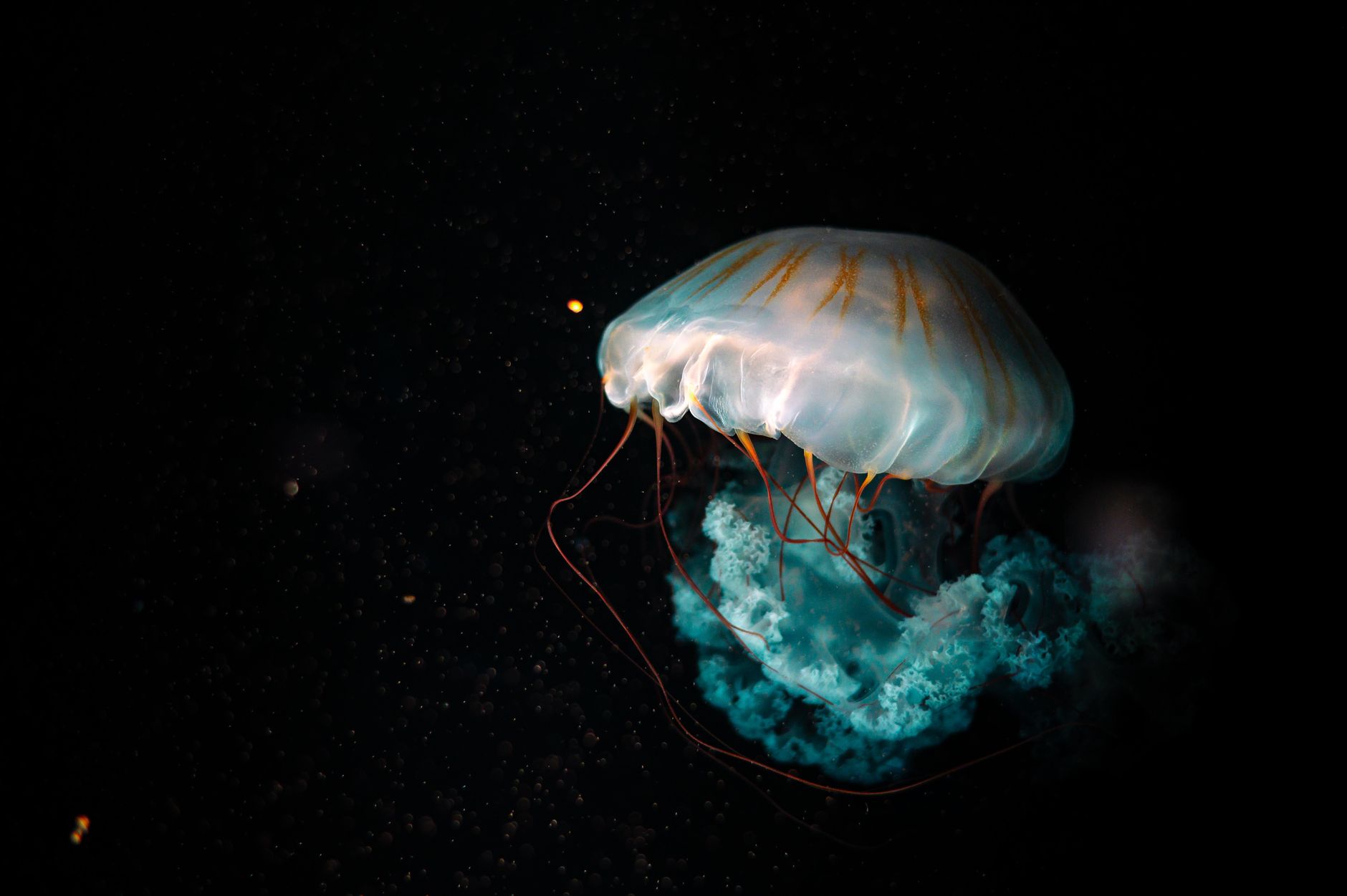
The jellyfish themselves, I should note, are not the primary subjects of the bioluminescence photographs you’ve likely seen. They appear in many of them as ghostly foreground shapes, their translucent bodies catching the light from the plankton below, but the glow comes from the dinoflagellates—the single-celled organisms that drift in the water column. The jellyfish are incidental, beautiful but passive participants. The eye reads the photograph as a single unified scene: jellyfish floating in a lake of light, each bell a lens through which the turquoise shines. The camera doesn’t care about taxonomy. It cares about contrast and composition and the slow accumulation of photons across a thirty-second exposure.
Rizky had mentioned that some visitors arrive expecting the glow to be visible from the surface without any disturbance at all—that they imagine the lake itself glowing like a neon sign. “They look at the water and say, where is the light?” he told me, shaking his head. “They do not understand it is a reaction, not a property.” This is the crucial point that gets missed in almost every piece of coverage I’ve encountered. The bioluminescence is not something the lake produces constantly. It is something the lake can do, under the right conditions, when prompted. You are not a spectator at a light show. You are a participant in an interaction—your hand, your paddle, your wake—that generates the very phenomenon you came to see. The glow is not waiting for you. You are making it.
One of the less discussed challenges of photographing Kakaban’s bioluminescence is the humidity. The lake sits in a depression surrounded by jungle, and by late evening the air is thick enough to fog a lens within minutes. I spent as much time wiping my front element with a microfiber cloth as I did adjusting settings. The salt spray from the lake—Kakaban is a mix of freshwater and saltwater, a brackish system that supports its unique population of stingless jellyfish—left a fine residue on everything metallic, and by the end of the night my tripod felt slightly tacky to the touch. These are the details you don’t see in the finished photographs: the wet cloth in the pocket, the careful breathing away from the camera body, the small rituals of maintenance that separate a usable exposure from a ruined one. I switched to a shorter focal length around eleven, partly for compositional variety and partly because the humidity was making the longer lens fog up too quickly to be practical. The wider angle worked better anyway, capturing more of the lake surface and the way the glow spread outward from the dock in concentric, fading rings.
A motorboat passed about a hundred meters out, heading toward the channel that connects the lake to the open sea. Its wake reached the dock maybe thirty seconds later—a gentle lift and fall, nothing dramatic—but the plankton response was immediate. The entire surface near the dock erupted in a wash of turquoise that lasted a full ten seconds, brighter than anything I had produced with my hand or my tripod. The wake had agitated a larger volume of water, and the dinoflagellates had responded in kind. I had been trying all night to get exactly that kind of broad, even glow, and here it was, courtesy of a fishing boat returning late from the outer reef. I fired off three exposures in quick succession, knowing even as I pressed the shutter that the second or third would be the keeper—the first frame would catch the glow at its peak but also the boat’s wake itself, which would read as a dark line across an otherwise luminous surface. The third frame, taken about eight seconds later, showed only the glow, settling back into stillness.
The glow is not a feature of the water the way its saltiness or its temperature is a feature. It is a behavior, a response, a conversation between the organisms and the environment. The longer I stayed, the more I felt like I was learning the grammar of that conversation: when to move and when to be still, how much disturbance produces a readable glow versus a chaotic blur, what the jellyfish do during the bright flashes (they don’t react at all, which is itself a kind of information about their nervous systems—or maybe they just don’t care). The lake has its own pace, and it does not speed up for a photographer’s schedule.
I packed up just after midnight, when the plankton seemed to dim slightly—a natural cycle, perhaps, or simply my own fatigue making everything look less vivid. The walk back to the jetty where a boat was waiting took me along a narrow path through the jungle, and I could hear the rustle of something in the undergrowth that I chose to interpret as a monitor lizard rather than anything larger. The boat ride back to Maratua was quiet, the engine puttering along at a low hum, and I sat near the bow watching the wake re-form behind us into trails of greenish light that faded and re-lit with each passing second. You are not a spectator. You are making it.

📷 Photos: Fotis Michalainas (Pexels), Fotis Michalainas (Pexels)