
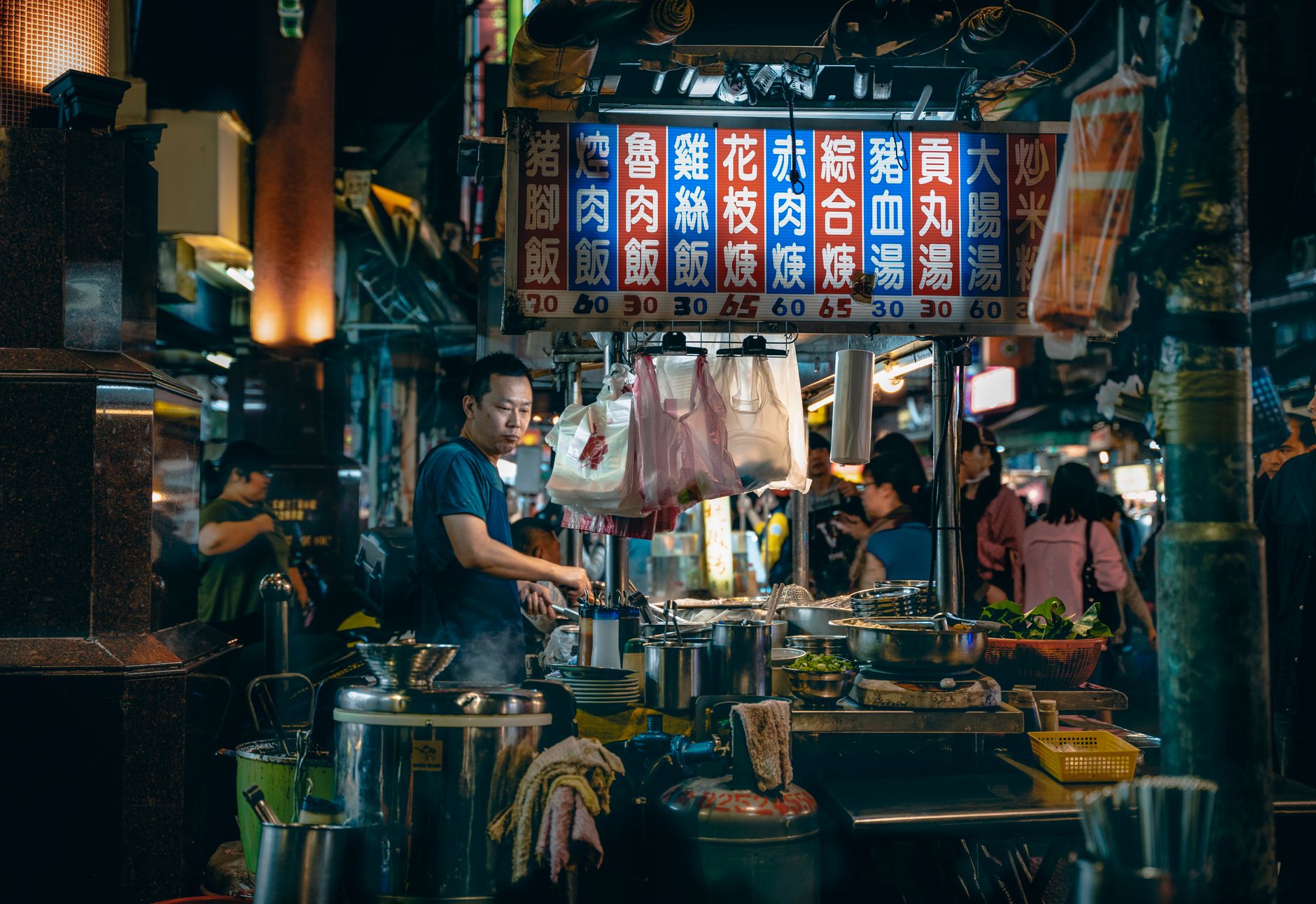
I found the first one by accident, which is how most good things happen in Bangkok’s old town if you let them. I’d been walking along a soi off Charoen Krung, the kind of narrow lane where motorbikes have to fold their mirrors in to pass, when I noticed a woman in a blue apron lifting a lid off a massive aluminum pot. Steam rose in a column that caught the late-morning light. I stopped without deciding to. She looked up, saw me looking, and gestured toward a plastic stool without a word.
The soup was jok — rice porridge, though that translation undersells what it actually is. The grains had been simmered until they’d dissolved into something almost creamy, with a slick of sesame oil on top, a raw egg stirred in at the last minute, and a scattering of what looked like fried garlic and sliced spring onion. A plate arrived beside it with a length of Chinese doughnut, pale and chewy, nothing like the crispy ones you get at dim sum places. The woman’s name was something I never caught, and when I tried to ask her about the stall — how long she’d been there, whether she’d ever thought about moving somewhere with air conditioning — she just laughed and pointed at the soup.
I ate it too fast and burned my tongue. It was worth it.
That was March. By the time I came back in July, the stall was gone. The blue apron, the aluminum pot, the plastic stools — replaced by a shuttered metal grille with a handwritten sign in Thai that I couldn’t fully read but understood anyway. The man selling grilled pork skewers next door told me she’d retired. “She was old already,” he said, not unkindly. “Her children don’t want to cook.”
I spent the better part of a month trying to find the stalls that were still open, partly because I wanted to eat well and partly because I wanted to understand what was being lost. A friend who’d lived in Bangkok for fifteen years gave me a list of names, half of which turned out to be wrong. An old guidebook from 2016 mentioned three places that had already closed. A man at a noodle stall near Wat Pho told me I should try a place on Soi Samran Rat that he said was “the real one,” but when I got there the sign said the hours were 5am to 9am, and I’d arrived at noon.
The ones I did find had a few things in common. They were almost always run by someone over sixty. They opened early and closed by early afternoon, sometimes earlier if the pot ran out. They didn’t have menus, or if they did, the menus were laminated sheets with English translations that had clearly been typed on a typewriter in the 1990s and never updated. The prices were low enough to make you wonder how anyone could afford to run a business at all — forty baht, fifty baht, sixty baht for a bowl that would keep you full until dinner.
You wouldn’t have found it unless you knew it was there, and I only knew because a woman at the flower market pointed me toward it when I asked. She said, “Go to where the buses park, then walk to the back. You’ll smell the garlic.” Ahead, the parking structure near the Saphan Phut night market swallowed the light.
She was right. The smell hit me before I saw anything — fried garlic and ginger and pork stock, the kind of smell that bypasses your brain and goes straight to your stomach. The stall was run by a man named Sarayuth, who told me he’d been making jok at that spot for thirty-two years. He wore a white singlet and a gold chain and he stirred his pot with a ladle that looked like it had been worn down to half its original size by decades of use.
“When I started, this was all empty land,” he said, gesturing vaguely at the parking structure around us. “Now it’s all buildings. The city changed. The customers changed too.”
I asked him what he meant by that. He said younger people don’t want to eat jok anymore. They want bread, cereal, iced coffee from chain shops. The ones who still come are regulars, most of them over fifty, many of them people he’s been serving since the beginning. “I know how they like it,” he said. “Extra ginger for that one. No egg for that one. Soft egg for the lady who sits at the corner table.”
He pointed at each customer as he described them, and each one nodded without looking up from their bowl.
I ate there three times in a week. On the third visit, Sarayuth remembered my order without me asking.
The second stall I tracked down was harder to find, and I almost gave up. It was supposed to be on a street called Trok Itsaraphap, which turned out to be less a street and more a footpath running between two rows of shophouses. I walked it twice before I realized the stall wasn’t visible from the main road — you had to go through a narrow alley, past a woman selling lottery tickets, and then turn right into what looked like someone’s backyard.
It was someone’s backyard. Or at least it had been, once. The stall was set up under a corrugated metal roof with a single fluorescent tube buzzing overhead. A woman named Priya, who looked about seventy and moved with the careful economy of someone who’d been doing the same physical work for decades, was stirring a pot that must have held fifteen liters of broth. She didn’t speak much English, and I didn’t speak enough Thai, but the woman selling lottery tickets volunteered to translate.
“Ask her how long she’s been here,” I said.
The answer came back: twenty-seven years.
“Ask her if she’ll still be here next year.”
The translation took longer this time. Priya stopped stirring and looked at me, then at the lottery ticket seller, then back at the pot. She said something I didn’t catch, and the translation that came back was: “She says she doesn’t know. Her hands hurt. She wants to stop, but nobody else will do it.”
I ate my jok in silence. It was good — maybe the best of the ones I’d tried, with a richer broth and a more generous portion of pork — but every spoonful carried a kind of weight I hadn’t noticed before.
The third stall was the outlier. It was in a proper shop, with a proper sign and a proper door, on a street that tourists actually walked down. The owner was a man in his forties named Pieter — a Dutch name, though he was Thai — who’d taken over the business from his mother-in-law. He was the only person I met who seemed optimistic about the future.
“Tourists like it,” he said, gesturing at a table of Europeans who were photographing their bowls. “They come because they read about it online. They think it’s authentic. And it is authentic. I didn’t change the recipe.”
I asked whether the regular Thai customers had stopped coming.
He paused. “Some. Not all. The old ones still come in the morning, before the tourists wake up. By eleven, it’s mostly foreigners. That’s fine. It pays the rent.”
He said it without bitterness, and I believed him. But it was hard not to notice that the jok at his shop cost eighty baht — double what everyone else charged — and that the portion was noticeably smaller. The soup was good, but it was different. Cleaner, somehow. More careful. Less like something that had been cooked in the same pot for thirty years and more like something that had been calculated to light up a certain kind of customer.
I wasn’t sure which version I preferred. I’m still not.
Toward the end of my time in Bangkok, I went back to the parking structure one last time. Sarayuth wasn’t there. His son was, a man in his mid-thirties who was stirring the pot with the same worn ladle. I asked where Sarayuth was, and the son said his back was bothering him, that he’d be back in a few days.
I ordered the same bowl I’d had before. It was fine — the broth was good, the pork was tender, the egg was soft — but something was off. The garlic wasn’t as generous. The ginger was missing. It was like hearing a song played by a different musician; the notes were the same, but the feel was gone.
The son saw me notice. “I’m still learning,” he said, before I could say anything.
I told him it was good. It wasn’t a lie, exactly. His father would have known to add the ginger.
On my last morning, I went back to Trok Itsaraphap. Priya was there, stirring her pot in the fluorescent light, and the lottery ticket seller was there, and the regulars were there, and the jok was as good as I remembered. I ate two bowls and wished I could eat a third. When I paid, I tried to give Priya extra — five hundred baht — and she refused. She pushed the money back at me and said something in Thai that I couldn’t understand. The lottery ticket seller translated: “She says you already paid. The money is not why she cooks.”
I sat on the plastic stool for a while after I finished, watching her work. The fluorescent tube buzzed. The pork stock simmered. A motorbike went past the alley entrance, then another. The regulars came and went, each one greeted by name, each bowl made to order.
I don’t know how long Priya will keep cooking. I don’t know how long any of them will. The stalls close without announcements, and the ones that replace them are different — newer, cleaner, more expensive, less alive. The heat hit me as I stepped onto the main road. The fluorescent light disappeared behind me. The smell of garlic stayed on my hands for the rest of the day.

📷 Photos: 李昂軒 (Pexels), Felix Schickel (Pexels)