The rain started about forty-five minutes in, which was almost exactly when I realized my boots were a size too big. Not the kind of too-big that pinches, but the kind where your foot slides forward on every downhill step and your toenails gradually find the rubber at the front. By the time I noticed, I was already committed — the trail behind me had become a slick of mud and rotting leaves, and the idea of turning back felt like more work than pressing forward.
Doi Inthanon is Thailand’s tallest mountain, which sounds more dramatic than it is. At 2,565 meters, it’s not going to make anyone who’s hiked in Nepal break a sweat. But the Kew Mae Pan nature trail — the one that’s supposed to loop around the summit and deliver you to a pagoda built for the king’s sixtieth birthday — has a reputation for being more jungle than path. I’d read the warnings online, but I’d read them from a hotel lobby in Chiang Mai, where everything felt theoretical. The warnings mentioned “slippery conditions” and “strenuous sections.” They did not mention the leeches.
The first one I found was on my ankle, just above the sock line, looking like a very small, very determined slug that had figured out how to stand upright. I flicked it off without thinking, and it left a smear of blood that took ten minutes to stop. An hour later, I stopped counting. There was a rhythm to dealing with them: walk a few steps, check the boots, scrape off whatever had attached, keep moving. The local hikers I passed — a group of three Thai women in their sixties — wore gaiters wrapped tight around their calves and carried salt shakers. One of them saw me staring at my bloody socks and gestured with her chin toward a bamboo stalk. “Rub,” she said, in English. “The leaf. It stops the blood.” I didn’t understand until I tried it: a rough, dry bamboo leaf pressed against the bite really did clot the wound faster than anything I had in my pack.
That was the first of many small humiliations. The trail itself is only about three kilometers if you take the full loop, but those three kilometers are almost entirely composed of tree roots that have grown into a kind of natural staircase — uneven, slick, and positioned at intervals designed to catch the unwary. Every step requires a decision about where to place your foot, and every decision is wrong about half the time. I fell three times. The first was a slow, controlled slide onto my backside, mud coating the entire back of my rain jacket. The second was a proper stumble that ended with my knee against a rock and a bruise that stayed purple for a week. The third was the worst: I stepped on a root that looked solid, felt it give way under my weight, and pitched forward into a thicket of ferns that concealed a ditch about a meter deep. I landed on my hands and knees in water, and for a moment I just stayed there, breathing hard, listening to the sound of my own heart beating somewhere near my ears.
What I hadn’t known, what the trailhead signs in English didn’t bother to mention, was that the Kew Mae Pan loop is considered a pilgrimage route by local Buddhists. The pagoda at the end — Phra Mahathat Naphamethanidon — isn’t just a viewpoint. It’s a reliquary, built in 1995 to mark the king’s sixtieth birthday, and it sits at the highest point of the trail like something from another century. The design is classic Thai temple architecture: white and gold, with a stepped spire that catches the light even through cloud cover. I’d seen photos of it online, framed by blue skies and blooming rhododendrons. The reality was a structure half-shrouded in mist, with water dripping from the eaves and a small crowd of Thai pilgrims sitting on the steps, eating sticky rice out of banana leaves.
One of them, a man in his seventies with a face like weathered stone, offered me a piece of chicken from his container. I took it, mostly because I hadn’t eaten in six hours and my hands were shaking from the cold. The chicken was cold and slightly sweet, the kind of roadside-grilled meat you can buy for twenty baht anywhere in the country. It was the best thing I’d eaten all week. He didn’t say anything, just nodded when I said thank you, and went back to his meal. I sat down a few feet away and watched the mist drift through the pagoda’s open sides, occasionally revealing the valley below before closing up again.
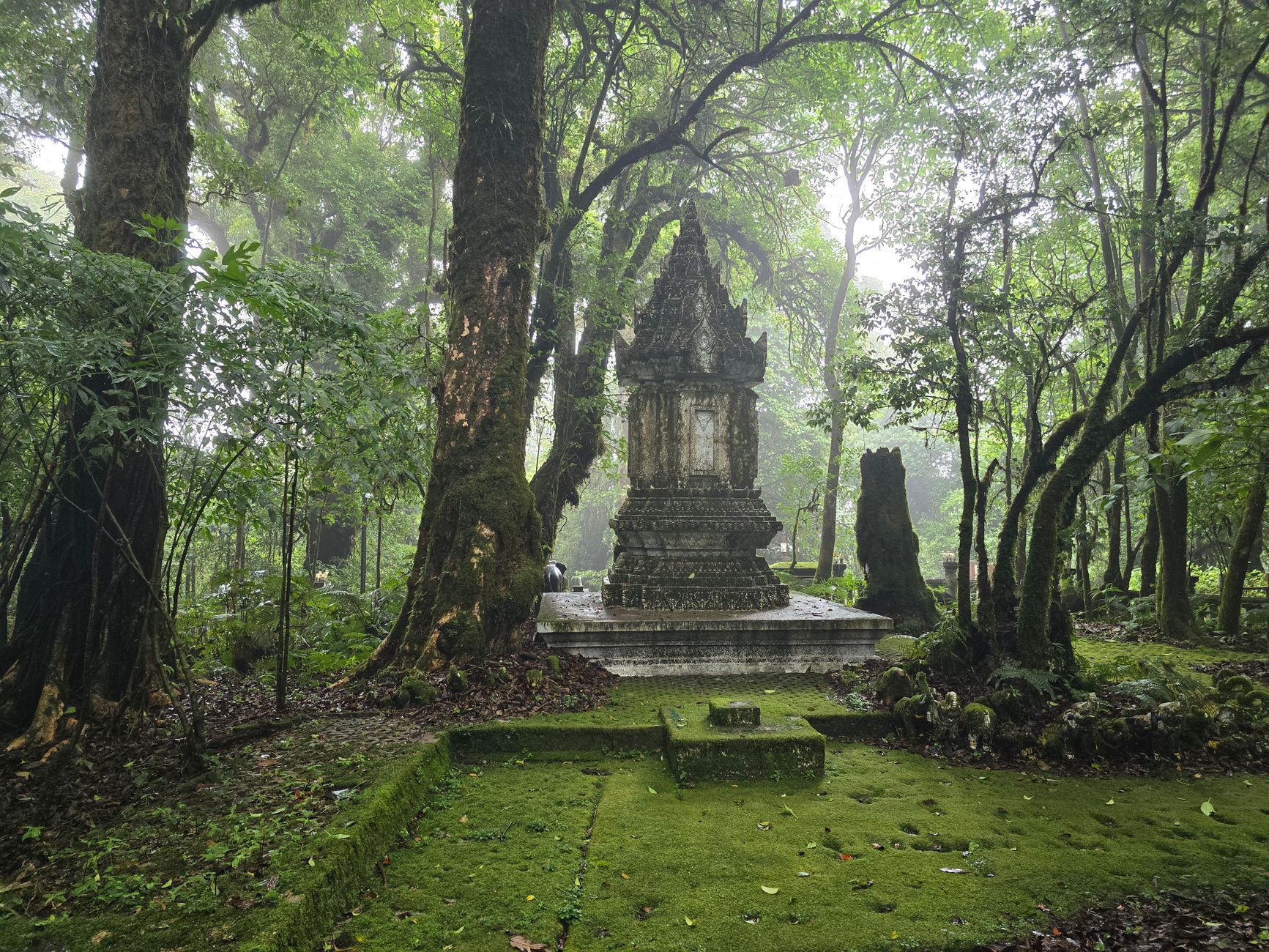
The thing about the trail that nobody warns you about is the silence. I don’t mean the absence of noise — there’s plenty of that, from the insects to the birds to the steady drip-drip-drip of water hitting leaves. I mean the silence between those sounds. The forest at that elevation has a stillness that feels almost deliberate, as if the trees have decided to stop. It’s not peaceful, exactly; it’s more like being watched. I’ve hiked in rainforests before, in Costa Rica and Borneo, and the constant noise of life — the calls, the rustling, the hum — always felt like a conversation you were eavesdropping on. On Doi Inthanon, the conversation had stopped. The moss-covered trunks and the ferns and the orchids growing out of crevices all seemed to be waiting for something, and I wasn’t sure whether I was the thing they were waiting for or just an interruption they were tolerating.
I’d started the hike at eleven in the morning, which was my first mistake. The trailhead parking lot was already full when I arrived, and the ticket booth had a line of about fifteen people buying the mandatory forty-baht entry fee. I’d assumed midday meant fewer crowds — a naive assumption that ignored the fact that Doi Inthanon is one of Thailand’s most popular national parks. The parking lot smelled of gasoline and fried chicken, and a group of teenagers were taking selfies in front of a sign that said “Highest Point in Thailand” in three languages. The trailhead itself was crowded enough that I spent the first twenty minutes walking behind a German couple who kept stopping to photograph every orchid they saw. They were nice people. They were also moving at a pace that suggested they had nowhere to be until next Tuesday.
I broke away from them at a fork in the path — left for the shorter loop, right for the longer one — and took the longer route without really thinking about it. This was my second mistake. The longer loop is about four kilometers, but it gains close to two hundred meters in elevation over terrain that is, at several points, essentially a root-and-mud ladder. The gradient is steep enough that you have to use your hands, grabbing at tree trunks and bamboo stalks for leverage. My backpack, which had seemed perfectly reasonable in the hotel room, now felt like it was packed with bricks. I stopped to drink water and realized I’d only brought one liter. I finished it by the two-kilometer mark.
There’s a ranger station about halfway through the loop, a small wooden hut with a thatched roof where you can buy bottled water and electrolyte drinks for thirty baht. But the hut is only staffed during peak season — November to February — and I was hiking in early March. The windows were shuttered, the door locked, and a handwritten note in Thai that I couldn’t read was taped to the counter. I stood there for a minute, hoping that maybe a ranger would emerge from somewhere, before accepting the situation and moving on. My tongue felt thick and dry, and I could feel the beginning of a headache pressing behind my eyes. I rationed the last few sips of water, taking them in small, deliberate swallows, trying to make them last until I reached the pagoda.
The pagoda itself, when I finally reached it, was anticlimactic in the way that most destinations are after a hard journey. I’d expected a clearing in the clouds, a view of the valley stretching out like a green carpet. Instead, I got fog so thick that I couldn’t see more than twenty meters in any direction. The pagoda’s gold spire disappeared into the white, and the only indication that there was anything below was the occasional muffled sound of a car horn from the parking lot somewhere far beneath. The pilgrims had finished their lunch and were now making their way around the base of the structure, their hands clasped in prayer, their voices low and steady. I followed them for a few circuits, not praying but not not praying either, letting the rhythm of the walk settle my breathing.
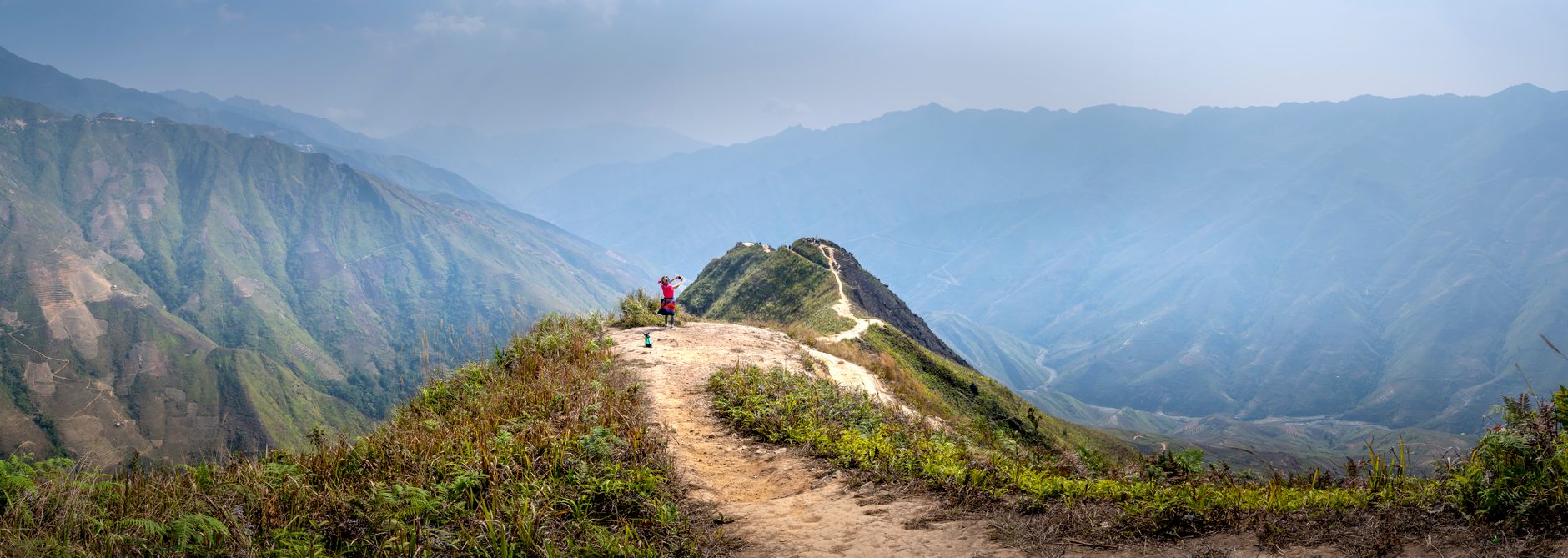
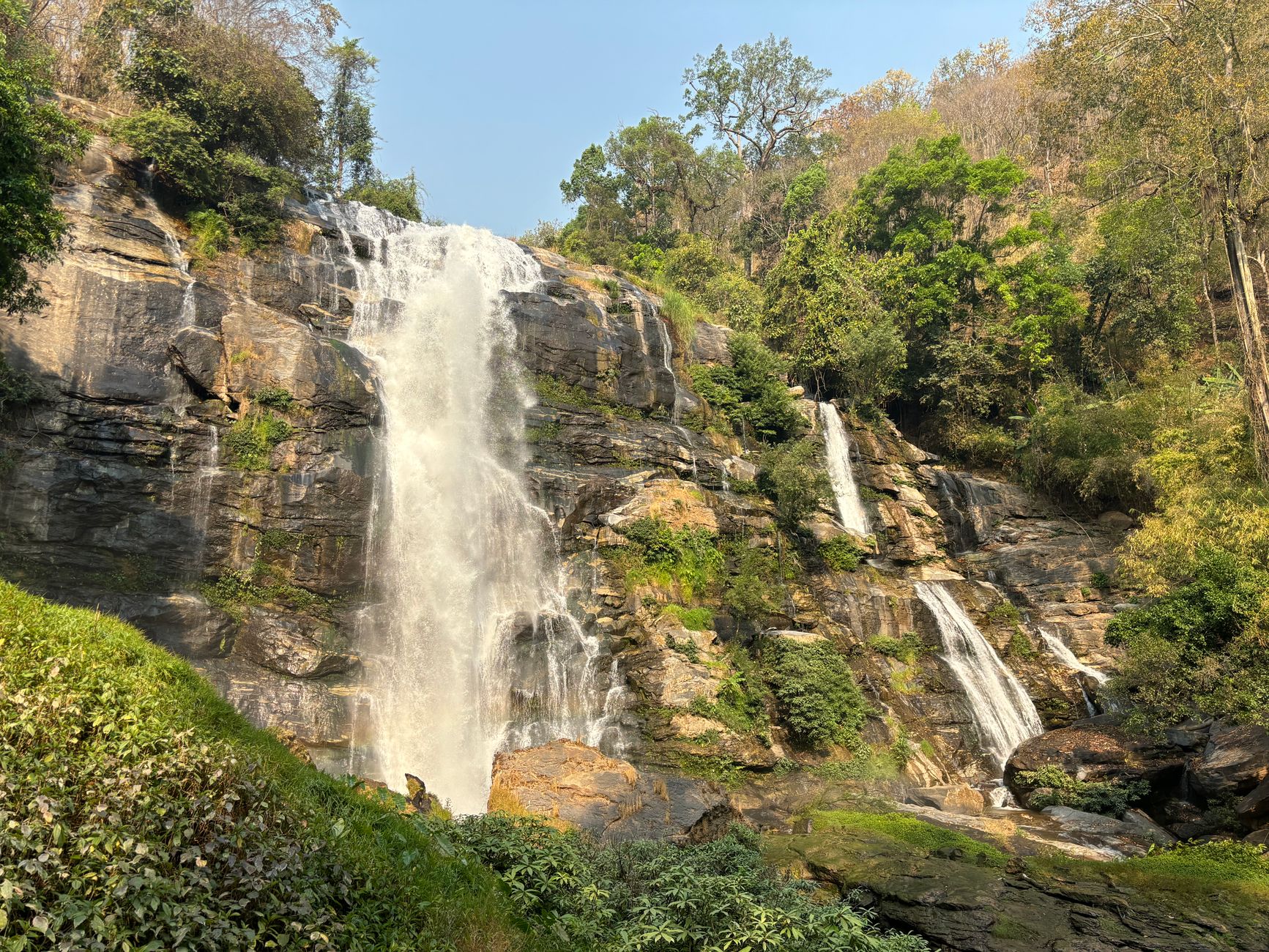
It was only when I started the descent that I understood what I’d missed. The clouds, which had been thick all morning, began to break up about thirty minutes after I left the pagoda. Patches of blue appeared, then widened, and suddenly the valley was visible — thousands of feet of green, layered like a painting, with distant waterfalls catching the light. I stopped on a ridge and watched it for a long time, feeling the sun warm the back of my neck. The trail here was easier, the roots less treacherous, the mud drying to a manageable slickness. I made better time on the way down, even with my feet sliding forward in those too-big boots, even with the headache that had settled into a dull, persistent throb.
By the time I reached the parking lot, it was nearly four o’clock. The crowds had thinned out, and the ticket booth was closed. I sat on a bench near the entrance and took off my boots, peeling away socks that were wet through with sweat and mud and the lingering residue of leech bites. My feet were a mess: blisters on both heels, a bruise on my left big toe, and a dozen small red welts where the leeches had fed. I counted them. Fourteen. That seemed like a lot for a three-hour hike, but I had no frame of reference.
In the car, I found a bottle of water I’d forgotten about, half-full and warm from sitting in the sun. I drank it in long gulps, letting it run down my chin, not caring about the mess. The drive back to Chiang Mai took two hours, most of it spent in the dark, the headlights picking out the shapes of motorbikes and trucks on the winding mountain road. I stopped at a gas station in Mae Rim and bought a bag of salted peanuts and a bottle of Coca-Cola — the glass kind, which still costs twelve baht in that part of the country — and sat on the curb eating them, watching a stray dog sniff around the pumps.
📷 Photos: Messy Moe (Pexels), Jazz Kaundal (Pexels)