The coastal path between Seongsan and Udo ferry terminal is one of those roads that feels designed to keep drivers awake — sharp curves, sudden drops in elevation, the sea appearing and disappearing behind volcanic rock walls. I’d driven it three times before I noticed the place. A low concrete building, the kind of structure that could be a small storage shed or a workshop, with a single metal sign so weathered the letters were barely legible from the road. What drew my attention on the fourth pass wasn’t the building itself but the smoke coming from behind it, and the way the smoke smelled — like soy caramelizing on something that had been cooking for a while.
The chicken at this shack, which locals call simply the halmeoni makgeolli house — though I’ve since learned it has a proper name I can never remember — bears almost no relation to the sweet-soy chicken that fills food-court stalls across South Korea. The chain version, the one you find at every highway rest stop and department store food court, is engineered for consistency: a factory-made sauce, fried chicken that’s been frozen and reheated, sweetness that hits immediately and fades just as fast. What comes off the halmeoni’s grill is something else entirely — chicken that’s been slowly braised in a clay pot over a wood fire, the skin turned dark and sticky from hours of contact with a sauce made from local jeju tangerines, soy sauce, garlic, and something I could not identify on first taste.
I asked the woman who runs the place — everyone calls her Halmeoni, though she’s younger than the name suggests, probably in her late sixties — what the mystery ingredient was. She laughed and gestured at the hillside behind the building, where a few dozen tangerine trees grew in irregular rows. “The fruit this year was too sour to eat fresh,” she said through a customer who translated. “So I cooked it down. Three days, low heat, no sugar added.” That was the difference: the sweetness in her chicken doesn’t come from corn syrup or processed sugar. It comes from tangerines that would have been thrown out by the farms that supply the island’s juice factories, tangerines too tart or too small for the commercial buyers, reduced over days into a concentration that tastes like the island itself — slightly bitter, floral, not cloying at all.
The first time I ate there, I ordered one portion and ended up ordering two more. The chicken comes on a metal tray with a side of pickled radish and a bowl of the makgeolli she makes in the back — cloudy, lightly effervescent, with a sweetness that cuts through the richness of the meat. The total for three portions and two bottles came to 24,000 won, which is roughly what you’d pay for a single fast-food fried chicken meal at a chain in Seoul. The dining area is a narrow room with four tables, plastic chairs, a television that plays old Korean dramas at a volume just below conversational. There is no menu. You say how many you want, and she cooks them.
Most coverage of Jeju food focuses on the things that photograph well: the abalone porridge at seaside restaurants, the black pork barbecue with its dramatic presentation, the seafood stews served in stone bowls that bubble for minutes after they reach the table. The sweet-soy chicken at a cliffside shack doesn’t make it onto many food blogs because it doesn’t look distinctive. It’s dark, almost black, unglamorous in the way that slow-cooked food often is — its appeal isn’t visual but cumulative, built from layers of taste and texture that don’t register in a photograph.
A friend who’d lived on Jeju for two years told me about the place before I found it myself. “You’ll drive past it the first three times,” he said. “Everyone does. It’s not on any map.” He was right. The shack has no website, no social media presence, no listing on the major Korean restaurant review apps. It survives entirely on word of mouth and the fact that people who eat there once tend to come back. “I’ve been coming here for fourteen years,” a man at the table next to mine told me during my second visit. He was a truck driver who delivered supplies to the Udo ferry terminal three times a week. “My wife thinks I’m crazy. But I know what good food tastes like.”
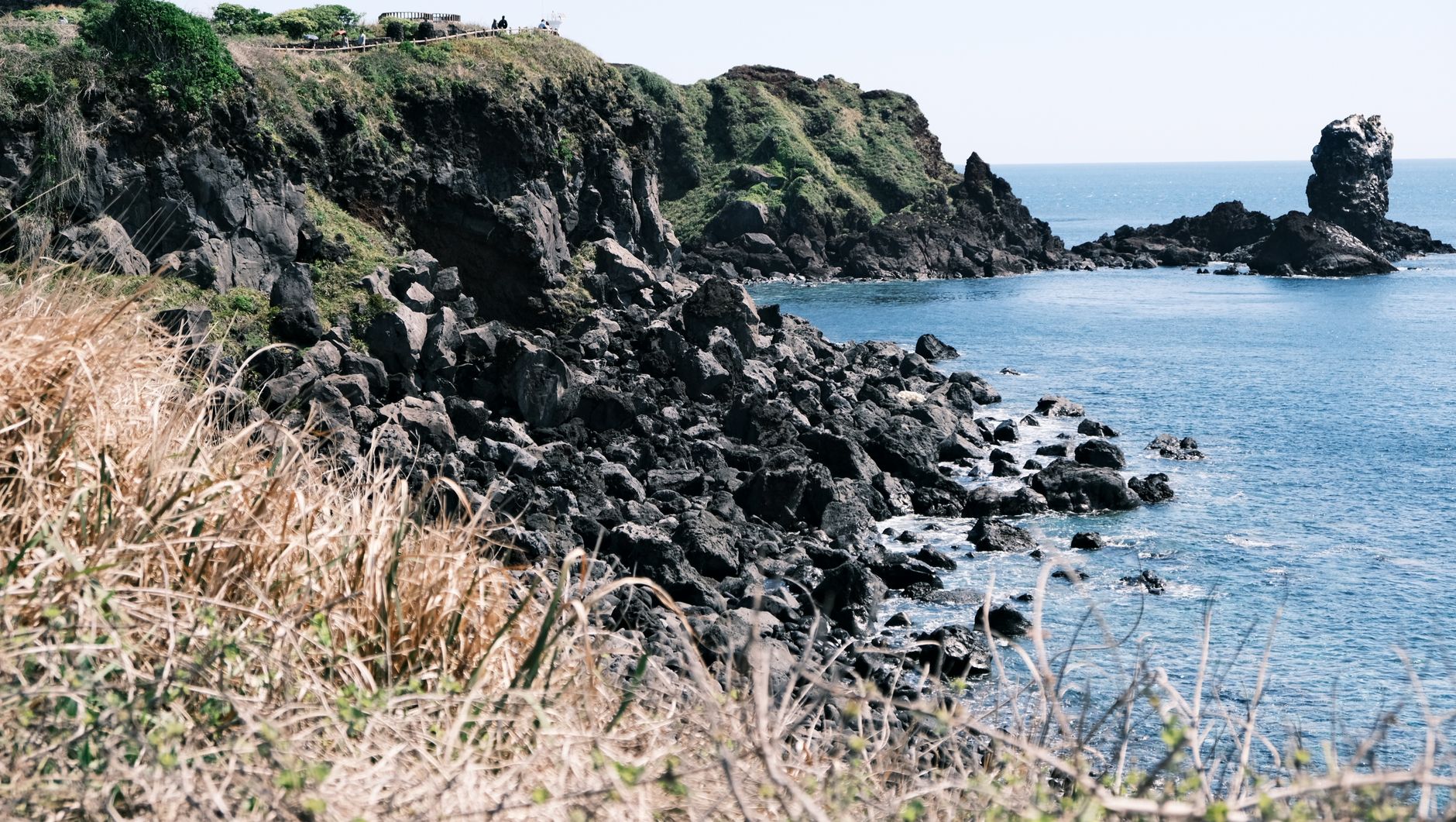
The shack sits maybe fifty meters from the edge of a cliff that drops straight into the sea, and on clear days you can see the volcanic cone of Udo island rising across the channel. But there’s nothing picturesque about the building itself — the concrete floor is worn smooth by decades of foot traffic, the ceiling has water stains from a leak that’s been patched more than once, and the kitchen is visible from the dining room, a small space dominated by a wood-fired stove that fills the room with heat and smoke. The chairs are mismatched, the kind you’d find at a flea market. The makgeolli is served in glass beer mugs, not traditional bowls. None of this feels like an aesthetic choice. It feels like a kitchen that has been making the same food for so long that everything else has become irrelevant.
The chain version of sweet-soy chicken, the one that dominates menus across Korea, is a product of optimization. It’s engineered to be inexpensive, fast, and consistent across hundreds of locations. The sauce is a proprietary blend produced at a factory in Gyeonggi Province and shipped frozen. The chicken is par-fried, frozen, and reheated on demand. A plate arrives at your table in under ten minutes, and it tastes exactly the same in Busan as it does in Daegu or Seoul or on Jeju. That consistency is valuable for a certain kind of dining — the kind where you know what you’re getting and that’s the point.
What the halmeoni makes is the opposite of optimization. The recipe changes with the seasons because the ingredients change. The tangerine concentrate she uses in winter is different from what she makes in summer, because the fruit is different. The wood she burns comes from whatever is available on the hillside — sometimes pine, sometimes oak from a neighbor’s tree that fell in a storm. The cooking time varies depending on how hot the fire is, how windy the day is, how many customers have ordered at once. You can’t franchise this. You can’t scale it. You can’t even predict exactly how it will taste on any given day. And that unpredictability is precisely what makes it worth seeking out.
On my third visit, I brought a friend who works as a food writer for a Seoul magazine. She ordered the chicken skeptically — she’d eaten more Korean fried chicken than anyone I know and had developed strong opinions about what counted as good. After the first bite, she put her chopsticks down and stared at the plate for a few seconds. “I can’t figure out what I’m tasting,” she said. “It’s sweet, but not in a way I recognize. It’s not sugar. It’s not honey. It’s not fruit syrup or something like that.” I told her about the tangerines. She nodded slowly. “That makes sense. But then why doesn’t it taste like citrus?” That was the thing — the tangerine flavor had been cooked down so thoroughly that it had transformed into something else entirely. The fruit’s acidity had mellowed into a gentle tartness, its essential oils had dispersed and recombined with the soy and garlic, and what remained was sweetness without origin, a flavor that tasted like itself rather than its ingredients.
The halmeoni came out of the kitchen during our meal and sat down at the table next to us, lighting a cigarette and watching the television. My friend asked her, through my limited Korean, how long she’d been making the chicken. “Longer than you’ve been alive,” she said. “Longer than my children have been alive. I started when my husband was still here.” She gestured at a framed photograph on the wall — a younger man in a fishing cap, standing next to a boat. “He caught the fish. I cooked the chicken. That was the agreement.” She didn’t elaborate, and we didn’t ask. The photograph has been there on every visit since. So has the chicken.
There’s a moment that happens around halfway through a portion of the halmeoni’s chicken, a moment I’ve experienced every time I’ve eaten there. The initial hunger has been satisfied, the first few pieces have gone down quickly, and now you’re eating more slowly, tasting more deliberately, noticing details you missed on the first pass. The skin has a texture that’s hard to describe — not crispy, not soft, but something in between, like a barrier that has been cooked to the point of surrender. The meat underneath is almost falling apart, separating from the bone with a gentle pull. The sauce has soaked through to the deepest layers, so that even the center of the largest pieces tastes of the tangerine-soy combination. It is, in its way, a perfect piece of cooking — not because of any single element but because of how completely every element has been integrated into every other.
The shack’s location, at the edge of a cliff on the eastern coast of Jeju, means the weather is never predictable. I’ve eaten there in rain so heavy the roof drummed like a percussion instrument, in a fog so thick the sea disappeared entirely, in a wind that made the building’s walls creak and groan. Each time, the chicken tastes the same — not in the way chain food tastes the same across locations, but in the way that a stable recipe made by the same hands over decades tastes the same. The environment changes. The food doesn’t. That consistency, paradoxically, is what makes it feel so alive compared to the sterile predictability of the chain version.
The last time I visited, in November of last year, the halmeoni was closing early. A storm was forecast to hit the island overnight, and she wanted to get home before the roads became dangerous. She sold me her last three portions at a discount, wrapped in foil and newspaper, and told me to eat them before they got cold. I drove to a pull-off near the Seongsan Ilchulbong peak, parked facing the sea, and ate the chicken with my hands while the sky darkened and the first drops of rain began to fall. The wind was strong enough to rock the car. The chicken was still warm, still sticky, still tasting of tangerines and smoke and something I will never be able to describe accurately to anyone who hasn’t eaten it themselves.

📷 Photos: nana liu (Pexels), Kharl Anthony Paica (Pexels)