The mask is the detail nobody warns you about. Not the heavy, industrial respirators the miners carry, but the cheap surgical masks sold outside the parking area at the foot of Ijen for five thousand rupiah — about thirty cents. I bought one because the man selling them had a kind, patient face and because I hadn’t packed anything better. It was the first of several decisions that morning that I would revise in my head before the sun even came up.
I arrived in Banyuwangi two days before the climb, on a bus from Probolinggo that took the coastal route through Situbondo. The road hugged the northern shore of East Java for stretches, and through the grimy window I could see the strait to Bali, hazy and distant. The bus dropped me at a terminal that was mostly a dirt lot. A motorcycle taxi took me the last three kilometers to a homestay I’d booked the night before, a converted house with a concrete floor and a fan that sounded like a small engine struggling to start. The owner, a woman named Ibu Retno, brought me a glass of sweet tea and asked when I planned to go up the mountain. She said it as if assuming I would, and I said yes, the next morning.
What I hadn’t realized until then was that the climb to the crater rim is only half the journey. The miners themselves descend another eight hundred meters into the crater, down a loose stone path that switchbacks along the inner wall, to reach the fumaroles where sulfur gas condenses into a bright yellow liquid that hardens as it cools. They chip it out by hand, load it into woven baskets, and carry it back up — a load of sixty to eighty kilograms per trip, sometimes two trips a day. The gas they breathe can hit concentrations well above any short-term exposure limit you’d want to look up. The gas masks issued by the cooperative work, but many miners prefer not to wear them because the masks fog up or make it harder to breathe during the climb.
I started the hike at one in the morning. The guide I’d found through the homestay, a man in his early thirties named Yusuf, met me at the post with a flashlight and a plastic bottle of water. He asked if I had a mask and I showed him the flimsy surgical one. He didn’t say anything, but he handed me a proper respirator from his own bag, a half-face model with replaceable filters. “You will need this,” he said. “The gas is worse tonight.” I asked him how he knew. He pointed at the sky, which was clear, and said the wind was low. “No wind means the gas stays in the crater. It pools. The miners call it the blue lake, but it is not water.”
The trail is a steady incline for about three kilometers, the surface a mix of packed volcanic gravel and larger rocks that shift underfoot. There are reflective markers at irregular intervals — some attached to posts, some painted on boulders — and in the dark, with only a headlamp and the flashlights of other climbers ahead, it was easy to lose the path entirely. I lost it twice. The first time, I ended up walking through a patch of scrub that scratched at my arms and turned out to be a dead end above a drainage gully. Yusuf called me back without irritation, just a short whistle and a gesture toward the correct line. The second time, I was following a group of three French tourists who took a wrong turn near the top; we all ended up on a ridge that overlooked the dark crater but had no safe way down. Yusuf appeared again, wordless, and pointed to a set of stone steps cut into the wall that I had walked straight past.
The rim at 2,300 meters is cold, colder than I had expected for a tropical volcano. The wind, which Yusuf had said was absent lower down, was present at the top — a steady, cool draft that smelled faintly of struck matches. The view into the crater was a black void with occasional pockets of orange glow where the sulfur burned. Below, at the bottom of the crater, the miners’ headlamps moved like slow fireflies across the floor. I could hear them, too — a sound like metal on stone, repeated and rhythmic, the noise of chisels and hammers breaking apart sulfur deposits that have been forming since the last eruption.
The descent into the crater is not a path at all. It is a series of switchbacks cut into the rock, some so narrow that two people cannot pass each other without one pressing against the wall. The grade is steep enough that I had to lean backward and dig my heels into the loose gravel with every step. Yusuf went ahead, his flashlight beam bobbing, and I followed, trying to match his pace. After about fifteen minutes, the gas hit.
It hits the throat first — a sharp, acrid sensation that is not quite burning but feels like inhaling something that has physical weight. Then the eyes start watering. I put on the respirator Yusuf had given me and the relief was immediate, but I could still taste the sulfur at the back of my tongue, a metallic tang that stayed with me for hours afterward. I saw a miner coming up the path in the opposite direction, a basket of sulfur on his back, and he was not wearing a mask at all. His face was streaked with sweat and yellow dust. He nodded at me as I passed, and I nodded back, and I could not think of anything to say.
Inside the crater, the liquid sulfur that condenses at the vents is a vivid, almost unnatural yellow — the color of a school bus or a warning sign. It drips from ceramic pipes that the miners have fitted into the fumaroles and pools in shallow depressions in the rock. When it catches fire, it burns with a blue flame that is visible only in near-total darkness, a low, flickering light that looks more like a chemical reaction than a fire. The miners call it api biru, blue fire. It is the reason most tourists come — to see the flame. But the miners are the reason the flame exists at all, because without their pipes and their labor, the gas would simply vent into the atmosphere and the sulfur would harden underground.
I spent about an hour at the bottom, moving between three different fumaroles. The heat from the vents was intense enough that I could feel it on my face through the respirator. The ground around each vent was warm to the touch, even through the soles of my boots. I took photographs, but the camera struggled with the contrast — the bright blue flame against the black rock, the headlamps of the miners, the occasional flare of a cigarette. I adjusted settings I had not touched since a workshop in Melbourne three years ago. Most of the frames came out underexposed or blurred. A few worked, but not the ones I had envisioned.
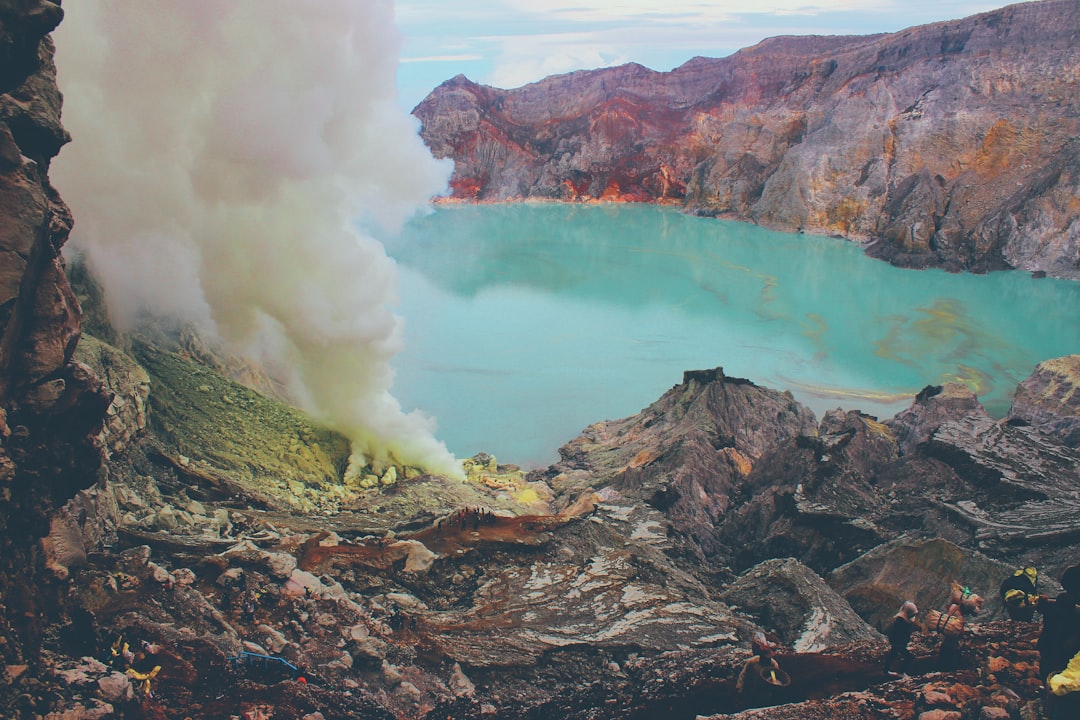
The climb back out of the crater is the part that most accounts skip. It is harder than the descent, because the gas is thicker in the morning as the sun warms the crater floor and the air becomes still. I took breaks every twenty or thirty steps, leaning against the rock wall, trying to breathe slowly through the respirator. My legs were shaking by the time I reached the rim again. Yusuf waited at the top with a bottle of water and a small packet of biscuits, which I ate sitting on a rock while the sky turned gray and then pink. The crater below was now visible in daylight — a vast, pale yellow basin streaked with black, the fumaroles smoking at the bottom. It looked like a different place entirely, stripped of the mystery that the darkness had given it.
On the rim, I met a miner who had finished his first load of the day. His name was Adi. He was twenty-six and had been working the crater for eight years. He had a wife and a daughter in a village on the other side of the mountain. He showed me the calluses on his hands, thick and yellowed, hard as the sulfur itself. When I asked him what he thought of all the photographers who came up here, he laughed and said they were strange — climbing a mountain to take pictures of a job that he did every day. “But it is good for us,” he said. “The tourists bring business. Sometimes they buy the sulfur carvings.” He pulled a small figurine from his bag, a crude elephant carved from a block of sulfur. It smelled faintly of rotten eggs. I bought it for fifty thousand rupiah, about three dollars. It is sitting on a bookshelf in my apartment now, and every time I pass it I remember the taste of the air in the crater.
Most of the other tourists had left by the time I made it back down. The parking area was nearly empty, the food stalls packing up. I bought a bottle of water and a fried banana from a woman who had a small charcoal grill and a stack of paper plates. The banana was hot and sweet and I ate it standing by her stall, watching the last of the miners come down the trail with their baskets. A few of them stopped to buy cigarettes or tea. One of them sat on a bench and took off his boots, revealing feet wrapped in strips of cloth where the blisters had formed. He did not look at me. He just sat there, lighting a cigarette, staring at the ground.
The bus back to Banyuwangi left at nine in the morning. I sat by the window with the respirator still around my neck, the sulfur dust ground into the fabric of my jacket. The sun was already hot. The view from the bus was the same road I had traveled two days earlier, but in the opposite direction. I thought about the miners, about Adi and the man with the blistered feet, about Yusuf and his spare respirator. I thought about the number of times I had read or heard a description of Ijen before coming here — the blue flame, the turquoise crater lake (which I never saw, because the sulfur mining obscures it with smoke most mornings — or so they tell me), the photographs of men in masks carrying baskets. Those descriptions were not wrong. They just all ended too early. They stopped at the image, at the moment the shutter clicked, and left out everything that came after — the climb back, the gas in the lungs, the silent bus ride home.

📷 Photos: Zulfahmi Khani (Unsplash), Marc Szeglat (Unsplash)