The Rail Line That Led to the Wrong Orchard
The Rail Line That Led to the Wrong Orchard
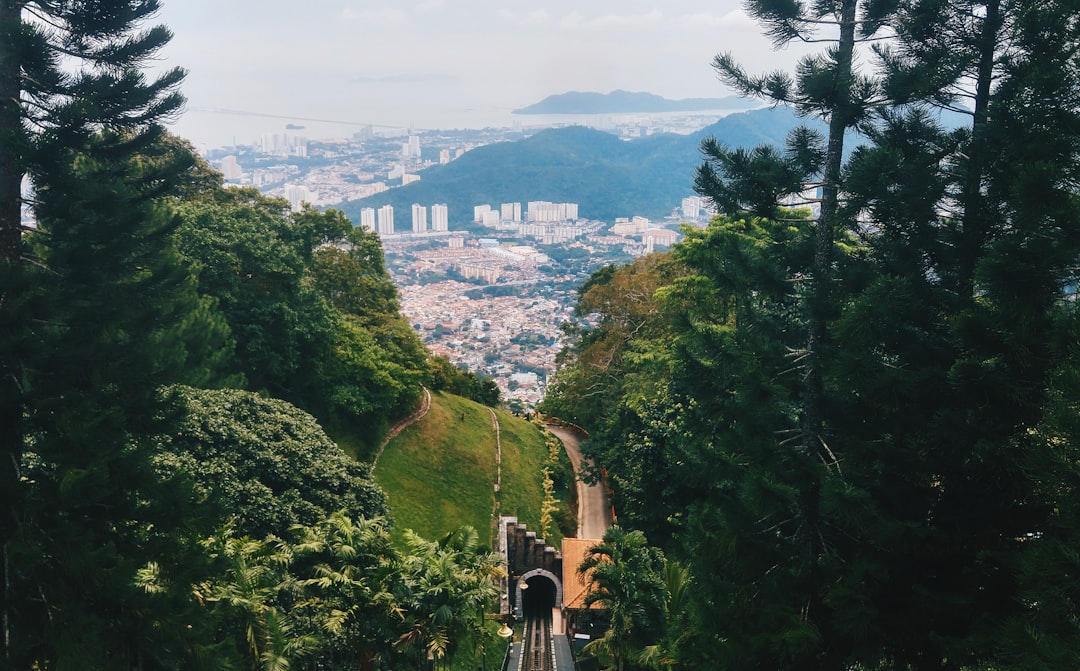
The Penang Hill Railway is what most visitors mean when they talk about train tracks and durian on the island. It’s a funicular, runs every half hour, and drops people near a cluster of stalls that sell the fruit at prices adjusted for tourists. That’s not the route that matters. There’s another set of tracks, disused and mostly forgotten, that runs along the northern edge of the island near the coast. It was built in the 1890s to haul tin and rubber, and it stops abruptly just past a village called Teluk Kumbar. The durian orchard at the end of it is not easy to find, and the first time someone tries, they will almost certainly get it wrong.
A visitor named Renata had read about this orchard in a forum post from 2019. The post was imprecise on directions—”follow the tracks past the blue shed, you’ll smell it before you see it”—and the blue shed, it turned out, had been demolished. Two hours of walking in the wrong direction, under a sun that moved faster than expected, led to a dead end at a fenced-off quarry. The guard at the gate shrugged. “You’re the third one this week,” he said. “Everyone wants durian. Nobody wants to look at a map.”
The Track That Wasn’t a Trail
The old railway bed is not maintained as a walking path. Vegetation reclaims it unevenly—some sections are clear gravel, others require pushing through waist-high lalang grass that leaves thin cuts on bare arms. The rails themselves are gone, salvaged decades ago, but the sleepers remain in places, half-rotted and slick after rain. Renata’s mistake was assuming a “walk along the tracks” meant a gentle stroll. It did not. By the time she reached the quarry gate, she had lost forty minutes and a litre of water she should have conserved.
The man at the quarry gate gave directions that were better than the forum post, but not by much. “Go back to where the tracks cross the stream,” he said. “There’s a red-and-white post. Follow the small path to the right, not the left.” The small path was not immediately visible. Another fifteen minutes of backtracking before it appeared, mostly hidden behind a cluster of bamboo. The path itself was narrow, barely a foot wide, and led uphill through secondary forest. The air changed noticeably: the humidity deepened, and the sound of traffic from the coastal road faded entirely.
The Problem With “Smell It Before You See It”
The forum post’s description was true but useless. Durian has a strong smell—anyone familiar with the fruit knows the mix of custard and diesel and something like fermented onions—but in a forest, smells don’t travel in a straight line. Wind shifts. The valley funnels scents in unpredictable ways. Renata caught a whiff twice, followed it both times, and ended up at the same tree, which had no fruit on it. The actual orchard was another hundred metres further, hidden behind a rise, and visible only once she was nearly on top of it.
The grower, a man named Ah Hock who had been running the orchard for thirty-two years, found her first. He was coming down from the upper slope with a basket of dropped fruits. “You walked past three times,” he said, without apparent surprise. “The wind was wrong today. Tomorrow it will be better.” He did not ask why she was there. Tourists had been finding their way to his orchard for years, though he claimed the number never exceeded a few dozen in any given month. “Too hard to reach,” he said. “That’s the point.”
What Cost More Than Expected
The financial cost of the trip to the orchard was small—the durian itself was fifteen ringgit per fruit, about three dollars and fifty cents US, a fraction of what the stalls near the funicular charged. What cost more was time and what Ah Hock called “the patience tax.” Renata had assumed a half-day excursion: coffee in George Town at eight, a Grab ride to Teluk Kumbar by nine, an hour of walking, an hour at the orchard, and back in time for lunch. The actual timeline was different. The Grab driver dropped her at the wrong intersection—”Teluk Kumbar is a big area, ma’am”—and the walk from there added forty minutes. The trail itself took an hour and twenty minutes one way, partly because of the backtracking. Total round trip from George Town: six hours, not including the time spent sitting under the orchard’s open-sided shelter, eating fruit that had fallen that morning, and talking to Ah Hock about rain patterns.
“The mistake everyone makes,” Ah Hock said, “is thinking they can rush it. You can’t. The fruit waits, but the trail doesn’t.” He pointed at the sky. “If the rain starts, the path becomes mud. Then you’re not going anywhere for an hour.” Renata had not checked the weather forecast. It rained at three, a sudden tropical downpour that turned the narrow path into a slick channel of red clay. The walk back took an extra thirty minutes, most of it spent trying not to fall.
The Fruit That Defied Expectation
Ah Hock’s orchard grows a variety called durian kampung—village durian, not the cultivated hybrids sold in air-conditioned supermarkets in Kuala Lumpur. The fruits are smaller, with thinner flesh and a more variable taste. Some are intensely bitter, almost medicinal. Others are sweet in a way that feels accidental rather than engineered. Renata opened one that had fallen the previous night and found flesh the colour of pale butter, with a flavour that started sweet and finished with a distinct note of burnt caramel. “You won’t find this in the shops,” Ah Hock said. “The shops sell consistency. This sells surprise.”
The surprise was not always pleasant. Another fruit, which looked identical, tasted of nothing but alcohol—overripe, fermenting, almost undrinkable. Ah Hock shrugged. “Eat it anyway. It won’t hurt you. It’s just experience.” He did not offer a replacement or a refund. The transaction was informal, cash only, no receipt. The orchard had no sign, no website, no social media presence. It existed purely by word of mouth and by the occasional visitor who found their way down a disused railway bed and up a hidden path.
The Path That Changes Every Year
The orchard’s isolation is not accidental. Ah Hock explained, without any particular pride, that he had deliberately let the trail overgrow in certain sections. “If the path is too easy, people come who don’t respect the trees,” he said. “They shake branches to knock fruit down. They leave trash. They take unripe fruit. The difficult path filters them out.” He described a group of young men who had arrived the previous season with a machete, intending to clear a shorter route. “I told them not to. They did it anyway. The path they made is gone now. The forest took it back in three months.”
The railway bed itself is also changing. Sections have been washed out by monsoon rains. A new housing development near the quarry has redirected the access point. The blue shed that Renata’s forum post mentioned is gone, replaced by a concrete drainage structure that looks nothing like a shed. “The instructions you read last year might not work next year,” Ah Hock said. “That’s why I don’t write them down. It’s better if people arrive and figure it out. The ones who figure it out are the ones I want to talk to.”
The Hours Spent Sitting
What made the trip worthwhile, in the end, was not the fruit itself but the time spent under the shelter while the rain fell. Ah Hock brought out a Thermos of weak Chinese tea and a plate of sliced coconut. He talked about the trees—which ones were oldest, which ones produced reliably, which ones he was considering cutting down because their fruit was consistently mediocre. “People think all durian is the same,” he said. “They don’t know that a tree has a personality. Some are generous. Some are mean. This one here”—he pointed to a squat tree with a scarred trunk—”has been giving me good fruit for twenty years. That one over there, the tall one, gives me bitterness every time. I don’t know why. Maybe it’s trying to tell me something.”
Renata asked how he knew which tree produced which taste. He looked at her as if the question were absurd. “Because I eat the fruit,” he said. “Every season. Every tree. You have to know what you’re selling.” It was a level of attention that the durian sold at the roadside stalls never received—those fruits arrived in bulk from plantations, sorted by size, not by character. Ah Hock’s approach was closer to that of a small winemaker than a farmer.
What the Guidebooks Don’t Say
No guidebook mentions Ah Hock’s orchard. It does not appear on Google Maps, does not have a listing on any tourism website, and cannot be reached by calling a number—the orchard has no phone signal and no landline. The only way to confirm it still exists is to go there. That is by design. Ah Hock does not want more visitors than the trail naturally permits. His income comes from a dozen regular buyers in George Town who pick up fruit twice a week during the season. The occasional tourist is a bonus, not a business model.
“If you want to tell people about this place, don’t give them exact directions,” he said, at the end of the visit. “Tell them to look for the old train tracks. Tell them to bring water and to expect to get lost. The ones who come anyway will find it.” It was not a marketing strategy. It was a filter, and it worked.
For anyone considering it, the advice is simple: figure out the details as you go. That’s half the experience.
📷 Photos: fidel (Unsplash)