Chasing the Last Sounds of Hand-Pulled Noodles in Penang’s Chowrasta Market Before They Vanish
Chasing the Last Sounds of Hand-Pulled Noodles in Penang’s Chowrasta Market Before They Vanish
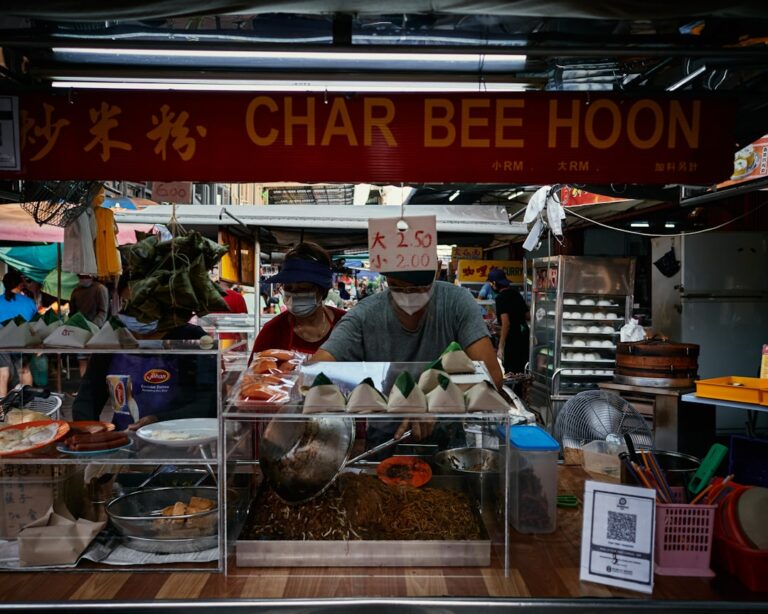
Penang’s Chowrasta Market has been the island’s commercial spine since the early nineteenth century, a dense grid of stalls, pushcarts, and makeshift counters that spill from Jalan Penang into a warren of covered walkways. It is a place of constant, purposeful motion — not a tourist market in the usual sense, but a daily market for people who live in George Town. Among the fishmongers and fabric sellers and fruit vendors, a handful of stalls still do one thing the old way: pull noodles by hand, in full view, to order. That sound — the rhythmic slap and stretch of dough against a wooden counter, the soft thud as it hits the board, the quick slice of a knife — is becoming rare, and in a few years, likely gone.
The hand-pulled noodle, or la mian, requires a technique that takes years to develop. The dough is a simple mixture of flour, water, and alkaline salts, which give the noodles their springy texture and faint yellow tint. What separates a proper hand-pulled noodle from a machine-made one is not just the irregular thickness, which gives each strand a slightly different chew. It is the air trapped inside the dough during the pulling process, the stretching and folding that creates a honeycomb of tiny pockets that absorb broth in a way a uniform extruded noodle cannot. That texture cannot be faked, and it cannot be scaled.
Chowrasta still has two or three stalls that do this work by hand, each with a different approach, each worth finding before the economics of the market make them untenable. The key is knowing where to look, what to order, and how to read the rhythms of a market that does not follow a visitor’s clock.
The Courtyard Behind the Dried Fish Stall
Chowrasta is not a single building but a district of connected lanes and covered sections. The main covered market, a concrete structure from the 1970s, houses the wet market on the ground floor — fish, poultry, vegetables — and dry goods above. But the hand-pulled noodle stalls are not inside that building. They are on the periphery, along the streets that feed into the market, where the rent is lower and the clientele is more local.
The easiest to find is on Jalan Chowrasta itself, the street that gives the market its name. A small stall, no more than a few feet wide, operates off a wheeled cart near the junction with Lebuh Kimberley. The cook works at a waist-high wooden block, pulling a single rope of dough into a full fan of strands in maybe six or seven motions, dusting with flour between each stretch. The rhythm is hypnotic — pull, fold, slap, stretch, repeat — and the noodle count doubles with each pass. A single batch of dough becomes sixty-four strands in about ninety seconds. The skill is in the hands; the timing is in the wrist flick that keeps the strands from sticking.
A second stall is farther in, near the back of the market where the covered walkway opens into a small courtyard. This one is harder to spot because it has no sign and shares its counter space with a stall selling dried squid. The noodle maker here works from early morning until around noon, or until the dough runs out, whichever comes first. Customers bring their own containers or buy the noodles raw, wrapped in banana leaves, to cook at home. That practice — buying raw noodles by weight from a hand puller — is itself a dying habit, as more home cooks switch to dried noodles from the supermarket.
The Tricycle Cart on Lorong Pasar
There is a third stall, less reliably present, that operates from a tricycle cart on Lorong Pasar, the narrow lane that runs alongside the market. The tricycle is the key detail: the stall moves. It appears around 9 a.m. and stays until the noodles sell out, usually by 11:30. The cook here makes only one shape — a thick, irregular strand that resembles biang biang noodles from Shaanxi, though he calls it simply mee tarik, the Malay term for pulled noodles. The noodles are boiled in a large pot of water that is never quite at a full rolling boil, which keeps the starch from washing off the surface. They are served with a soy-vinegar dressing and a handful of fried shallots, nothing more. It is one of the simplest, best things to eat in the market.
The irregular hours of these stalls are not a quirk. They are the result of a business model that depends on a single person doing skilled physical work for a limited number of hours before fatigue sets in. Hand-pulling noodles is demanding — the repetitive motion strains the shoulders and wrists, and the constant standing in the tropical heat of a Penang morning takes a toll. The stall owners are not young, and the economics of the work do not encourage young people to learn the trade. Prices for a bowl of noodles at a restaurant in George Town have risen, but the wholesale price of raw hand-pulled noodles has not kept pace with the labor required to make them. The numbers simply do not work for a new generation.
Three Ways to Eat the Noodles
The noodles sold at these stalls are not intended for immediate eating on-site, which is a point of confusion for many visitors. Unlike the char koay teow stalls in the same market, which cook and serve on the spot, the hand-pulled noodle stalls typically sell the raw product. The buyer takes the noodles home and cooks them. This makes sense for locals, who know exactly what to do with fresh noodles. For a traveler, it requires a small adjustment.
There are three ways to eat hand-pulled noodles from these stalls, none of them difficult:
Option one: Buy the noodles raw and bring them to one of the nearby kopitiam coffee shops that allow outside food. The coffee shop at the corner of Lebuh Kimberley and Jalan Penang, for example, will serve a bowl of hot broth to pour over the noodles for a small charge, typically the price of a drink. The etiquette is to order a drink at the coffee shop — a kopi-O or a teh tarik — and then present the raw noodles to the counter, where the staff will boil them for a minute and serve them in a bowl with the broth. This is the closest the traveler gets to the full experience without a kitchen.
Option two: Some stalls, particularly the ones on Jalan Chowrasta and Lorong Pasar, will cook the noodles on request for a small surcharge. This is not a menu option; it is a negotiation. The cook will indicate an extra ringgit or two, and then boil the noodles in the same pot used for the wholesale batches. The result is served in a plastic bag with a separate bag of broth, which the buyer then empties into a bowl. It is inelegant but effective, and the noodles are at their peak texture — just minutes out of the boiling water.
Option three: Find a stall that serves the noodles ready-to-eat. One such stall is located inside the main market building on the upper floor, near the fabric section. The stall has a small seating area of three plastic stools and a low table. The noodles here are served in a simple broth with a few slices of pork, a handful of green vegetables, and a drizzle of lard at the end. The broth is made from pork bones and dried flounder, a Cantonese technique that gives it a smoky depth. This is the proper way to eat them — hot, in a bowl, from a stall that does nothing else.
Saturdays Are the Wrong Day
Chowrasta Market is busiest between 7 a.m. and 10 a.m., when the morning deliveries arrive and the local shoppers do their daily marketing. The hand-pulled noodle stalls operate within this window, with the best selection between 8 a.m. and 9:30 a.m. Arriving after 11 a.m. means accepting the risk that the stalls have sold out and packed up. Tuesday and Wednesday are the quietest days, when the market is less crowded and the stall owners have more time to talk. Saturdays are the busiest and the least pleasant for a slow exploration.
One practical detail that beginners commonly get wrong: the stalls in Chowrasta do not take credit cards. Cash is the only option, and small denominations are preferable. A bundle of raw noodles for two people costs around three to four ringgit — roughly one US dollar. A cooked bowl from the upper-floor stall runs between six and eight ringgit. The vendors make change from a small metal box strapped to their waist, and they do not appreciate being handed a fifty-ringgit note for a four-ringgit purchase. Break large bills before arriving.
The other common mistake is to assume that the visible stalls on the main street are the only ones. Some of the best noodle pullers operate from the side alleys that only regulars know. The courtyard behind the main market — accessible through a narrow passageway next to the dried fish stall on Jalan Chowrasta — contains a small cluster of stalls that appear after 9 a.m. and disappear by lunchtime. The noodle stall here is operated by a woman who learned the technique from her father, who learned it from his uncle before him. She works at a slower pace than the younger stallholders on the main street, but the noodles are more carefully pulled — thinner, more uniform, with a finer chew. She sells out first, usually by 10:30 a.m.
Ninety Ringgit for Four Hours
It is tempting to describe Chowrasta’s hand-pulled noodle stalls as an endangered species, a last vestige of a dying craft that must be preserved. That framing flatters the visitor’s sense of urgency but misrepresents the situation. The stalls are not vanishing because of neglect or indifference from the local community. They are vanishing because the math of the business no longer holds. A skilled noodle puller can produce perhaps thirty kilograms of noodles in a morning, wholesaling for around three ringgit per kilogram. That is ninety ringgit in revenue, or about twenty US dollars, for four hours of physically demanding work. The alternative — working in a restaurant kitchen, driving a ride-share vehicle, or selling mobile phone accessories — pays better and is less taxing on the body.
The younger generation has made a rational choice. The hand-pulled noodle tradition will not disappear because Penangites stop loving the texture of a freshly pulled la mian. It will disappear because the economic structure that supported it — the apprenticeship model, the multi-generational stall, the pricing that accounted for skill rather than labor time — has eroded faster than the tradition itself. Some things persist despite the numbers, but noodle pulling is not one of them. It is a craft that depends on daily practice, and daily practice depends on daily pay.
What is worth noting is that the hand-pulled noodle stalls that remain are concentrated in Chowrasta because of the market’s particular ecology. The wet market provides the raw ingredients — fresh pork bones for broth, Chinese chives for garnish, lard for frying. The coffee shops provide the seating and the boiling water. The customers provide the demand for a product that has been the same for decades. When any one of these elements shifts — a coffee shop closes, a customer base ages, a rent increases — the entire system becomes unstable. The stalls at Chowrasta are not isolated businesses. They are nodes in a network that is itself being remade by development and gentrification in George Town.
Six Months of Renovation
The Penang state government has announced a series of upgrades to Chowrasta Market, including improved drainage, new electrical wiring, and a reorganization of stall layouts. The intention is to modernize the market and make it more attractive to tourists and younger shoppers. The risk, which has been noted by local heritage groups, is that the disruption of the renovation — the temporary relocation of stalls, the uncertainty of reallocation — will drive the marginal operators out permanently. A noodle puller who cannot work for six months during renovations will likely not return. The stall will be reassigned to a vendor selling dried goods or souvenirs that meet the new aesthetic.
The practical takeaway is that the hand-pulled noodle stalls of Chowrasta are not a permanent attraction. They are an ongoing, fragile practice that could disappear within a few years — not dramatically, not with a public farewell, but simply by not reappearing one morning. A traveler who wants to see the process and eat the noodles should plan the visit sooner rather than later. Checking the dates of any planned renovation work before booking a trip to Penang is a simple step that makes a disproportionate difference in the quality of the experience. A market under construction is a market operating on reduced capacity, and the first stalls to vanish during a renovation are the ones with the thinnest margins — exactly the ones worth seeing.
Showing up early enough, with small bills in hand, and accepting that the stall may not be there on the day of the visit — that uncertainty is part of what makes the encounter worth having in the first place.