The morning was clear above Kidapawan, which felt like good luck at the time. I’d arranged a guide the night before through a contact at the hostel—a man named Emil who’d been climbing Apo since he was seventeen and now, at forty-three, ran a small cooperative of porters and guides out of Barangay Ilomavis. We met at four-thirty outside a bakery that sold plastic-wrapped ensaymada and coffee so sweet it could have been syrup. Emil drank his without sugar. He was slight, with the kind of quiet authority that comes from having done something a thousand times without fanfare.
The first hours were what I’d trained for. The trail from the Lake Agko jump-off climbs through lowland forest, then transitions into mossy terrain where the trees get stunted and the air starts to thin. I felt strong. The pack weighed fifteen kilos—tent, sleeping bag, three litres of water, food for two days—and I’d convinced myself that was reasonable because I’d read blog posts from people who carried twenty-five. I stopped to adjust the straps exactly once. By the time we reached the saddle below the summit, I was still breathing enough to talk.
That should have been a warning, but it wasn’t.
The summit itself is anticlimactic in the way that most actual summits are. There’s a wooden cross, a small clearing, and a view that stretches across Mindanao if the clouds cooperate. They did not. A grey mass rolled in around eleven and stayed. I ate a tuna sandwich and felt the altitude headache begin, faint but distinct, like a finger pressing behind my right eye. Emil sat on a rock and didn’t say much. He’d been up here more times than he could count. The weather was just weather.
What I hadn’t understood—what I don’t think most first-time climbers understand—is that the summit is not the midpoint of the experience. It’s the end of the easy part.
The descent from Apo’s summit follows a different route than the ascent. You come down through what’s called the Boulders, a long stretch of volcanic rock and scree that spills down the mountain’s southern face. It looks manageable from above. I remember looking at it and thinking, okay, this is just walking on rocks. I’d done that before.
It is not just walking on rocks.
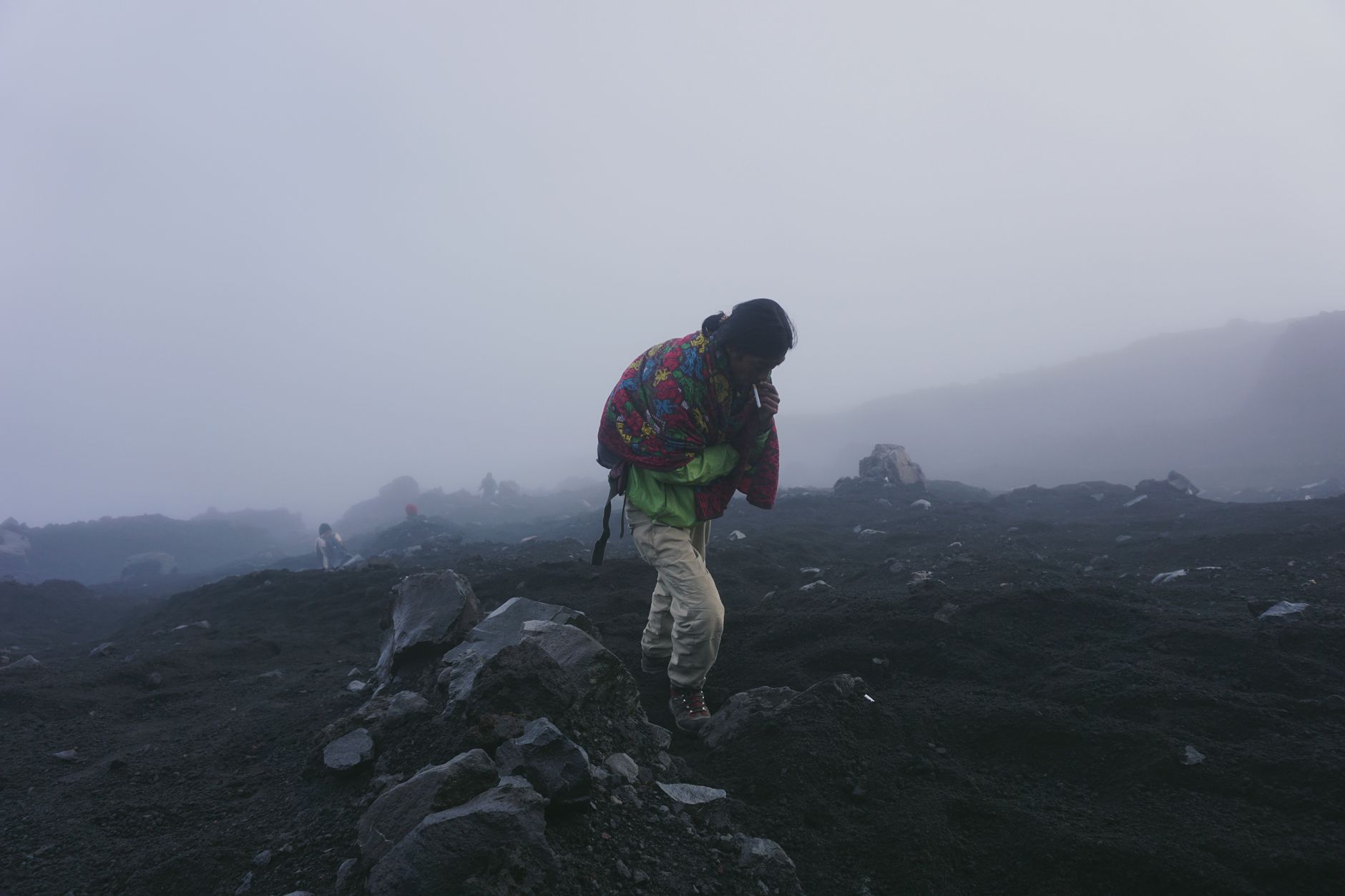
The Boulders section is somewhere around two and a half kilometres of loose, sharp-edged volcanic stone in a gradient that feels engineered to punish anyone carrying weight. Every step requires a choice: commit to a rock that might shift, or step to a different one that also might shift. There’s no stable ground. The rocks are black and jagged, fractured from cooling lava centuries ago, and they slide against each other with a grinding sound that I came to hate. I fell within the first ten minutes. My knee hit a sharp edge and I felt it through the fabric of my trousers—not a cut, but the kind of deep bruise that announces itself later. Emil looked back, saw me on the ground, and waited without expression. He’d seen it before.
The physics of descent is different from ascent in ways that matter. Going up, your quadriceps do the work. They’re strong muscles, built for force. Going down, the load transfers to your knees, your shins, and the small stabilising muscles in your ankles—the ones nobody trains for. Every step is a controlled fall. After forty minutes on the Boulders, my legs started to tremble. The tremor wasn’t dramatic. It was a fine, constant vibration, like the hum of a machine about to shake apart. I stopped to drink water and realised I’d already finished one of my litre bottles. Five hours of descent remained.
I asked Emil how much further to the campsite. He said, in the way that guides say things they’ve said a hundred times, that we would get there when we got there.
The second thing nobody talks about is the heat. The ascent had been cool. At altitude, the sun is strong but the air moves, and sweat evaporates fast enough to keep you comfortable. The descent drops you into a different climate. By the time we reached the lower stretches of the Boulders, the forest had thickened again and the wind stopped. The humidity pressed down. I was sweating through my shirt, and the sweat wasn’t evaporating; it just pooled. My socks were wet inside my boots. The dust from the volcanic rock mixed with the moisture and turned into a fine grey paste that coated everything.
A detail I learned the hard way: the trail markers on the descent are not what you expect. There are no signposts. The path is indicated by small cairns—piles of rocks balanced on larger rocks—that blend into the surrounding terrain. In clear weather, a trained eye can follow them. In the low light of late afternoon, with fog moving through the trees, they become nearly invisible. Emil never hesitated. He walked at a pace that seemed casual but was actually precise, turning at gaps in the vegetation that I couldn’t see until I was right on top of them. Once, I stopped to tie my shoe and looked up to find he’d disappeared. The forest was silent except for my breathing. I called his name and heard nothing. Thirty seconds passed. Then his head appeared from behind a boulder fifteen metres away. He’d been waiting. He didn’t say anything about it.
The campsite at Lake Venado is a grassy area beside a small crater lake, and it arrived at the edge of evening after seven hours of descent. I dropped my pack and sat down on the ground, not caring about the mud. The tremor in my legs had become a permanent state. I ate cold noodles from a plastic container and watched the light fade over the lake. Emil and the other guides set up their own camp a short distance away. They cooked rice and dried fish over a small stove. I heard them laughing about something—one of the porters was telling a story in Bisaya that I couldn’t follow, but the rhythm of it was easy, unhurried. They had worked. Now they were done.
I slept badly. The ground was uneven, and my sleeping pad was too thin to make a difference. At some point in the night, a rat or something similar ran across my tent. I lay awake listening to the fabric shift and decided that this was fine, this was part of it. But the truth is that I wasn’t enjoying myself. I was tired and sore and looking forward to being done.
The next morning, Emil told me the hardest stretch was still ahead.
The descent from Lake Venado to the village of Sibulan is a different kind of challenge. It’s not technical like the Boulders. It’s relentless. The trail drops through dense forest on a path that alternates between steep, eroded gullies and slippery root systems that function like natural stairs—except the stairs are irregular, coated in mud, and angled wrong for human legs. I slipped on the first major descent and landed hard on my tailbone. The pain was sharp and specific, the kind that makes you see stars. I sat there for a moment, not wanting to move. Emil came back and offered his hand. I took it.
The porters carried loads that would have broken me. One of them, a man maybe fifty years old with grey in his hair, had a basket strapped to his back containing two propane tanks, a case of canned goods, and someone’s duffel bag. He moved downhill at a pace I couldn’t match. I watched his feet find purchase on surfaces that seemed designed to reject traction. He never looked down. He had been doing this for twenty-five years. I was a tourist with an overpriced backpack and a knee that was starting to swell.
The mistake I made—the one I keep thinking about—was not training for the descent. I had prepared for the climb. I’d done stair workouts, lunges, calf raises. I’d carried a weighted pack up a hill near my apartment until my neighbours started to recognise me and wave. None of it translated. The descent uses muscles in a different way, under different conditions, with the fatigue of the previous day already baked into your body. You can’t simulate that in a city park.
I asked Emil if most climbers struggle with this part. He said, without looking at me, that most climbers are not prepared for the mountain. They train for the summit. They don’t train for the return.
The last three kilometres were the worst. The trail flattened out into a series of river crossings and agricultural land, which sounds easy but wasn’t. By then, my feet had blistered in places I didn’t know could blister—along the sides of my heels, between my toes, on the ball of my left foot where I’d been compensating for the knee. Every step produced a small wince. I had stopped drinking water because I was tired of stopping to pee. My head ached from dehydration and the lingering altitude. I was moving at a crawl.
A farmer passed us on the trail. He was carrying a sack of something—vegetables, maybe—and he nodded at me with the kind of acknowledgement that people give when someone is clearly struggling and there’s nothing to say about it. He was wearing flip-flops. Rubber flip-flops, the kind you buy at a market for eighty pesos. He walked past me without breaking stride.
The village of Sibulan appeared through the trees as a cluster of tin roofs and concrete walls. I could hear dogs barking and someone playing music from a phone speaker—a pop song I almost recognised. The trail widened into a dirt road, and then I was walking past houses where children were playing in the yard and women were hanging laundry. A tricycle driver saw me coming and started his engine. He knew the routine. Tired climber, dirty clothes, dead look in the eyes. He quoted three hundred pesos to take me back to Kidapawan. I didn’t negotiate.
The guides stayed behind to clean up at the jump-off point. I shook Emil’s hand and paid him the agreed amount plus a tip that he accepted without counting. He said I did fine. I didn’t believe him, but I appreciated the gesture.
On the ride back, sitting in the open air of the tricycle with my pack balanced on my lap, I watched the landscape shift from mountain forest to farmland to town. The driver didn’t try to make conversation. The wind dried the sweat on my face. My knee was throbbing. My feet were ruined. I thought about the farmer in flip-flops and the porter with the propane tanks and the way Emil had walked the trail like he was strolling through his own neighbourhood, because he was.
I got back to the hostel and showered for a long time. The water ran grey. I ate a plate of chicken adobo at a nearby carinderia and drank two bottles of water in a row. The woman running the stall asked where I’d been. I told her Mount Apo. She nodded and said something in Tagalog that I didn’t quite catch, but the tone was knowing. She had probably heard this story before.
The next morning, I couldn’t walk down the stairs without holding the railing. My calves were rigid. My knee had swollen to the size of a small orange. I sat at the same bakery where I’d met Emil two days earlier and ordered the same overly sweet coffee. The woman behind the counter recognised me. She asked if I was going back up. I laughed and said no.

📷 Photos: Iqx Azmi (Pexels), sara nudaveritas (Unsplash)