The first sound I registered in Gyeongju wasn’t birdsong or chanting or the wooden clack of a moktak—it was the wheeze of a radiator pipe in a room that had been heated since three in the morning. I lay there on the thin cotton mat, the yo beneath me doing almost nothing against the floor’s residual warmth, and considered what I’d signed up for. A temple stay at Golgulsa, the only temple in Korea where you can learn Seonmudo—a martial art that looks like tai chi performed by someone who’s genuinely annoyed—had seemed like a good idea when I booked it three months earlier. At 4:35 a.m., with the copper temple bell still vibrating through the stone walls, I wasn’t entirely convinced.
But I got up. Everyone gets up. The bell rings, and you go. Not because anyone checks, but because the person in the next room is already moving, and inertia becomes this quiet collective force. I pulled on the grey practice clothes they’d issued the night before—stiff cotton that smelled faintly of laundry starch and woodsmoke—and walked barefoot across the cold corridor toward the main hall. Dawn hadn’t started. The sky was the colour of old porcelain.
Breakfast wouldn’t come until after the first meditation session, around six. The 108 prostrations—jeol, three bows in sequence repeated until your forehead knows the floor’s exact grain—took about forty minutes. My knees complained. My lower back, which has never been reliable, made its opinion clear somewhere around prostration 30. By the time we finished, the sun had started to edge over the eastern hills, and the cold light coming through the paper doors had a pale, watery quality that made the whole room feel underwater.
Then we ate.
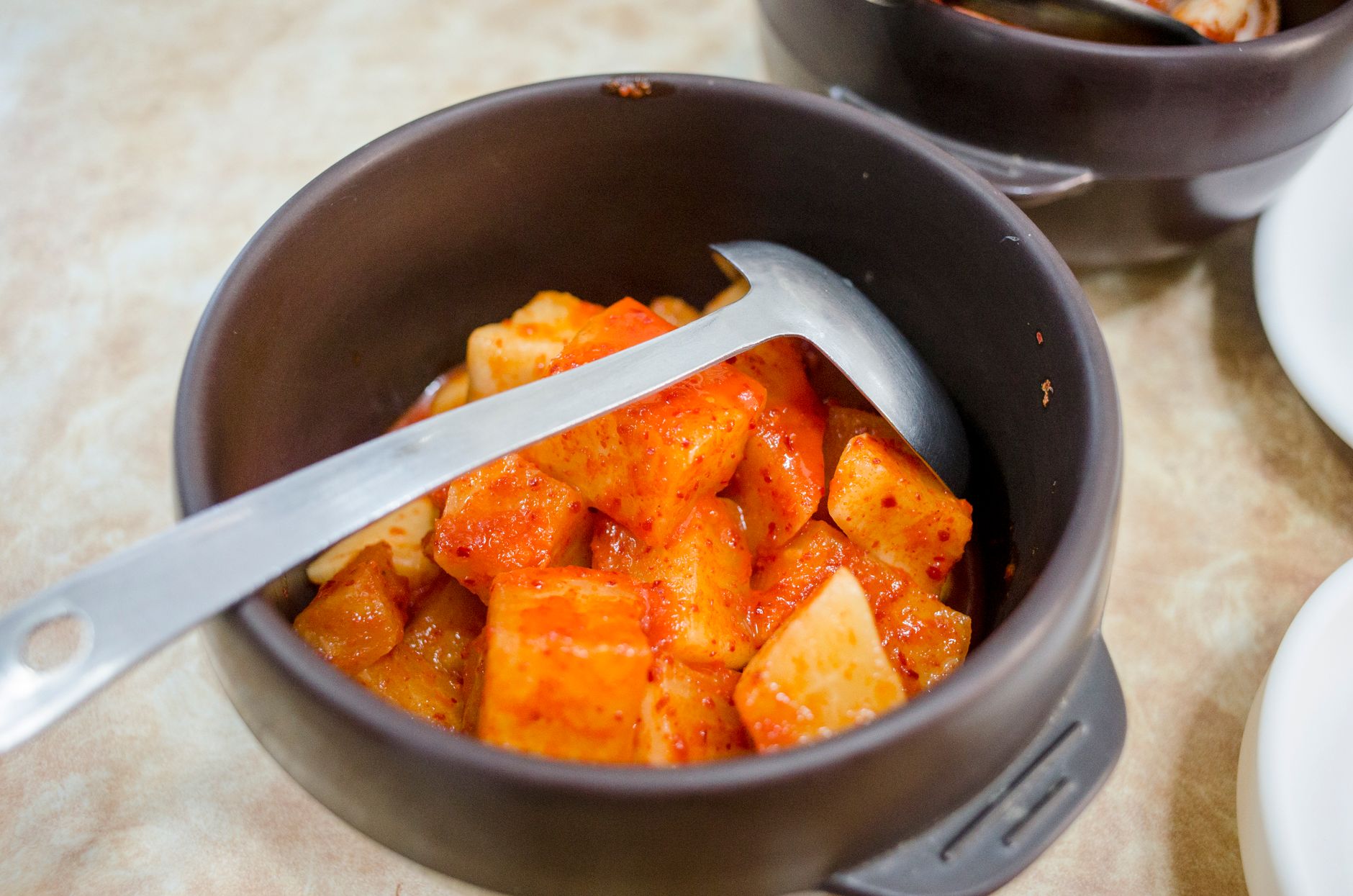
Barley congee, juk, served in a heavy ceramic bowl so hot you had to hold it with both hands through a cloth napkin. Next to it, three small dishes: kongnamul—soybean sprouts seasoned with sesame oil and a touch of gochugaru—slightly vinegary kimchi that had fermented long enough to develop a serious personality, and a small pile of what I later learned was dureup, a wild mountain vegetable blanched and dressed in soybean paste. The entire meal couldn’t have covered an area larger than a dinner plate.
I was hungry enough to eat everything without thinking, but I made myself slow down. The instructions had been clear: eat in silence, in mindfulness, with gratitude. I tried. The congee was plain in a way that felt almost confrontational—no salt, no garnish, just grain cooked until it surrendered. The kimchi provided the only real punch, a sharp, acetic note that woke up my mouth in a way coffee couldn’t have. I finished everything in maybe eight minutes and sat there, bowl empty, chopsticks placed neatly across its rim, wondering if I was supposed to feel something more than just not-hungry.
“Most people expect enlightenment with their first meal,” said the monk who led the afternoon walking meditation. His name was Sunim—not a name, technically, but a title—and he’d been at Golgulsa for eleven years. “They think breakfast will taste different because the circumstances are different. But congee is congee. The difference is in how you receive it.” He was somewhere in his late thirties, I think, with the kind of calm that comes from not being in a hurry, and he said this the way someone might describe the weather.
I thought about that line for the rest of the day. It’s the kind of statement that sounds like a koan until you’ve actually sat through a meal that minimal, in a room that quiet, with nothing to do but notice the temperature of the bowl and the texture of the barley and the way the salt in the soybean paste hits the back of the tongue. The congee wasn’t a revelation. But the act of eating it, stripped of everything else—no phone, no conversation, no plan for what came next—made me realise how much of what I usually call “eating” is actually something else: distraction management, multitasking, nervous consumption of fuel between events.
The temple stay lasted two nights, and each morning followed the same rhythm. Bell at 4:30. Meditation at 5:00. Breakfast at 6:00. The congee changed slightly—one day it had pumpkin, another day small cubes of potato—but the principle held. By the second morning, I’d stopped waiting for the meal to mean something and just ate it. I don’t know if that’s the point, but it felt closer to the point than whatever I’d been doing on the first morning.
What most people don’t tell you about temple food—sachal eumsik—is how much texture matters when flavour is restrained. Korean temple cuisine avoids the five pungent vegetables: garlic, onion, leek, chive, and green onion. These are believed to stir desire and aggression, and they’re excluded from monastic kitchens. So the usual flavour anchors of Korean cooking—the garlic in the kimchi, the scallion in the broth, the raw onion in the dipping sauce—simply aren’t there. What remains are the subtler notes: sesame’s nuttiness, the gentle heat of ginger, the deep savour of fermented soybean paste without the sharpness that garlic usually provides.
This absence changes everything. The kimchi, made without garlic, is less aggressive and more complex, the fermentation doing work that garlic usually covers up. The soy sauce-based soups are lighter, almost translucent. Vegetables appear in their own flavour, not as a vehicle for seasoning. A simple dish of braised burdock root, ueong-jorim, becomes a study in sweetness that builds slowly rather than hitting you immediately. I ate a bowl of rice with doenjang jjigae—the temple version, without garlic—and found myself paying attention to the soybean paste in a way I never had before, noticing the way different batches of fermentation produced different levels of funk and salt.
There was a mistake, early on, that I’m glad I made. On the first afternoon, between the chanting practice and the tea ceremony, I’d wandered into the temple’s small kitchen garden, thinking I might take a photo of the neat rows of perilla and chard against the stone wall. A young monk—I never got his name, just the impression of someone under twenty-five with a shaved head and a serious expression—saw me and motioned for me to come closer. He didn’t speak English. I didn’t speak Korean beyond the basics. But he handed me a pair of scissors and pointed at the perilla leaves, then at a basket, then at himself, then at me. The message was clear: help.
I spent forty minutes harvesting perilla in the late autumn sun, the leaves cool and slightly fuzzy against my fingers, the scissors making a satisfying snip-snip-snip sound. No one checked on me. No one told me where to take the basket when I was done. I just worked until the basket was full, then stood there holding it, unsure what came next. Eventually the young monk reappeared, took the basket with a small bow, and disappeared back into the kitchen. I never saw the perilla again. It was, I think, a kind of test—or maybe just a practical request that I’d accidentally turned into a meaningful experience by not being able to ask questions about it.
That evening, the congee was slightly different. I like to think a few of those perilla leaves ended up in it.
Gyeongju itself surrounds you like a museum you’re allowed to touch. The temple is set into the side of Mount Hamwol, about twenty minutes by taxi from the city centre, and the drive passes through rolling hills dotted with the grassy burial mounds of Silla kings—enormous, deliberate humps of earth that look like the landscape is breathing. The city’s official nickname is “the museum without walls,” and it earns it. Every third turn reveals a pagoda or a stone Buddha or a pavilion that’s been standing since before anyone thought to write down its date of construction.
But the temple stay isolates you from that, deliberately. You’re not supposed to sightsee during the retreat. The boundary between the temple grounds and the rest of the world is both physical and psychological—a low stone wall, yes, but also a schedule so full that you don’t have time to wonder what’s happening in the city. The only exception is the free hour between 4:00 and 5:00 p.m., when guests are allowed to walk the dulle-gil, a forest path that loops around the temple complex. I walked it both afternoons, following the trail through pine and oak, the ground carpeted with fallen needles that made every step soft and quiet. The only sounds were my own breathing and the occasional scrape of a magpie overhead. I didn’t see another person on either walk.
The second morning, I ate the congee differently. Not faster or slower, but with fewer thoughts about whether I was doing it right. The kimchi was the same batch—I recognised the slightly pink tint of the liquid, the way the cabbage had softened unevenly—and it tasted better the second time, or maybe I tasted it better. The soybean paste on the dureup was saltier than I remembered, and I ate the vegetable without rice first, just to feel the bitterness and salt together before the grain smoothed everything out. The meal took maybe fifteen minutes, and when it was done, I sat with the empty bowl and the four small dishes and the chopsticks laid flat, and I didn’t have a thought worth naming. It was just quiet, and I was in it.
I checked out that afternoon, returning the grey clothes and getting back my own bag and phone. The gate of the temple, when I stepped through it, made a sound like a door closing in a library—not loud, but final. I walked down the stone path toward the main road, where a taxi would take me back to the station, and for the first time in two days I thought about coffee. There would be coffee in Seoul in three hours. There would be garlic in my dinner. There would be conversation, and phones, and the usual scatter of modern life.
And when I ate dinner that night—a bowl of spicy pork stew with rice and more banchan than I could count—I noticed how fast I ate it. How little I tasted the individual components. How much I was already thinking about what to order next. The congee had been a kind of reset, I think, not because it was profound but because it was the opposite: boring, repetitive, plain. And that plainness had done something that intensity never could. It made me pay attention.
The best thing about temple food, I’ve decided, isn’t its sophistication or its history or its health benefits. It’s that it refuses to perform for you. It doesn’t try to impress. It sits there, in a ceramic bowl, at six in the morning, in a room full of people who’d rather be sleeping, and it asks only that you eat it. That’s all. And for two days, that was enough.

📷 Photos: makafood (Pexels), Kai-Chieh Chan (Pexels)