The jeepney dropped me at the lakeside dock in Talisay at 7:13 AM. I know the time because I checked my phone twice, hoping I’d misread the departure schedule I’d found on a forum the night before. The air already felt thick and wet, the kind of humidity that settles into your lungs before you’ve done anything strenuous. A dozen other people milled around the ticket booth, most of them Filipino families with coolers and children in sandals that were not going to survive the volcanic scree. You always notice the shoes first.
I hadn’t considered the boat situation. This was the first mistake, and it set the tone for everything that followed. The crater is on an island in a lake, and to get to the island you need a boat, and to get a boat you need to wait for enough people to fill one unless you pay for the whole thing yourself. The families had already formed their groups. I stood at the edge of the dock watching a man scrape barnacles off a hull with what looked like a garden trowel, calculating whether I wanted to pay 2,500 pesos for a private boat or wait an indeterminate amount of time for another solo traveler to appear.
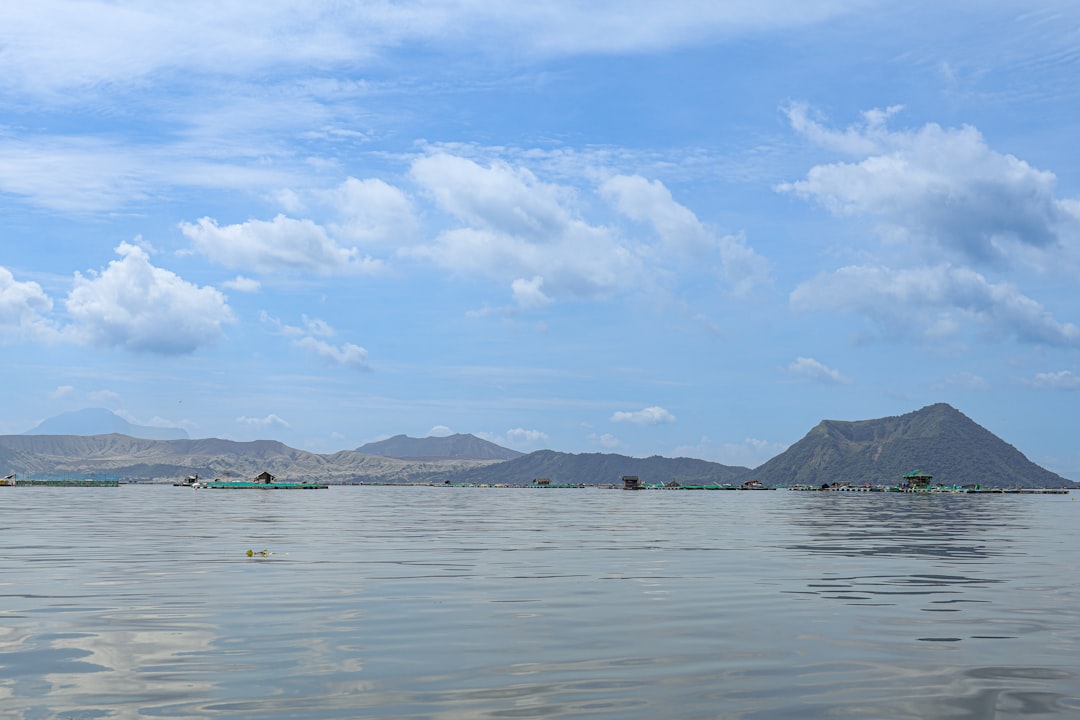
A German guy named Tobias showed up twenty minutes later, backpack and hiking poles, the kind of prepared that made me feel embarrassed about my single bottle of water. We split the boat. The lake crossing took maybe fifteen minutes, and the water was the color of old tea. The boatman pointed at something in the distance — a fish cage, I think — and said something in Tagalog that I didn’t understand. I nodded anyway. This became a pattern.
The trail starts at the island’s dock and goes straight up. Not switchbacks, not a gradual incline. Straight up, on loose volcanic gravel that shifts under every step like walking on a steep beach. Within ten minutes I understood why the guy at the guesthouse had looked at my sneakers and said nothing. Local kids had ponies for rent — 500 pesos to ride most of the way up — and watching them pass me, small bare feet dangling, I felt a specific kind of tourist shame that only arrives when you’re already committed to a bad decision.
The sulfur smell hit before I saw anything. It came in waves, faint at first, then strong enough that I could taste it. The guidebook I’d skimmed mentioned it but described it as a “distinctive volcanic aroma,” which is the kind of phrasing that prepares you for nothing. It smelled like a struck match held too close to your face, mixed with something rotting. A few tourists ahead of me had tied bandanas over their mouths. I hadn’t brought one.
Tobias, who had done this before, told me the crater lake changes color depending on the season and the volcanic activity. “Sometimes it’s turquoise,” he said, not breathing hard despite climbing at a pace I was struggling to match. “Sometimes it’s gray. Last year it was almost green.” He’d been in the Philippines for three months, working his way south, and he said Taal was the most unpredictable volcano he’d visited. “It’s active. Not like, ‘oh, it could erupt someday’ active. Like, it erupted three years ago and forced evacuations active.” I had not known this. I had assumed the permit I bought at the trailhead covered the relevant risks. Or something like that.
The permit cost 500 pesos. The guide cost another 500. The boat was 1,250 each. The jeepney from the town to the lake was 50 pesos. By the time I reached the crater rim, I had spent close to 2,500 pesos on getting to one spot, and I hadn’t eaten anything since the pandesal I grabbed at 5 AM from a bakery near my hostel. The numbers run through my head because I remember sitting on a rock at the top, trying to calculate whether the whole thing was worth what I’d spent, and realizing the calculation itself was pointless.
The crater lake is smaller than the photos suggest. This is not a complaint — it’s a factual observation that would have saved me some disappointment if I’d known it beforehand. The wide-angle shots you see online compress distance and make the lake look like a massive body of water inside the crater. In reality, it’s a pond. A striking, sulfuric, steaming pond, but a pond nonetheless. The steam rises from vents along the edges, and the water itself is a pale gray-green that shifts as you watch. I sat on the rim for maybe forty minutes, watching the steam move, listening to the other tourists take turns posing for photos with their backs to the lake. No one spoke very loudly. The sound that carried most was the crunch of gravel under boots.
Here’s the detail that surprised me: the crater rim has vegetation. I had assumed, based on every photo I’d seen, that it would be barren rock, all gray and brown and dramatic. But there were small bushes and tufts of grass growing out of the ash, and even a few flowers — yellow, small, unbothered by the sulfur. A local guide was explaining to his group that these plants only grow back after a long period without eruption. “The more plants you see,” he said, “the longer it’s been quiet.” The last major eruption was January 2020. The plants were coming back.
I had not checked the 2020 eruption history before coming. I had glanced at Wikipedia the night before, read something about it being one of the most active volcanoes in the Philippines, and moved on. The 2020 eruption killed people, destroyed crops, coated everything in a layer of ash that took months to clean up. The communities around the lake were evacuated. I learned this from a laminated information board at the crater rim, standing next to a German tourist who already knew it. The way I learned it — belatedly, from a sign, after I’d already arrived — felt wrong. Not dangerous, exactly. Just disrespectful.
The hike down was harder than the hike up. The loose gravel, which had been annoying on the ascent, became treacherous. I watched a woman in front of me slide about ten feet before catching herself on a guide’s arm. My sneakers had no grip left. I sat down twice, not from exhaustion but from the specific fear of twisting an ankle a kilometer from the nearest vehicle. Tobias, who had proper boots, offered to carry my water bottle. I let him.
At the bottom, the ponies were being led back to their owner’s house, and the boatman was waiting with a cigarette and a paper cup of coffee. He asked if I enjoyed the view. I said yes, because what else do you say. The lake crossing back was quiet. The sun had burned off most of the morning haze, and the water looked different in the full light — clearer, less mysterious. A group of kids were swimming off a floating platform near the shore, yelling and splashing. The boatman pointed at them and laughed. “They swim every day,” he said. “Good for them.”
Back in Talisay, I found a small eatery near the jeepney terminal and ordered chicken adobo and rice. The woman running it asked where I was from and whether I’d made it to the crater. She laughed when I said yes. “You look tired,” she said. “Everyone looks tired after.” She refilled my water without asking.
I spent the rest of the afternoon sitting on a bench near the terminal, waiting for the next jeepney back to the main road. A rooster kept walking past. A dog slept under a parked tricycle. A man sold boiled peanuts from a basket, and I bought a small bag for 20 pesos, not because I was hungry but because he’d been sitting there for hours and no one had bought anything. The peanuts were warm and salty and made my fingers sticky.
The jeepney took forty minutes to fill up. I sat in the back, next to a woman carrying a live chicken in a woven bag, and watched the lake disappear behind the trees. The road curved around hills planted with coconut palms and banana trees, and every few minutes we passed a house with a sari-sari store built into the front room. A child waved from a doorway. I waved back.
Bring proper shoes. Check the eruption history. Eat before you go. Accept that the boat situation will cost more than you expect. The rest you figure out as you go. That’s half the experience.

📷 Photos: Bridget Adolfo (Unsplash), Andreyanto Arby Kurniawan (Pexels)