I paid 4,000 won for a can of iced Americano from a vending machine near the Seongsan Ilchulbong ticket booth. It was 4:20 in the afternoon, and the woman behind the counter at the convenience store across the lot had already started wiping down her grill. She gave me a look that said she wasn’t expecting any more business from the crater today. Most visitors had come and gone by then, funneled through the site between dawn and lunch, their day already documented and posted before the real light even showed up.
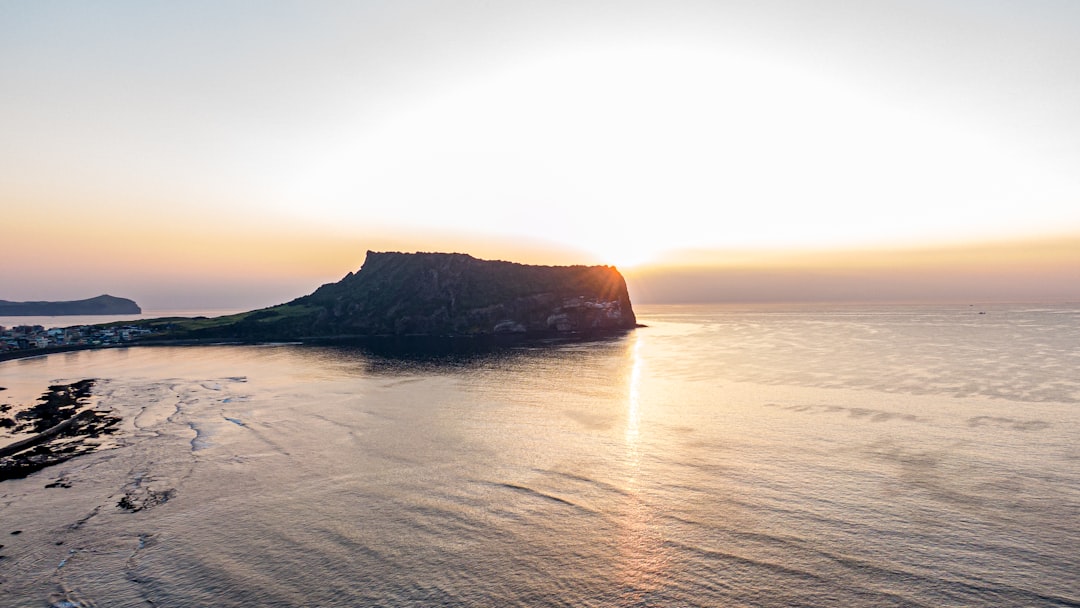
The volcano is famous for its sunrise. The name itself means “Sunrise Peak,” and the standard visitor experience involves arriving before 5:30 AM, joining a queue of several hundred people, and ascending the 600-meter wooden stairway in near-darkness to watch the sun emerge over the horizon. I had done it once myself, on a previous visit, and the experience was exactly what the promotional materials promised: dramatic, communal, and photographed from seventeen nearly identical angles by the time the sun had fully cleared the sea. What the promotional materials don’t mention is that the sunrise light on Seongsan is clean and golden, yes, but it’s also harsh within about twenty minutes. The crater itself spends most of that time in shadow, and the landscape flattens into a single bright exposure that hides more than it reveals.
I had returned on a Tuesday in early November, not for the sunrise but for something I’d noticed on my phone’s weather app the night before: sunset at 5:28 PM, and a forecast calling for scattered clouds. The combination suggested a blue hour—that twenty-minute window after the sun drops below the horizon when the sky turns a deep, saturated indigo and the remaining light takes on a quality that photographs poorly but looks almost supernatural in person. I had a feeling the volcano, which faces east and is usually admired at dawn, would catch that light from behind.
The ticket booth closed at 7 PM, and the woman who sold me my entry pass—a different woman than the one at the vending machine, younger, wearing a parka against the wind—seemed mildly surprised to see a customer arriving so late. “You know it takes about thirty minutes to climb,” she said, not as a warning but as a clarification. I told her I was aware. She handed me the ticket and said nothing else.
The stairway up the volcano’s western face is a well-maintained wooden structure, wide enough for two people to pass, with railings that feel slightly too low for comfort. At midday, it can feel like a theme park queue. At 4:35 PM, it was empty. I passed three people on the way up: a Korean man in his sixties carrying a small tripod, a young couple speaking Japanese who stopped at every third landing to take phone photos, and a park employee in an orange vest descending with a broom and a black trash bag, his shift apparently ending soon. The wind was stronger than it had been at the base, and the sound of the sea—which at the entrance had been a distant murmur—grew into a steady roar as I gained elevation.
Seongsan Ilchulbong isn’t a tall volcano. The summit sits just 182 meters above sea level, and the climb, while steep in parts, takes about twenty minutes at a moderate pace. The effort feels less like a hike and more like an ascent through a series of distinct microclimates: cool and damp near the base, where the vegetation is dense and the path stays shaded; warmer and drier halfway up, where the trees thin out and the wind picks up; and then, suddenly, exposed at the top, where the full panorama of the eastern coastline opens up and the crater itself becomes visible for the first time.
The crater is the main event for most visitors: a bowl-shaped depression about 600 meters in diameter, ringed by steep green walls that drop into a flat grassy floor. From above, it looks less like a volcanic crater and more like a natural amphitheater. Nothing important did happen there, geologically speaking—the volcano last erupted about 5,000 years ago, and the crater floor has been a calm grassland ever since—but the scale of it, when seen from the rim at the right moment, creates an effect that feels significant regardless.
The right moment, I was about to discover, was not sunrise.
I reached the summit at 4:52 PM. The sun was still above the horizon, but it had dropped behind a bank of clouds to the west, casting the crater in a shadow that grew deeper by the minute. The few other visitors were scattered along the rim, phones and cameras pointed east, waiting for the sunset to do something worth capturing. But the real shift happened not at the horizon but above it. The sky to the west, where the sun had disappeared, turned a soft orange that faded into pink, then into violet. The clouds, which had looked ordinary and slightly dull twenty minutes earlier, began to glow at their edges, lit from below by the hidden sun. The volcano itself, which had been a uniform green-gray in the afternoon light, began to change color: the grassy walls of the crater took on a warm, almost bronze tone, while the shadows between them turned a deep blue.
By 5:15, the sky had deepened into a shade I can only describe as the color of a bruise healing. The crater floor was now fully in shadow, but the rim, where I was standing, caught the last of the indirect light. The wind had picked up, and I had to brace myself against it to keep my phone steady. I wasn’t the only one who had stayed. The man with the tripod had set up at the far end of the rim, his camera pointed west rather than east, and he seemed to be shooting long exposures, his shutter clicking at intervals of several seconds. The Japanese couple had given up on phone photos and were simply standing at the railing, watching the light change. We were all there for the same thing, and none of us were talking about it.
The best moment, if I had to pick one, was around 5:24, when the sky was a uniform dark blue except for a thin strip of orange along the western horizon, and the crater walls had turned the color of charcoal. The wind had dropped for a few seconds, and for that brief interval, there was no sound except the distant sea and the occasional click of a tripod shutter. That silence felt almost physical, a pressure against the ears, and it lasted just long enough to notice before the wind returned and the sounds of the world came back.
I stayed on the rim until the light had faded completely, around 5:45, when the sky had become a flat, unremarkable gray and the only sources of illumination were the lights from the town below. The descent was quicker than the climb, and I passed no one on the stairs. The park employee in the orange vest had finished his shift and was gone. When I reached the bottom, the ticket booth was closed, and the parking lot was empty except for a single car—a white Kia, presumably belonging to the man with the tripod, who was still somewhere up top.
The convenience store near the entrance was still open, and I bought another can of Americano, this time hot, for 1,500 won. The woman behind the counter had put away the grill and was watching a drama on her phone. She asked me how the sunset was. I told her it was good, better than the sunrise. She didn’t look surprised—she had probably heard that before, from the handful of visitors who bothered to show up after noon. “Most people come for the morning,” she said, not dismissively but as a statement of fact. “They don’t know what they’re missing, or something like that.” She turned back to her drama, and I took my coffee outside and sat on a bench.
The thing about Seongsan Ilchulbong is that it is a volcanic crater formed by a single underwater eruption, and the shape of it—the near-perfect circle of the rim, the flat floor, the steep walls—is what makes it famous. But the shape is also what makes it difficult to photograph well in any light. From the rim, the crater floor appears as a flat oval, and the scale is hard to capture without a wide-angle lens or a drone. The sunrise photos that fill social media tend to be taken from the same spot, looking east, with the sun rising behind the crater’s far wall. They are all essentially the same photo, and they all flatten the volcano into a two-dimensional backdrop.
The blue hour, in contrast, demands that you look west, not east. It demands that you pay attention to the sky rather than the crater, and that you wait for the light to do something subtle rather than dramatic. It is not an experience that translates easily into a single frame. The best photos are the ones that show the crater in shadow, with the sky doing most of the work—and those are the photos that most visitors don’t bother to take, because by the time the light gets interesting, the sunrise crowd has already posted their shots and left.
I finished my coffee and walked back to my car, which I had parked on a side street about a five-minute walk from the entrance. The street was dark, lit only by a single streetlamp and the faint glow from the windows of a guesthouse. A dog barked from somewhere behind a wall. I checked my phone and saw that I had taken exactly eleven photos, none of which looked as good on the screen as the scene had looked in person. This is the standard disappointment of blue hour photography: the camera captures the light but never the feeling of standing in it. I didn’t mind. The memory of the wind dropping and the crater turning to charcoal was worth more than any single image I could have taken.
The drive back to my accommodation in Seogwipo took about forty minutes, mostly along the coastal road. The sky had cleared, and the stars were visible over the sea. I stopped once, at a rest area with a view of the ocean, to watch the lights of a fishing boat moving slowly across the dark water. There was no one else at the rest area. The air smelled of salt and diesel. I stood there for maybe ten minutes.
The next morning, I drove past Seongsan Ilchulbong on my way to Udo Island. The parking lot was already full at 7 AM, and the queue at the ticket booth stretched halfway across the plaza. A tour bus was unloading passengers near the entrance, and a guide was shouting instructions in Korean. The sunrise had been clear that morning, and the photos my friend showed me were exactly what I expected: golden light, a crowded rim, seventeen nearly identical angles. “It was beautiful,” he said. I believed him. I just didn’t think it was the most interesting version of the volcano I had seen.

📷 Photos: Sung Shin (Unsplash), Drew Bae (Unsplash)