The rain had been falling for three hours when a taxi driver in George Town offered a piece of advice that rewrote the morning. He gestured at a side street near Lebuh Kimberley, its asphalt dark and slick, the drains running fast. “Not many people come here during the rain,” he said, and drove off before anyone could ask what he meant.
He meant the light. Under overcast skies, Penang’s streets lose the harsh shadow lines that photographers spend all morning fighting. The gray becomes a diffuser, wrapping every surface in an even, soft illumination that makes colors sit differently. A blue shutter against a wet wall reads as deep and saturated rather than washed out by direct sun. The textures come forward—chipped paint, rusted iron, the grain of old wood—without the glare that normally buries them by mid-morning.
The instinct, when rain starts, is to wait it out. Coffee shops fill with people refreshing weather apps, watching radar maps, betting on a break in the clouds. But the best window for street photography in Penang is often the one that opens during the rain itself, not after. The city’s colonial shophouses, its narrow five-foot ways, its temples and clan jetties—all of them look different under a wet sky, and the window closes the minute the sun burns through. You have to be out there when it happens.
This is not a secret. A local photographer in George Town once shrugged and said, “I mean, you just go out. You get wet. The camera’s fine. Or something like that.” But visitors tend to arrive expecting the postcard version: bright blue sky, white clouds, the Kapitan Keling Mosque glowing under golden hour light. That version exists, but it’s crowded, and it’s been photographed a thousand times. The rain version is the one that still has room for discovery.
A cyclist rode past a row of closed shutters on Lebuh Armenian, the wheels throwing up a thin spray that caught the light for a split second. The pavement was empty. The wet surface turned the street into a mirror, reflecting the shophouse facades upside down, doubling the visual density of a corner that normally reads as quiet and slightly tired. A single frame, taken from the opposite curb, captured the reflection, the cyclist mid-pedal, and a cat watching from a dry doorway. The composition would have been impossible in direct sun—too much contrast, too many blown highlights.
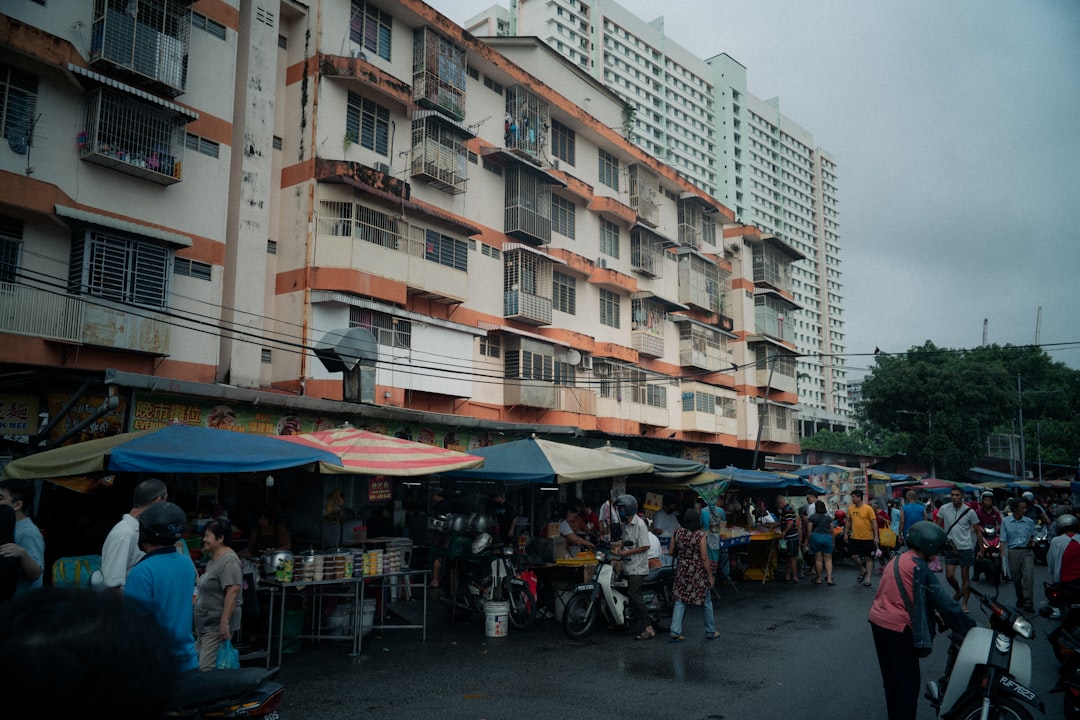
It’s not just the light. Rain changes the behavior of everyone on the street. People move closer to buildings, huddle under awnings, cross roads faster. The normal rhythms of a city compress into smaller, more choreographed patterns, and those patterns are where the interesting frames live. A vendor at a wet market on Lebuh Cecil, instead of standing behind his stall, came forward to adjust the canvas tarp stretched over his vegetables. The gesture was ordinary. The rain made it feel deliberate, almost theatrical.
The first mistake most newcomers make is trying to keep the camera dry at all costs. A plastic bag over the body, a towel in the bag, a constant anxiety about the lens. A camera body designed for professional use can handle light rain without damage. The real risk is the condensation that forms when moving between air-conditioned spaces and humid streets. A camera pulled from an air-conditioned hotel room into 30-degree tropical rain will fog immediately. The fix is simple: leave the camera in the room for twenty minutes before heading out, letting it acclimate to the humidity. Or better yet, keep it in a bag that’s been sitting at room temperature, not in the cold.
A photographer who attempted to use an umbrella while shooting on Lebuh Chulia learned this the hard way. The umbrella became a second subject, catching wind, throwing shadows, making framing nearly impossible. The results were unusable. The next day, without the umbrella, hood up, rain jacket zipped, the camera got wet but the images worked. A few droplets on the front element added a soft diffusion that looked intentional. The shots that got discarded were the ones where the photographer was trying to stay dry, not the ones where the camera got wet.
The second mistake is thinking the rain needs to be heavy to be useful. The best light often comes during drizzle, when the sky is still gray but the rain is just a mist. The streets are damp enough to reflect, the clouds are thick enough to diffuse, and the rain itself is barely visible in the frame. A steady light shower can produce an hour of excellent shooting conditions. A downpour produces puddles and umbrellas and interesting reflections, but it also drives people indoors and makes movement difficult. The sweet spot is the kind of rain that feels like it could stop at any moment—and sometimes does.
Around midday, the drizzle paused. The clouds lifted slightly, and a pale, milky light filled the streets of the Chinese clan jetties along the waterfront. The wooden walkways were wet, the boats tied to the stilts were rocking gently, and the air smelled of salt and wet timber. A woman sat on her porch peeling garlic into a bowl, the purple skins curling against the gray wood. She didn’t look up. The light was flat, even, and patient—the kind of light that lets a photographer work slowly, recomposing, waiting for the right moment instead of rushing to capture it before it changes.
This is the paradox of rain photography in Penang. Most people assume bad weather means bad conditions. But the conditions that produce the most memorable images—soft light, rich color, reflective surfaces, compressed street activity—are the ones that arrive with the clouds. The sun, when it finally breaks through, often makes everything harder. Harsh shadows, blown highlights, crowds of people who’ve been waiting under awnings suddenly flooding the streets. The first thirty minutes after rain stops are useful, but only if the clouds haven’t fully cleared.
A tukang beca, an old bicycle rickshaw driver, sat under a tree near the Chew Jetty entrance, his vehicle parked beside him. He was reading a newspaper, using it as both entertainment and makeshift umbrella. The rain had stopped, but the ground was still wet, and the tree above him dripped occasional droplets onto the paper. The composition was almost too obvious—an elderly man, a rickshaw, a tree, wet ground—but the light made it work. The gray sky behind him was a single tone, unbroken, and his white shirt stood out against the dark wood of the rickshaw seat. A tourist walking past stopped, took a photo with her phone, and moved on. A photographer waiting for the right moment would have gotten a different shot: the moment he turned a page, or looked up at the sky, or adjusted his position. The rain had stopped, but the patience it required hadn’t.
A bowl of laksa at a hawker stall near Lebuh Kimberly cost seven ringgit. The stall was under a permanent awning, so the rain didn’t matter to the regulars who sat on plastic stools, bowls steaming, while water ran off the roof in a steady curtain. The photographer who sat down to eat missed a few street frames but gained something else: time to watch how the rain affected the space. The way steam rose differently in humid air. The way the cook moved faster when the rain picked up. The way the regular customers sat in the same seats regardless of weather. These observations, made over a bowl of fish-based broth and thick rice noodles, shaped the afternoon’s shooting plan.
George Town’s street art, famous for its painted murals and wrought-iron caricatures, takes on a different character in the rain. The murals lose the glare that often obscures them in bright sun. The colors look deeper. The iron sculptures, mounted on walls and poles, have water beading on their surfaces, catching light from unexpected angles. A mural of a boy on a bicycle, one of the most photographed pieces on Lebuh Armenian, looked almost damp in the rain, the paint appearing fresher, the outlines sharper. The wet ground below it reflected the bicycle’s wheel, completing the composition in a way that the dry version never does.
The crowds around the famous murals were thin. A few people with umbrellas, a couple with a selfie stick, a family taking turns under the shelter of a shop awning. No one was waiting in line for the shot. The rain had done what no time of day could achieve: it cleared the space. The photographer who braved the drizzle got the mural without a single tourist in the frame—something that requires a dawn arrival on a dry day and still doesn’t guarantee the result.
By late afternoon, the sky darkened again. The drizzle became a steady rain, then a downpour. The streets emptied. The drains filled. The sound changed from the patter of droplets on leaves to the rushing of water through concrete channels. Most photographers packed up and headed for cover. But the rain’s intensity shifted the visual landscape entirely. The reflections became deeper, more abstract. The puddles expanded into small lakes, spreading across intersections, transforming flat street surfaces into sheets of mirror. A car turning onto Lebuh Pantai sent a wave across the road, and the spray hung in the air like a curtain.
The images from this period were not the ones anyone planned for. They were looser, more abstract, less about subject and more about atmosphere. A motorbike passing through a flooded intersection, its headlights creating a streak of yellow across the wet asphalt. A stray dog trotting along a pavement, its reflection stretching ahead of it. A row of shop signs, their colors bleeding into the water below. These frames required a willingness to work quickly, to shoot from angles that weren’t comfortable, to accept that the camera would get wet and the images might not all be keepers.
At dusk, the rain stopped. The clouds pulled apart, just slightly, and a pinkish light slipped through the gap, hitting the wet streets for exactly seven minutes. The city caught fire, not with heat, but with color. The red of a temple gate, the gold of a mosque dome, the green of a painted shutter—all of them intensified by the water that still clung to every surface. A photographer who had stayed out through the downpour, cold and soaked, stood on a corner near Little India and watched the light change. No one else was there. The street was empty. The moment lasted long enough for a dozen frames, then it was gone.
The tukang beca from earlier had gone home. The laksa stall was packing up. The streets were quiet, wet, and darkening quickly.

📷 Photos: Kelvin Zyteng (Unsplash), Zhen Hao Chu (Unsplash)