The man at the rental counter in Jerantut had a patient way of explaining things I hadn’t asked about. He slid the tent bag across the counter and said, without any particular emphasis, “You’ll want the pegs hammered all the way in. Not halfway. The ground here is loose on top and hard underneath — people do half the job and wake up with their flysheet in a tree or something like that.” I nodded the way you nod at advice you intend to follow but haven’t fully registered. I was thinking about the drive, about whether I’d make it to the park entrance before the afternoon rain, about whether I’d brought enough water. The pegs seemed like a future problem.
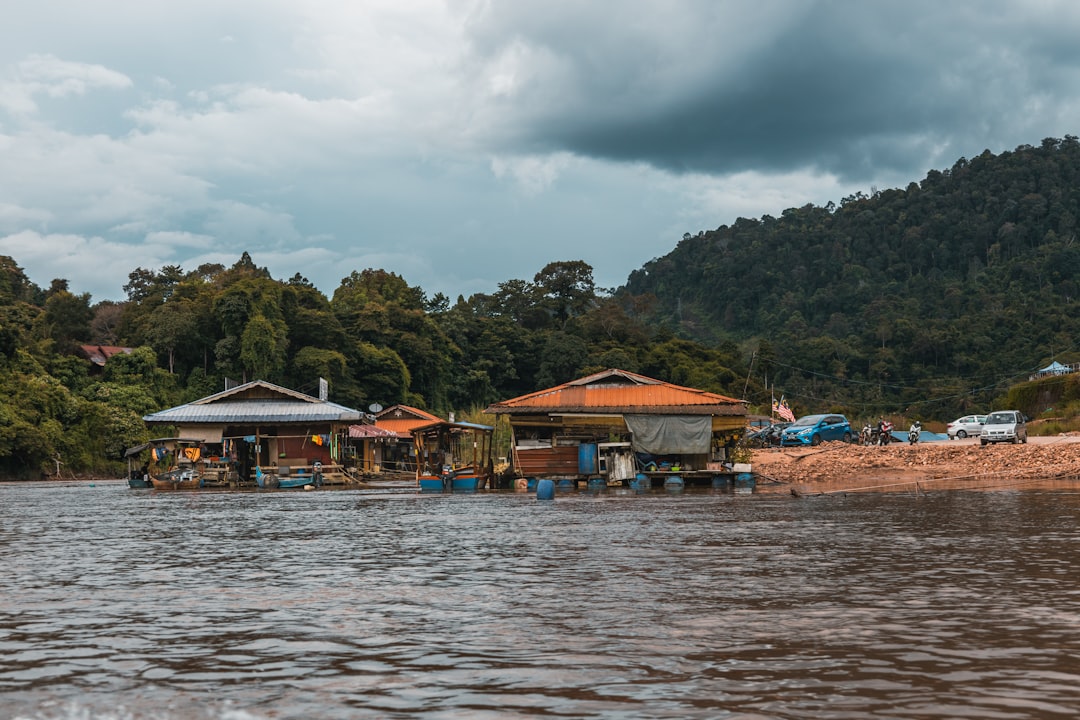
The road from Jerantut to Kuala Tembeling is the kind of road that doesn’t seem to have been designed so much as paved around whatever was already there. It narrows without warning. It bends around hillsides where the vegetation leans in so close the light turns greenish and dappled, then opens out onto flat stretches of palm plantation where the heat comes through the windscreen directly. I passed a motorcycle carrying three people and a cage of chickens. I passed a sign warning about elephants, which felt like a prop from a more exotic version of the trip I was on. The park entrance, when I reached it, was quieter than I’d expected. A few cars in the lot. A ticketing booth with a handwritten schedule taped to the window. The ferry across the Tembeling River runs on a loose schedule — every hour, or when it’s full, or when the boatman feels like it — and I’d just missed one.
Forty minutes later, on the other side, I found myself walking the trail to the camping area with a pack that felt like it had gained weight since I’d left the car. The path follows the river for a stretch, then cuts inland through low forest where the canopy closes overhead and the temperature drops by a degree or two. The camping area itself is a clearing on a rise above the riverbank, with a few wooden platforms and a central shelter that serves as a cooking and gathering point. It was empty when I arrived. Just my tent and the sound of something moving in the leaf litter maybe twenty metres away — a sound that could have been a monitor lizard or a squirrel or my own imagination working too hard. I stood still and listened. Whatever it was stopped moving. I started setting up the tent.
I did not hammer the pegs all the way in. I got them about two-thirds of the way and decided that was enough. The ground was hard. My arm was tired. The early afternoon was hot and the site had no shade and the promise of a swim in the river after the work was done felt more urgent than the long-term structural integrity of my shelter. I wrestled the flysheet into place, threw my bag inside, and walked down to the river. The water was the colour of weak tea and cooler than I’d expected. I waded in up to my waist and floated for a while, staring up at the canopy and the patches of sky between leaves, trying to convince myself I wasn’t being watched by anything with teeth.
Back at the site, I cooked dinner on a camping stove that had a tendency to flicker and die when the gas canister was low. The meal was instant noodles with a packet of sambal I’d bought at a rest stop, and a handful of dried anchovies that had gone slightly soft in the humidity. I sat on the wooden platform and ate while the light changed from white to yellow to orange to the brief, fierce purple that lasts about ten minutes in the tropics before the dark takes over. I had a book with me. I read maybe three pages before I gave up. The darkness here isn’t like the darkness in a city or even a rural town. It has weight. It presses in from all sides. The sounds start low — a rustle, a chirp, a distant call that could be a bird or a primate — and then they build, layering on top of each other until the air itself seems to be vibrating. Cicadas. Frogs. Something that made a clicking sound I couldn’t identify. Something that made a sound like a large stone being dragged across concrete. I lay in the tent, listening, convinced that every sound was getting closer.
Sleep came in fragments. I’d drift off, then snap awake at a crack or a thump or a rustle too close to the tent wall. Around midnight, a sound I still can’t describe — somewhere between a cough and a roar, deep and chest-rattling — came from maybe a hundred metres away, and I lay perfectly still for what felt like a long time, staring at the ceiling of the tent, wondering whether this was the moment something decided the tent was a convenient entrance to a meal. Nothing happened. The sound didn’t repeat. My heart eventually stopped hammering. I slept, badly, until just before dawn, when the birds started and the night sounds stopped all at once, like a switch had been flipped.
I stepped out of the tent into grey light and air that smelled of wet leaves and river silt. The flysheet was still in place. The pegs were still holding. I walked down to the river to wash my face and saw a large monitor lizard — maybe a metre and a half from nose to tail — sunning itself on a rock near the water’s edge. It watched me with the flat, unhurried gaze of something that has no predators and knows it. I watched it back. After a minute, it slid into the water and disappeared. I thought about that cough-roar sound from the night before and realised that even if I knew what it was, it wouldn’t change anything. The jungle was going to make whatever sounds it makes. I was just a guest who’d paid for one night’s stay.
Breakfast was instant coffee and a banana that had bruised badly in my pack. I sat on the platform and watched the river move and thought about the pegs I hadn’t fully hammered in. The advice from the man in Jerantut had been straightforward and I’d chosen to follow most of it but not all of it, and what I’d learned was that the part I’d ignored was the part that mattered. A half-driven peg doesn’t fail the first time the wind hits it. It fails the third time, or the fourth, when each gust has worked it a little looser, and by then you’re inside, asleep, and the flysheet lifts and the humidity gets in and you wake up to condensation on everything you own. The tent had held, barely. Next time, I’d do the whole job.
I packed up slowly. The sun was already hot by eight, and the humidity was climbing. I took the trail back toward the jetty, passing a couple of hikers coming the other way — a young French woman and her boyfriend, both carrying packs that looked too heavy for the terrain. She asked me, in careful English, whether I’d seen any wildlife. I said a monitor lizard and a lot of things I’d only heard. She nodded. “The sounds are the best part,” she said. I wasn’t sure I agreed then. I’m still not sure now. But I think I understand what she meant.
The ferry back didn’t run for an hour, so I sat on a bench at the jetty and watched a kingfisher work a stretch of riverbank. It would perch, dive, come up empty, shake itself off, and try again. It did this maybe eight times before it caught something — a small fish, silver and wriggling — and carried it into the trees. The ferryman arrived, untied the boat, and gestured for me to board. On the other side, in the parking lot, I sat in the car with the air conditioning on full for a few minutes before I started the engine, letting the sweat dry and the heat leave my skin.
The drive back to Jerantut was quicker than the drive in. Familiarity changes the character of a road — what felt uncertain on the way becomes predictable on the return, each bend and dip already stored in muscle memory. I stopped at the same rest stop, bought a bottle of iced tea and a packet of curry puffs from a woman who remembered me from the day before. “How was the jungle?” she asked. I said it was loud. She laughed and said that was the point.
I dropped the tent back at the rental shop. The man behind the counter asked if everything went okay. I told him about the pegs. He didn’t say I told you so, but I could see him not saying it. “Better to find out on a short trip than a long one,” he said, which was generous of him. I drove back toward Kuala Lumpur with the windows down and the radio on, trying to find a station that wasn’t talk or tinny pop, and failing, and not minding. The heat coming through the window smelled like tar and roadside grass and exhaust. A familiar smell. The smell of being back.
I’ve thought about that night a few times since. Not the sounds, exactly, or the half-light of dawn, or even the moment with the monitor lizard — those are the parts you’d expect to remember. What sticks is the feeling of having been in a place where I didn’t matter. The jungle didn’t care that I was there. It didn’t care that I was scared or uncomfortable or that I’d slept badly. It was going about its business, and I was just something that passed through, left a few footprints, and left. That’s not a comfortable feeling, but it’s an honest one.

📷 Photos: Febe Vanermen (Unsplash), Febe Vanermen (Unsplash)