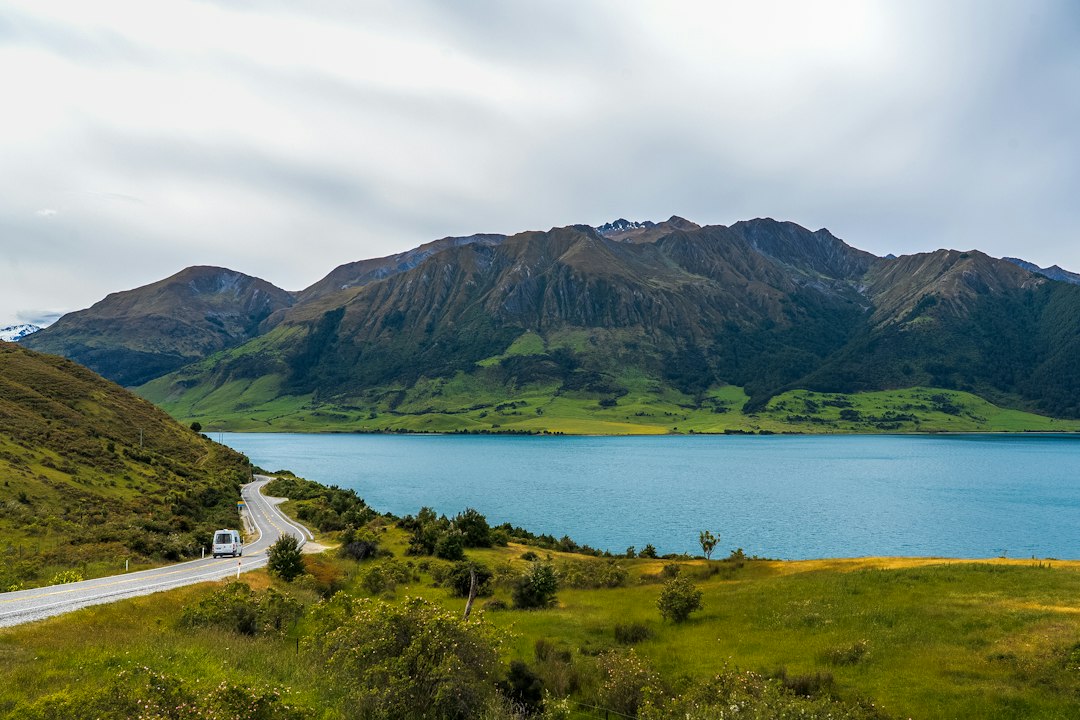
The smell hits somewhere past the Waiau Pass turnoff: hot pastry, diesel, and the mineral cold of a river that’s been running through beech forest since before anyone thought to put a road beside it. A roadside stall with an honesty box and a handwritten sign listing venison pies, bacon butties, and a flat white that costs four dollars and comes in a cup that’s seen some things. The pie is still ticking with heat when it’s handed over. The pastry flakes onto a knee. The river keeps running. Nobody’s in a hurry, and the road ahead is a long, winding line of grey that disappears into the hills.
This is the shape of South Island eating between the big towns: not restaurants so much as interruptions. A tray of eggs left out on a gate post. A chill bin of whitebait fritters behind a caravan in a gravel lay-by. A baker who opens at a time that suits the baker and closes when the shelves are bare. The distances here are real, and the food is calibrated to them — quick, hot, eaten standing up, gone before the sandflies find their mark.
Most of what’s worth stopping for isn’t signposted in any official sense. A hand-painted board on a fencepost outside a town with one intersection and a war memorial. A chalkboard propped against a shed. The signal to stop is usually a cluster of utes and a couple of campervans pulled onto the verge — the local tell that something’s worth the detour, and one that has never once let me down.
The pies earn their reputation for a reason. In a small town on the road between the east coast and the lakes, a bakery counter holds a row of them under a heat lamp, and the steak-and-cheese version is dense enough to count as two meals if you pace yourself, which almost nobody does. The pastry is thick at the base, the gravy has the peppery edge that catches at the back of the throat, and the whole thing is best eaten out of the paper bag while leaning against the vehicle, watching the light change across the valley. Flavour is only part of it. The rest is context: cold air, an incoming front, the knowledge that the next real town is a decent drive away.
The south’s whitebait is a whole other operation. Little translucent fish, caught in nets at river mouths on the west coast, fried into fritters that are mostly egg and not much fish by volume, which is the whole point — the fish is the seasoning, not the bulk. A fritter bought from a caravan near the coast arrives on white bread with a squeeze of lemon and a grind of pepper. It tastes faintly of the river and mostly of butter. Somewhere in the transaction, a man in a Swanndri and gumboots will tell you, unprompted, that the season’s been slow, or the season’s been late, or something along those lines. The exchange lasts about ninety seconds. The fritter is gone in less.
What surprises a lot of drivers is how much of the food culture sits offshore, or almost offshore. The green-lipped mussels that turn up in a bucket at a roadside shack near the Marlborough Sounds are the same ones that get shipped around the world, but eaten here they come with a pot of something vinegary and a view of the water they were pulled from that morning. The shells are big enough to use as spoons. The shack’s owner will tell you to eat them fast, because they’re better that way. There’s no ceremony to it, no menu. You pay at the counter, take a seat at a picnic table with the paint worn off, and the wind rearranges your hair while you work through the bucket.
Cheese, oddly, turns up in the most unlikely places. A farm gate near a winding gorge road has a fridge — an actual fridge, plugged into an extension cord that snakes back to a shed, and you find yourself wondering who ran the cord and how long it’s been there — stocked with wheels of something hard and sharp, plus a cash box and a note asking for exact change. The cheese is wrapped in paper, cold from the fridge, and eaten in the vehicle with a pocketknife on the dashboard. The note asks that the fridge door be closed properly. Someone before you didn’t close the fridge door properly. You close the fridge door properly.
Central Otago sits in a rain shadow, and the food there follows from it. Stone fruit — apricots, cherries, peaches — grows in the dry heat and turns up at roadside stalls through the summer in cardboard trays, sold by the kilo, with a sign telling you not to squeeze the fruit. The apricots are small and intensely sweet, the skins slightly fuzzy, and the ones closest to ripe are the ones you have to eat that day. A tray left on the passenger seat in the sun will perfume the whole vehicle within an hour. By the time you reach the next town, half the tray is gone and the pit stops are sticky.
Drive for a couple of hours, stop for something small, drive again. There’s a rhythm to the whole enterprise, and it takes a few days to learn. The South Island rewards this more than most places, because the food isn’t concentrated in the towns — it’s scattered across the spaces between them, in sheds and caravans and fridges plugged into extension cords. The trick is to treat the driving itself as the meal, with courses along the way. A pie at one stop, a fritter at the next, a tray of apricots for the long stretch, a bucket of mussels at the coast before the light goes. The road is the restaurant. The table is wherever you pull over.
Some of the best eating is almost invisible. A caravan parked at the end of a gravel road near a surf beach, with a hand-lettered menu taped to the window and a queue of people in wetsuits. A community hall on a Sunday morning with a fundraising breakfast — sausages, eggs, white bread, a pot of tea, five dollars in a tin. A roadside stall that sells nothing but smoked fish, wrapped in newspaper, the smoke smell clinging to your hands for the rest of the drive. These aren’t attractions. They’re just what’s there, run by people who live nearby and figured out a way to make a bit of money off the passing traffic.
Weather reshapes the food stop entirely. On a clear day, everything is a picnic — the gravel verge, the riverbank, the tailgate of the vehicle. When the rain comes in sideways off the Tasman, the same stop becomes a scramble for the one sheltered corner, and the pie eaten in the lee of a building tastes different, more urgent, the heat of it pressed against cold fingers. The west coast gets a lot of that weather. The food there is built for it — hot, dense, eaten fast — and the little caravans and sheds do a roaring trade in the rain, steam rising off the fryers, the queue huddled under the awning.
The distances also mean that what you don’t eat matters. A tray of apricots bought in the morning and left in a hot vehicle all afternoon will be a different thing by evening. A pie bought at the wrong moment — too close to the next stop, too far from the last — sits heavy in the stomach on a winding road. The learned skill is pacing, knowing that the mussels are worth waiting for at the coast, that the apricots need to be eaten while they’re still cool, that the cheese will keep but the fritters won’t. It’s a small logistical puzzle that runs alongside the driving, and getting it right feels like a quiet victory.
Then there’s the question of what to do when the stop you’d planned on isn’t there. The caravan that’s closed on a Tuesday. The bakery that sold its last pie before you arrived. The honesty box with no change and no way to break a note. The south is full of these small arithmetic problems, and there’s no app to solve them, because half of these places don’t show up anywhere at all. You either backtrack, or you carry on to the next thing, or you eat the emergency crackers in the glovebox and call it lunch. All three are fine.
By the time the road turns inland and the towns get bigger, the food changes too — proper restaurants, menus, places to sit down. That’s fine, but a table and a laminated menu are a different business from a gravel verge. The road stops are the ones that stick: the cheese fridge, the whitebait caravan, the apricot tray on the passenger seat, the mussel shells scraped clean with a thumb.
The last stop of a long day comes as the light goes gold and the sandflies arrive. A tray of something, a bottle of something, the vehicle pulled onto a verge with a view of the water. The food is simple — bread, cheese, a few apricots, whatever the day turned up — and it’s eaten slowly, because there’s nowhere left to be until morning. The road is still there in the morning. But for a while, sitting still with the engine ticking as it cools, the stop is the whole point.

📷 Photos: JinHui CHEN (Unsplash), Lisha Riabinina (Unsplash)