The Cobalt Shadow on Eng Hoon Street
The air already carries a wet warmth at eight in the morning, but the low-rise buildings cast a cobalt shadow across Eng Hoon Street. At the edge of one of Singapore’s oldest housing estates, the calm is unexpected. The shutters of the corner coffeeshop are rolled halfway up, and the clatter of porcelain cups and the hiss of a steam wand drift onto the pavement. A wiry man in a singlet arranges a pyramid of pink guavas on a wooden crate. A tabby cat sits on a low wall, blinking slowly at nothing. This is Tiong Bahru at a moment when the city’s famous efficiency hasn’t yet fully kicked in. Caught in a rare, unhurried breath.
Built in the 1930s as one of Singapore’s first public housing projects, Tiong Bahru’s architecture is a curious relic: a pocket of Streamline Moderne and Art Deco that survived the city’s relentless vertical ambitions. Curved balconies, rounded building corners that soften the geometry of the streets, simple horizontal grooves that run like ripples across pale plaster facades. The scale is human — three, four, five storeys, no higher — and the buildings are set back just enough that the frangipani trees and potted plants on the ground floors have room to spread. Through the open front doors of older blocks, a grandmother sits on a plastic stool fanning herself with a cardboard advertisement. It feels less like a preserved heritage district and more like a living neighbourhood that happens to dress in a handsome, unfashionable suit.
Turn down Moh Guan Terrace, past the Tiong Bahru Community Centre, a low, white-painted building with a curved canopy and a row of Chinese chess tables under a rain tree. On a Sunday, the tables are already claimed by a handful of older men in polo shirts, their game punctuated by the sharp click of wooden pieces and the occasional burst of argument in Hokkien. A few feet away, a woman with a trolley bag stops to watch, leaning on the handle. The pace is so deliberately slow that you find yourself adjusting your own stride.
The street names follow Chinese dialects and clans — Eng Hoon, Yong Siak, Chay Yan — and each one opens onto a different slice of the estate’s character. On Yong Siak Street, a new wave of independent bookshops and cafes has settled into the ground floors of the pre-war blocks. Woods in the Books, a small children’s bookshop, has its door propped open, illustrated covers in pastel colours arranged on low shelves as if waiting for a small hand to pull one out. A few doors down, a coffee shop called Forty Hands is already serving flat whites to a patient queue on the pavement. It feels like a collision of worlds — the old kopitiam tradition and the third-wave coffee ritual — and they coexist without fuss. The customers in sneakers and linen shirts are just as much at home as the uncles in singlets.
The Art Deco details become more obvious the slower you walk. At the top edge of a shophouse facade, a sinuous wave of moulded plaster, a zigzag pattern, a sunburst relief. Some of the window grilles are original, wrought iron in geometric patterns that look like they might have been drawn by a draftsman in the 1930s with a ruler and a steady hand. The stairwells of the old walk-up flats are open to the air, letting in the morning light, and the terrazzo steps are worn smooth by decades of feet. These are not properties polished into perfection; they bear their age on their surfaces, in the cracks and the stains and the patina of use.
By the time you reach Seng Poh Road, the market is unavoidable — not visually at first, but audibly. The hum of activity builds as you approach, a layered sound of voices, the clatter of metal trolley wheels on concrete, the rhythmic thud of a cleaver on a wooden block. Then the Tiong Bahru Market and Food Centre rises before you, a low, utilitarian concrete structure that looks like it was designed for function rather than beauty. The beauty is inside — steam, oil, and the precise choreography of hawkers working their stalls.
The Fish That Still Open and Close Their Gills
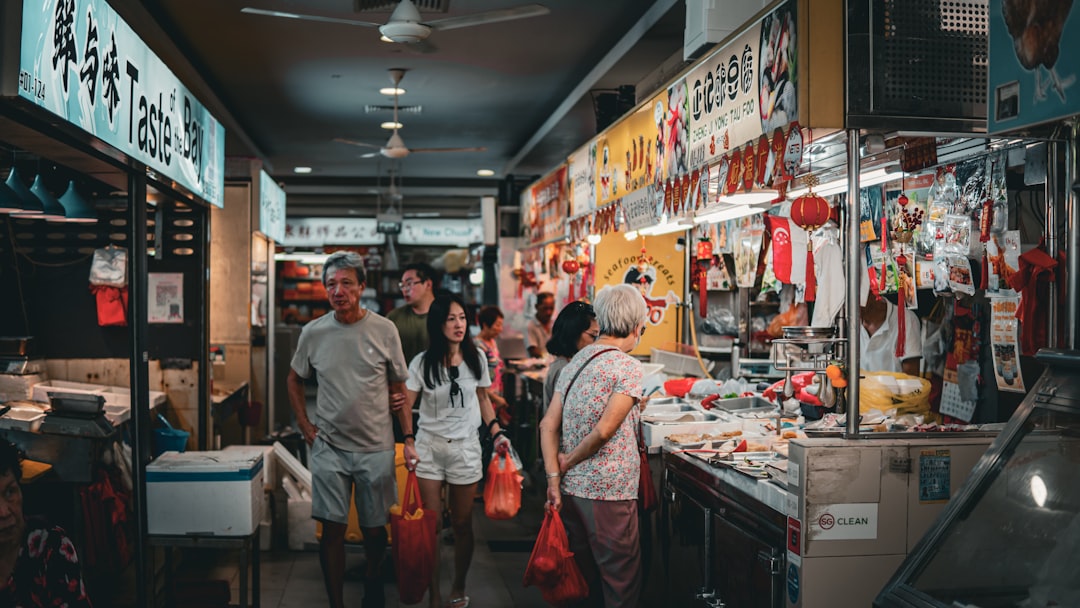
The ground floor is the wet market, a space of controlled chaos: rows of stalls under fluorescent lights, each one a universe of produce, meat, or seafood. The fishmongers are the most theatrical. They stand behind tilted metal slabs covered in crushed ice, and the fish are arranged with a kind of reverence — red snapper with their scales still gleaming, pomfret flattened and silver, whole groupers the size of a small child, their gills still opening and closing slowly. The sound of ice being crushed under a cleaver runs through the whole hall, a steady rhythm that the other vendors sync into without thinking. A woman in a blue apron guts mackerel with a speed that makes the process look like magic: a slit, a pull, a rinse, and the fish is clean, wrapped in newspaper, and handed over in under ten seconds.
The poultry section is quieter, the chickens already beyond making noise, hanging from hooks, plucked and pale, their feet still attached as a mark of freshness. The vendors don’t hide anything. You can see the skin, the fat, the colour of the flesh. A small woman in a floral headscarf is selling free-range kampung chickens, and she holds one up for inspection when you ask, turning it in the light to show the even colour. You don’t need to buy anything to appreciate the theatre of it.
The vegetable section is a rainbow of greens and reds and yellows arranged in careful pyramids. Kang kong bundles sit next to stacks of kailan, their stems as thick as your thumb. Lady’s fingers, long beans, bitter gourd with their bumpy skin, and a box of tiny, fiery bird’s eye chillies that one customer picks through with a careful thumb. A middle-aged man sorts through a crate of pandan leaves, running his hand over them to check for freshness before bundling them with rubber bands. The scent cuts through the fishy air, a clean, grassy sweetness that is unmistakably Southeast Asian.
The dried goods section reveals the market’s deeper layers: salted fish in jars, dried scallops the size of a coin, shrimp paste in blocks wrapped in brown paper, stacks of rice paper for spring rolls. One stall is dedicated entirely to mushrooms — shiitake, wood ear, enoki, and a basket of black, shrivelled cloud ear fungus that looks unappealing but, the stallholder explains without breaking eye contact, is essential for a proper loh bak. You nod as if you knew that already, and he gives you a slow, appraising smile before turning back to his inventory.
The Queue That Never Shortens
Upstairs, the food centre is the heart of the exercise. The hawker stalls are arranged in a horseshoe around a central seating area of formica tables and plastic stools, and the glow of the morning sun through the open sides of the building gives the whole space a faded, golden cast. By nine-thirty, the queues are already forming. The geometry of a serious hawker queue: it snakes not in a straight line but in a loose, organic curve, as people lean to watch the cooking while they wait. The air thickens with the smell of garlic, shallots, soy sauce, and the faint, darker note of char from a wok that hasn’t been scrubbed in years.
Tiong Bahru Hainanese Boneless Chicken Rice is tucked into a corner of the upper level. The queue is about eight deep, but it moves quickly — the hawkers work in a system that seems chaotic but is, in fact, a well-rehearsed ballet of ladles, tongs, and cleavers. The chicken arrives at your table on a white ceramic plate, the skin a pale, glossy yellow, the meat impossibly soft and just-warm. The rice underneath has been cooked in chicken fat and pandan juice, each grain separate and fragrant. A small dish of chilli with a vinegar tang, a saucer of dark, syrupy soy. Nothing else on the plate, and nothing else is needed. You eat with a spoon and a fork, the way the regulars do.
You could eat here every Sunday for a year and never repeat a meal. The fishball noodles at Seng Kee are served dry with a thick, dark sauce and a heap of lard croutons that are still crackling when they reach you. The char kway teow at the stall opposite is fried over such high heat that the noodles have a faint, bitter smokiness from a wok seasoned for decades. A woman in a white hat makes wanton mee with a vinegar-touched chilli that makes your eyes water. The dessert stalls offer cheng tng, a clear soup of longan, red dates, and white fungus — or something like that — served warm in a glass bowl, its sweetness restrained and clean.
The kopitiam stall at the edge of the seating area serves kopi-o kau, a thick, black coffee brewed through a cloth sock and concentrated into a cup barely a third of the size you’d get at a chain cafe. The bitterness hits first, then recedes into a caramelised sweetness that coats your tongue. You drink it standing at the stall counter, because the tables are full, and you watch a man in a vest and flip-flops drink his kopi-c the same way, the same stance, the same tilt of the head.
The Second Wind
When you finally leave, the sun is high and the shadows have retreated. The morning is over, but the neighbourhood feels like it has just begun its second wind. You walk back through the same streets, but they are different now: the cafes are full, the coffee queue has grown longer, the chess players replaced by a group of teenagers on phones. The Art Deco curves are still there, but they belong to a different time of day. You had your Sunday morning — the architecture you passed, the fish you didn’t buy, the queue you joined and the one you didn’t, the slow, deliberate drift from one lane to another, letting the morning fill itself. The only way to find out what the afternoon version looks like is to come back.

📷 Photos: Amos Lee (Unsplash), Fleur Kaan (Unsplash)