Taipa Grande at Sunset: Watching Macau’s Neon Inferno Ignite From Above
Taipa Grande at Sunset: Watching Macau’s Neon Inferno Ignite From Above
You’ve spent the day wandering Macau’s crowded streets, your senses battered by the clatter of baccarat chips and the steam of pork chop buns. But now, as the late afternoon sun softens, you find yourself at the base of Taipa Grande, a modest mountain that rises like a green exclamation mark from the sprawl of Cotai. This isn’t the Macau of VIP lounges and all-you-can-eat buffets; this is the Macau you climb, breath by breath, on a paved trail that switchbacks up through dense subtropical foliage.
The hike begins gently, almost deceptively. The path is a concrete ribbon wide enough for two, and the first few minutes are a cool reprieve from the humidity. You hear the city below as a low hum—construction drills, distant traffic, the occasional siren—but the forest closes in, muffling the noise. You’re grateful for the shade of acacia and banyan trees, their roots occasionally cracking the pavement like veins. The air smells of damp earth and something faintly floral, possibly jasmine, though you’re not sure.
The trail to the summit is roughly thirty minutes for a steady walker, but relentless in its upward pitch. You pause at the few shaded benches scattered along the route—not because you have to, but because each stop reveals something new: a glimpse of the Macau Tower through a break in the canopy, the distant shimmer of the Pearl River estuary, or the sudden, startling flutter of a black-faced spoonbill taking flight. Your calves burn, your breath quickens, but the path is forgiving.
You pass a small, weathered Taoist shrine tucked against a rock face, its incense urns cold and empty. A few steps later, a modern observation platform with stainless steel railings offers a plaque explaining the local flora in three languages. This collision of old and new, sacred and commercial, makes the climb compelling—you aren’t just hiking a hill; you’re climbing through Macau’s contradictions.
The View from the Top
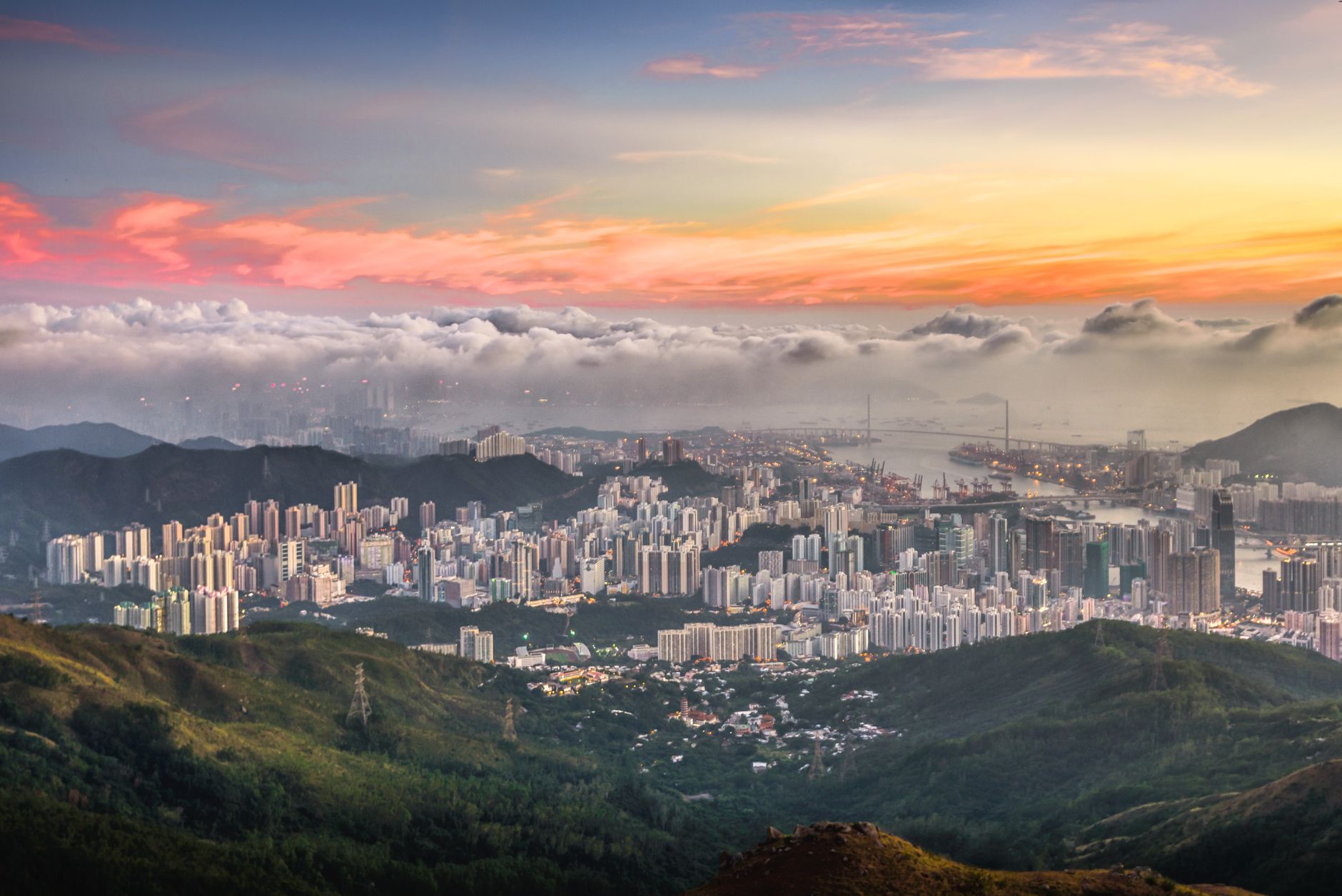
At the summit, the city below is still awake, still spinning its wheels of fortune. The viewpoint is a small, flat concrete area with a simple railing—no vertigo-inducing drop, no sheer cliff edge—but the panorama it offers is extraordinary. You stand facing west, and the entire Cotai Strip unfurls before you like a child’s diorama built from glass and neon.
At this hour, the light is liquid gold. The casinos—the Grand Lisboa’s lotus blossom, the Wynn Palace’s dancing fountain, the Venetian’s campanile—catch the last rays and glow with a soft, almost organic warmth. It’s easy to forget they are monuments to capital and chance. For these few minutes, they are simply architecture, laid out like a glittering board game. You watch the shadows lengthen, the colors deepen, and the sky turn from orange to lavender to a bruised purple. A few other hikers are scattered around, but you hardly notice them.
Then it happens. The sun dips behind the horizon, and the city begins its second life. First, a single strip of blue neon flickers to life along the Grand Lisboa’s façade. Then another, a pink ribbon across the MGM Macau. Within minutes, the entire Strip is a pulse of artificial light, a grid of electric colors that vibrates against the darkening sky. It’s not subtle—it’s a deliberate, almost aggressive display of wealth and energy. The casinos glow like they are trying to outshine the stars themselves, and for a moment, they succeed.
From above, the neon is not garish or tawdry; it’s mesmerizing. The patterns shift and ripple, and you pick out the landmarks you visited earlier—the Eiffel Tower mock-up, the dragon-shaped hotel, the fountain that synchronizes with a Celine Dion song. But from here, they are all part of a single, unified spectacle. You feel a strange sense of detachment, as though you’ve climbed above the city’s relentless appetite.
Your phone camera tries to capture it, and it fails—the images come out blurry, the colors bleeding into each other, the scale flattened. The memory you keep is better: the cool wind on your face, the faint hum of the city’s machinery.
Descending Through the Dark
The hike down is faster but requires more care. The path is not lit, and the night air amplifies every sound—your footsteps, a rustle in the underbrush, the distant thrum of a ventilation fan. You’ll want a headlamp or your phone’s flashlight, because your eyes struggle to adjust after the spectacle above. The forest feels different now, closer and more intimate. The city noise recedes, and you hear the chirp of crickets and the occasional rustle of a gecko.
About halfway down, a cleared area opens onto a small plateau. Here, you get one last look at the illuminated skyline through a gap in the trees—a fragmented view, pieces of neon between branches. It feels almost like a secret, a private window onto the city’s glittering heart. You stop for a moment, your breath steady, and let the image settle.
Most visitors to Macau never look up. They move from casino floor to Michelin-starred restaurant to shopping mall, their eyes fixed on the next win or the next meal. But Taipa Grande offers something the casinos never can: perspective. From the summit, you see Macau as a whole—not just its neon excesses, but its green hills, its winding waterways, its quiet neighborhoods that sit in the shadow of the towers. You see the contrast that defines this city.
This hike is not a challenge or a test of endurance. It’s a quiet, accessible ritual that lets you earn a view most tourists pay for with a hotel room. No special gear or guide needed—just good shoes, a water bottle, and the willingness to walk uphill for half an hour. When you finally reach the summit, and the city lights bloom beneath you, you’ll leave with a scene no casino can manufacture.

📷 Photos: Nick Kwan (Pexels), Bruno Storchi Bergmann (Pexels)