Catching the Sunrise at MacRitchie’s TreeTop Walk Before the Monkeys Do
Catching the Sunrise at MacRitchie’s TreeTop Walk Before the Monkeys Do
The alarm went off at 4:47 a.m. — a time that feels unnatural in Singapore, a city that rarely sleeps but never truly wakes before dawn. By 5:15, the taxi dropped a lone passenger at the Lornie Road entrance to MacRitchie Reservoir Park. The fare was $12.40, a small price for the privilege of watching the sun rise over a canopy that, in three hours, would be swarming with tourists, joggers, and the long-tailed macaques that own this place more than any signatory to the National Parks Board ever will.
Most coverage of the TreeTop Walk begins with a disclaimer about crowds. It mentions the 250-metre suspension bridge, the 25-metre height, the free admission. What it misses is the hour between 6:00 and 7:00 a.m., when the park belongs to a different species of visitor entirely.
6:07 a.m. — The Ranger’s Secret
The trailhead to the TreeTop Walk is a 40-minute walk from the car park, though “walk” undersells it. It’s a steady incline on a dirt path that winds through secondary rainforest, past termite mounds the size of small dogs and strangler figs that have wrapped themselves around host trees so completely the original trunks have rotted away, leaving hollow columns of roots.
A park ranger was standing near the first boardwalk section, a flashlight in one hand and a thermos in the other. He’d been working the dawn shift for eleven years. “Most people come at eight,” he said. “They see the monkeys, they take their photos, they leave. They don’t see the jungle wake up.”
He pointed to a patch of ground where a fallen branch had disturbed a pile of leaves. “Reticulated python,” he said. “She came through about twenty minutes ago. You can see the drag mark.” The mark was a faint S-shape in the damp soil, already fading. By eight, it would be gone, smoothed over by ants and foot traffic.
The Moss That Tells Time
The ranger had a habit of pointing out things most people ignore. On the underside of a wooden railing, a patch of moss that had turned from green to brown. “That means it hasn’t rained in the last three days,” he said. “The city’s humidity keeps most of it alive, but the exposed parts dry out fast. You can tell how long a dry spell has lasted by how far the brown has spread.”
It was the kind of detail that made the TreeTop Walk feel less like a tourist attraction and more like a living instrument, one that measured the weather in colours and textures most visitors never think to read.
6:34 a.m. — The Bridge Before the Crowds
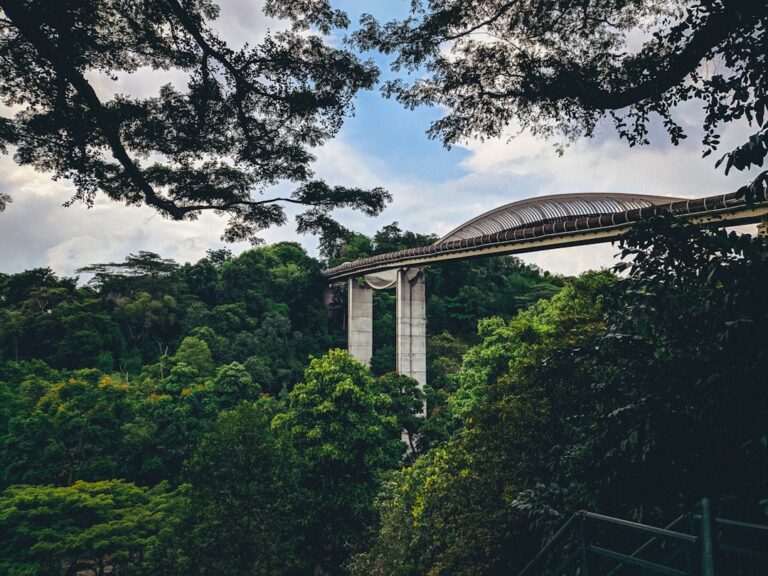
The TreeTop Walk itself appears suddenly. One moment the trail is dense with bamboo and rattan palms; the next, the canopy opens and the bridge spans the void, two steel cables and a series of aluminium planks suspended between two hills. At this hour, with the sky still a gradient of deep blue and pale orange, it looked less like a walkway and more like a trap for light.
A Singaporean woman in her fifties was already on the bridge, standing still near the centre. She carried no camera, no phone. “I come here every Saturday,” she said. “Before the monkeys wake up, before the children come. It’s the only time it feels quiet.”
She described the macaques as a nuisance, but not in the way tourist guides do. “They’ve learned the schedule. They know when the first bus arrives from the MRT. By seven-thirty, they’ll be sitting on the handrails, waiting for someone to drop a granola bar.” She paused. “I’ve seen them open a ziploc bag. It took them about three seconds.”
The Problem with Squirrels
The bridge swayed slightly as a breeze moved through the gap between hills. Below, the reservoir was flat and grey, the water so still it could have been a sheet of glass coated in dust. A monitor lizard was swimming across it, its head a tiny black comma against the surface.
The woman had a theory about why the monkeys had become so bold in recent years. “It’s not the tourists,” she said. “It’s the squirrels. The park used to have more squirrels. The monkeys used to compete with them for fruit. Then the city built the condos over there —” she gestured vaguely toward the eastern ridge — “and the squirrels left. Now the monkeys have all the fruit to themselves. They’re bored. They’ve started watching people.”
6:52 a.m. — The Mist and the Mistake
The sunrise, when it came, was not dramatic. The sky lightened incrementally, the orange fading to yellow, the yellow to white. The mist that had settled in the lower canopy began to lift. A group of five macaques appeared on a branch about twenty metres from the bridge. They were silent, watching.
A mistake made itself known: the visitor had forgotten insect repellent. By the time the sun was fully up, the mosquitoes had found the ankles, the wrists, the back of the neck. The bites would last three days. The itch would be a constant reminder that the park’s ecosystem did not make exceptions for early risers.
The Smell of Wet Bark
The scent of the rainforest at dawn is something no photograph can capture. It’s damp and woody, with a metallic undertone from the iron-rich soil. When the sun hits the leaves, the moisture trapped on their surfaces evaporates, releasing a sharp, almost chemical smell — the smell of photosynthesis starting up for the day.
It was the kind of detail that makes coverage that focuses solely on the bridge feel incomplete. The TreeTop Walk is not just a way to see the canopy from above; it’s a way to smell it, to hear it, to feel the temperature drop by three degrees as you step from the shade into the sun.
7:15 a.m. — The First Tourists Arrive
A group of three tourists appeared at the entrance to the bridge. They were speaking Mandarin, carrying selfie sticks and water bottles. One of them was eating a banana. The macaques noticed immediately. One of the females — smaller than the others, with a scar on her left ear — crept along a branch toward the bridge.
The ranger, who had followed the visitor from the trail, shook his head. “They’ll learn,” he said. “Or they won’t. Either way, it’s not the monkeys’ fault.”
The Banana Incident
The tourist dropped the banana peel. It hit the wooden platform with a wet slap. Within seconds, two macaques were on the bridge, moving with the casual confidence of creatures that had never been told no. The tourist froze. The monkey that had been watching from the branch snatched the peel and retreated to a nearby tree, where it sat peeling the banana skin inside out, methodically, as if it had done this a thousand times before.
It had.
7:37 a.m. — The View That Most People Miss
The official viewpoint of the TreeTop Walk is the centre of the bridge, where the structure dips lowest and the canopy opens widest. But the view that rewards the early riser is about two-thirds of the way across, where the bridge curves slightly to the north. From here, the reservoir is visible in full, but so is the skyline of the city — condos and office towers rising above the treeline, a reminder that the jungle is not wilderness, just a carefully managed patch of green in a city of six million.
A jogger passed, breathing heavily. He stopped at the centre, took a photo with his phone, and continued. He had been here before. He knew the routine.
The Angsana Tree
Near the end of the bridge, on the side that leads back to the trail, there is an angsana tree that has grown at an angle, its trunk leaning at about thirty degrees off vertical. It’s not mentioned in any guidebook. No sign marks it. But the ranger had a name for it: “The Listening Tree.” He said that if you put your ear to the bark early in the morning, you can hear the sap moving. “It’s a myth,” he admitted. “But it’s a good one.”
8:03 a.m. — The Exodus
By eight o’clock, the bridge was full. A queue had formed at the entrance. A mother was scolding her child for leaning over the railing. A man in business attire — tie loosened, sleeves rolled up — was taking a conference call on the far end, his voice pinched and professional.
The visitor left the way they came, past the macaques (now sitting on the handrails, as predicted), past the termite mounds, past the strangler figs. The mosquitos had settled down. The sun was hot. The park felt like a different place entirely.
The Last Quiet Moment
At the trailhead, a bench faced the reservoir. A heron stood on a rock near the shore, motionless. The visitor sat for ten minutes, watching the heron watch the water. A fish jumped. The heron didn’t move. Neither did the visitor.
The taxi came at 8:27. The fare back to the city was $13.60. The driver asked if the visitor had seen the monkeys. Yes, the visitor said. The driver nodded. “They’re fast,” he said. “Smarter than people give them credit for.”