Sleeping in a Converted Fishing Boat on Halong Bay’s Quietest Waterway
Sleeping in a Converted Fishing Boat on Halong Bay’s Quietest Waterway
The bus from Hanoi pulls into the harbor at 8:17 AM, seventeen minutes early. That is the first stroke of luck. The second is that the boat—a rust-streaked, forty-year-old fishing vessel named Cá Bạc—is still tied to the dock. A local boat captain had warned the group that the previous week’s typhoon had swept two of the converted boats clean off their moorings. Cá Bạc, it turns out, had been hauled inland by a friend.
The owner, a former fisherman named Nguyen Van Thanh, appears from the cabin. He is sixty-two years old, his hands calloused and stained with engine oil. He gestures at the boat’s hull, which has been painted a deep blue. “New paint didn’t survive the first day,” he says. “Salt water doesn’t care.”
Four guests—three Australians and a Canadian—board at 8:45 AM. The price is $85 per person for two nights, including meals. Thanh’s wife, Linh, runs a small kitchen in what was once the hold. She is already frying spring rolls when the boat drifts from the dock.
The Waterway Labeled “Luồng Cá”
The standard Halong Bay tour boats stick to the main channel, a parade of junks and cruise ships that churn past limestone karsts on a loop that takes six hours. Cá Bạc heads north, toward a narrow waterway labeled only as “Luồng Cá” on Vietnamese charts—a channel so shallow that most tour operators avoid it.
“We go where the big boats cannot,” Thanh says, his voice nearly lost to the engine’s clatter.
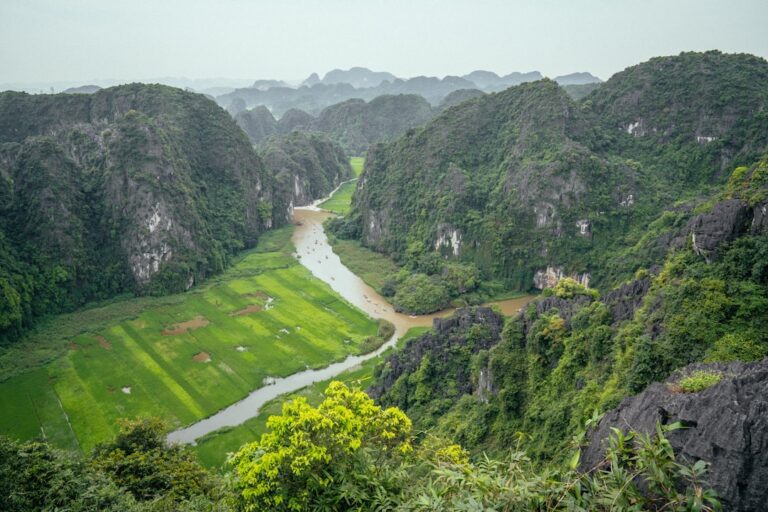
The water shifts from a tourist-billboard turquoise to a murky green. The karsts here are closer, their rock faces studded with ferns and orchids. A fishing net, woven from nylon and bamboo, hangs between two clifftops, set by a family whose stilt house appears around the next bend. The family waves. The Australians wave back.
At 10:30 AM, the engine sputters. Thanh lifts the floorboard and disappears into the engine compartment. Linh keeps frying. The boat drifts. For twelve minutes, silence settles over the bay—no jet skis, no karaoke boats, no helicopter tours. Just the slap of water against the hull and the distant clatter of a fisherman’s outboard.
Thanh emerges, wiping grease from his hands. “Fuel line,” he says. “Cleaned now.”
A Porthole at Water Level
The cabins are small: two single mattresses, a wooden shelf, a plastic bucket for washing. The window—a porthole—opens directly onto the water. At high tide, the waterline rises to touch the porthole’s lower edge. At low tide, the boat creaks, listing slightly as it settles onto a sandbar.
Mark, a fifty-year-old from Brisbane, had booked this trip expecting a “luxury junk boat.” He had not read the small print. “I thought it was a joke when I saw the bucket,” he says. “But the first night, you hear the water against the hull. It’s not silence. It’s breathing.”
The sandbar is a problem. At 2:15 PM, the boat runs aground on a sandbank that wasn’t on the chart. Thanh tries reversing. The propeller churns mud. The boat doesn’t move. For an hour, everyone sits on deck, watching the sun crawl across the sky. The Australians take photos. Rachel, the Canadian, reads a book. Linh brings out cold bottles of Saigon beer.
A local fisherman in a small sampan motors over, his boat riding so low in the water it seems ready to capsize. He ties a rope from his sampan to Cá Bạc’s bow. Thanh revs the engine. The sampan’s tiny motor whines. Nothing happens.
“Wait for high tide,” Thanh says. “Six hours.”
Rachel asks what they will do. “Nothing,” Thanh replies. “That is the point.”
Charcoal Squid and a Kinked Gas Line
Linh had planned to serve fish stew for dinner. But the boat is stuck on a sandbar, and the kitchen’s gas line has kinked. She improvises. On a small charcoal brazier she carries for emergencies, she grills squid that a passing fisherman sells her for 50,000 dong ($2 USD). She slices green papaya into a bowl, adds lime, fish sauce, and chili.
The meal happens at 7:30 PM, on the deck, under a string of solar lights that flicker when the battery runs low. The squid is charred, the papaya salad sharp and cold. The Australians share a bottle of rum they had smuggled aboard. Rachel asks Thanh how long he has been a fisherman.
“Thirty years,” he says. “Now I am a hotel manager.”
He laughs, a short, gruff sound. “I do not like hotels. Too many rules. On a boat, you sleep when you want. You wake when the sun says so.”
The conversation drifts to the storm. A typhoon had hit the bay three weeks earlier, sinking two houseboats and killing a fisherman in a neighboring commune. Thanh had moved Cá Bạc inland, dragging it onto a trailer. “Insurance does not cover typhoons,” he says. “The boat is my house. If it sinks, I have nothing.”
Duct Tape and a Plastic Bag
At 8:30 PM, a kayak is strapped to the roof of the cabin. Thanh had mentioned kayaking as an option. Mark volunteers first. He paddles into the darkness, his headlamp illuminating a narrow channel between two karsts. The water is still.
Ten minutes later, he returns, paddling hard. “It’s leaking,” he says. A hole the size of a coin, near the bow, has filled the kayak with a quart of water. Thanh shrugs. “I patched it yesterday. The patch did not hold.”
Mark is annoyed. He had paid for “kayaking included.” “It’s a safety issue,” he says. Thanh nods, says nothing, and disappears into the cabin. He returns with a roll of duct tape and a plastic bag. “Tomorrow, I will fix it again,” he says.
The kayak sits on the deck, unrepaired, for the rest of the trip.
5:30 AM, the Sandbar Lifts
At 5:30 AM, the boat begins to move. The tide has risen. The sandbar is now six feet underwater. Thanh starts the engine, and Cá Bạc lifts off the sandbank with a soft scraping sound. Nobody planned to be awake. But the shift in angle, the sudden smoothness of the water, wakes everyone.
The bay is empty. The karsts are black silhouettes against a pale pink sky. A fishing boat, half a mile away, has its lights on. The crew is hauling nets.
Rachel appears on deck, hair unbrushed, wearing a sweatshirt over her pajamas. “I didn’t sleep much,” she says. “Too quiet.”
Linh has already started breakfast: bowls of phở, the broth simmered since midnight on the gas stove that works again. The smell of star anise and ginger cuts through the damp morning air. The Canadians eat in silence, watching the fog lift from the water.
A Crab for 80,000 Dong
At 9:17 AM, a smaller boat approaches—a sampan with a burlap sack in the stern. The fisherman, a man in his fifties with a missing front tooth, holds up a live crab, its claws bound with rubber bands. He offers it to Thanh for 80,000 dong.
Thanh declines. “Too expensive,” he says. The fisherman shrugs and motors away.
“They are not supposed to sell crabs here,” Thanh explains. “It is a protected area. But the rangers only come during the day. At night, the fishing is free.”
He does not elaborate. He does not need to.
Just a Cave
At 10:45 AM, Thanh points to a crack in a cliff face, half-hidden by vegetation. “Cave,” he says. No name. No sign. He cuts the engine and drops anchor fifty meters from the entrance.
The kayak, still unrepaired, is deemed unusable. Everyone swims. The water is colder than expected, a low sixties. Mark complains until he hits the water, then he stops. The cave’s entrance is low, requiring everyone to duck. Inside, the ceiling rises to twenty feet. A colony of bats stirs, their wings rustling like dry leaves.
Tom, a younger Australian, had read about a cave in the area that contained “ancient carvings.” He looks for them, finding nothing but limestone and guano. “Just a cave,” he says, not disappointed.
The group stays for twenty minutes. The silence inside is absolute. Rachel says it feels like standing inside a held breath. Thanh waits at the entrance, floating on his back, not saying a word.
The Fuel Pump Sings
Back on board, the engine stalls again. This time, it’s the fuel pump. Thanh spends two hours disassembling it on the deck, using a screwdriver and a pair of pliers. He does not seem frustrated. He sings a folk song, the melody carried on the wind.
Linh brings the group a lunch of rice, grilled fish, and a soup made from the squid purchased during the sandbar wait. The cruise ships are visible in the distance, a white line on the horizon.
“You could be there instead,” Thanh says, gesturing. “Air conditioning. Buffet. No engine problems.”
Mark laughs. “No engine problems, no story.”
The fuel pump is fixed by 3:15 PM. The boat resumes its drift south, toward the main channel. The water turns back to turquoise. The karsts seem smaller now, less intimate. The bus back to Hanoi departs at 5 PM.