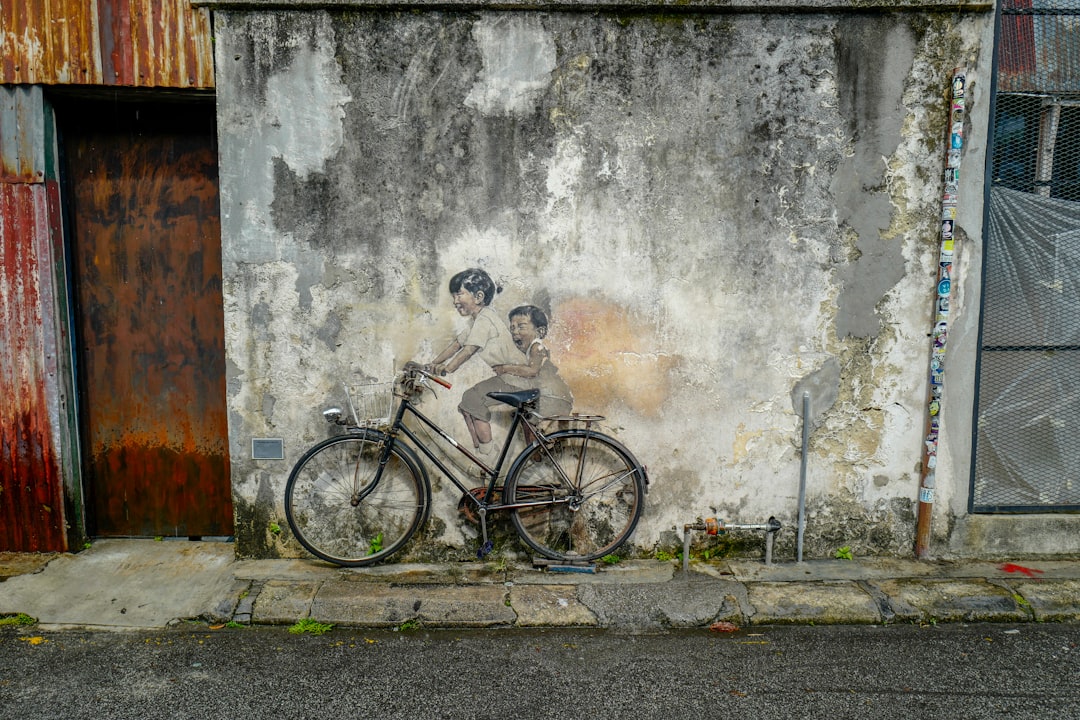
The first thing I noticed about the mural on Lebuh Muntri wasn’t the paint itself but the way the morning light caught the condensation beading on the wall beside it. It was six-thirty, and the street was still in shadow except for one strip where the sun slipped between two shophouses and hit that patch of limewash directly. I’d been told about this one by a friend of a friend who’d spent six months in George Town documenting street art for a local heritage trust, and she’d been insistent: go early, go alone, don’t bring a map. The standard advice for Penang’s murals is the opposite—go to Armenian Street, follow the crowds, find the famous kids-on-a-bicycle piece by Ernest Zacharevic and take the same photo everyone takes. But that advice, I’d learned by my second day, was for people who wanted to check a box, not for anyone who actually wanted to see something.
The mural I was standing in front of wasn’t one of Zacharevic’s. It was older, less polished, the figure of a fisherman rendered in a style that felt more like folk illustration than contemporary street art—thicker lines, less shading, a face that was more suggestion than portrait. A local told me later that week that the artist had been a retired sign painter from the mainland who’d done it in exchange for a year’s worth of coffee at the kopitiam next door. I have no way of verifying that story, but I wanted it to be true, and that’s the thing about Penang’s secondary murals: they come with these loose, unverifiable stories that are usually better than the official version anyway.
I’d started the loop at a random junction in Air Itam, a part of town most visitors drive through on their way to the funicular without ever stopping. A friend had recommended a bakery there that no longer existed—the space was now a motorcycle repair shop—but the owner of the repair shop, a man named Ah Keong who seemed unbothered by my presence at six-fifteen in the morning, pointed me toward a stall two streets over that he said served the best char koay teow on the island. “I don’t eat there myself,” he said, wiping grease from his hands with a rag that had long since stopped being white. “Too many people now. But for you, once, it’s fine.” The stall turned out to be a decade-old landmark I’d read about and dismissed as tourist-trappy, and the noodles were genuinely excellent—smoky, slightly sweet, the prawns still with their heads on. I sat on a plastic stool that wobbled on three legs and watched the morning get louder around me, and I understood that the mistake I’d been making was treating Penang as a series of destinations rather than a single, continuous place you moved through.
The usual route people describe for a Penang mural loop starts at the ferry terminal and proceeds south along the coast, hitting the main clusters in George Town before looping back. What I did instead was start in the hills and work down, which meant I hit the suburban murals first—the ones in Air Itam and Farlim and along the road to Balik Pulau—and saved the famous ones for the afternoon, when the light was worse and the crowds thicker and I had no choice but to see them differently. A photographer I’d met in a Georgetown hostel three years earlier had told me that you never really see a famous mural until you’ve seen it at a time when everyone else is seeing it too, because the thing that makes a place famous is the density of people trying to photograph it, not the thing itself. I’d thought that was pretentious at the time. Standing in front of the “Boy on a Chair” mural on Lebuh Cannon at two in the afternoon, with fifteen people lined up behind me and the light so flat it might as well have been grey, I finally understood what he meant.
The mid-afternoon hours are when Penang’s street art feels most like a performance. Tour groups rotating through in thirty-second intervals, couples holding phones at arm’s length, one guy in a linen shirt who’d clearly watched a YouTube tutorial about posing and was trying every variation. I stood to the side and watched for a while, and after about twenty minutes I noticed something I wouldn’t have seen if I’d just taken my photo and left: the sunlight was hitting a section of wall behind the main mural, catching a much older, much smaller painting that had been half-covered by a newer one. It was a simple fish, maybe two feet long, done in a blue that had mostly faded to grey. No one was photographing it. I walked over and took a picture anyway, and later, when I showed it to a gallery owner in the Hin Bus Depot, she laughed. “That’s from 2009,” she said. “Before the street art thing started. Somebody’s wall art from a festival that nobody remembers.” She paused. “You found it because you weren’t looking at what you were supposed to see.”
That became the organizing principle for the rest of the loop: don’t look at what you’re supposed to see. The sun was starting to angle lower by then, and I drove back toward the coast, taking roads that looked less like main routes and more like service lanes. One of them dead-ended at a small jetty where three elderly men were repairing a fishing net. There was no mural there, no tourist marker, nothing to indicate it was worth stopping for. I parked anyway, and one of the men—who spoke enough English to communicate but not enough to explain—mimed that I should look at the water. I did. There was a sea turtle, not more than fifteen feet from the jetty, surfacing slowly. It stayed for maybe ten seconds and then was gone. The man smiled at me with no teeth and went back to his net. I have no photograph of this, and I wouldn’t trade it for any of the murals I shot that day.
The street art loop that most guidebooks describe is about eight kilometers of walking through central George Town, with maybe a half-dozen extension routes if you’ve got a bicycle. But the island is bigger than that, and the murals are spread wider than any walking route can reasonably cover. What I was doing—driving a loop of about sixty kilometers, starting in the eastern hills, cutting through the center, dropping down to the southern coast, then coming back up through Balik Pulau and Teluk Kumbar before re-entering George Town from the west—is something I’ve never seen documented online. I’d figured it out by staring at Google Maps for two hours the night before, looking for roads that connected rather than roads that were direct. The direct roads, I’d learned from previous trips, were where the traffic and the food stalls and the frustration lived. The connecting roads were where the surprises were.
One of those surprises was a stretch of road near Gertak Sanggul where a fisherman’s cooperative had commissioned a set of murals depicting the history of the local fishing industry. They were not good murals, aesthetically speaking—the proportions were off, the paint was flaking, and one of them had a missing hand that looked less like a stylistic choice and more like a mistake nobody bothered to fix. But they were honest in a way that the polished murals in George Town weren’t. They’d been painted by someone who’d learned by doing, not by studying, and they told a story about the place rather than about the artist’s portfolio. I spent forty minutes there, longer than I’d spent at any single mural in town, and I learned more about Penang’s coastal villages from those flawed, flaking paintings than I had from any museum exhibit.
The friend who’d suggested the loop had made one specific mistake that she was still annoyed about months later: she’d driven the loop in the wrong direction, starting from Batu Ferringhi in the late morning and hitting the western coast at midday when the sun was directly overhead and every photograph came out washed-out and flat. She’d also skipped the Air Itam detour entirely, assuming—correctly, as it turned out—that the morning traffic would be bad. But the cost of that assumption was missing the best char koay teow of the trip, which she only learned about when I sent her a photo of the empty plate. “Next time,” she texted back, and I could practically hear the frustration in the message.
The timing matters, but not in the way most advice frames it. The conventional wisdom says to go early to beat the crowds, which is true only if you’re going to the places where the crowds go. If you’re doing what I was doing—hitting the peripheral murals first, saving the famous ones for the afternoon—then the timing reverses. The early morning is for the ghosts, the faded paintings, the ones nobody’s photographing. The midday is for the mistakes, the dead ends, the wrong turns that lead to something better. The late afternoon is for the coast, when the light goes golden and the humidity drops just slightly and the whole island seems to exhale.
I found one more unexpected piece near the end of the loop, on a wall in a residential area of Jelutong that I’d only turned into because my GPS was being stubborn. It was a portrait of a woman in a headscarf, rendered in black and white, with a single red line running from her eye to the edge of the frame. There was no signature, no plaque, no context. I asked a neighbor who was watering plants whether she knew anything about it. “It’s been there three years,” she said. “Maybe four. The man who painted it was from Jakarta, I think. He stayed with his cousin on this street for a month and then left.” She shrugged. “We like it. It’s ours.”
By the time I got back to Georgetown, it was almost dark. The street art was lit by the warm glow of the shophouse lights, and the crowds had thinned to a few stragglers with tripods trying to get long-exposure shots. I walked past the famous murals one more time, not to photograph them but to see how they looked in the half-light, and they looked different—smaller, less imposing, more like walls that happened to have paintings on them than like destinations. I sat at a hawker stall across from the “Children on a Bicycle” mural and ate a bowl of laksa that was too spicy and too sour and exactly what I needed, and I watched the occasional person walk up to the mural, take a photo with their phone, and walk away. None of them looked at the wall beside it, where a tiny painting of a cat—maybe a foot tall, barely visible in the dim light—sat unnoticed. I hadn’t noticed it either, the first time I’d passed. I only saw it now because I was sitting still, not moving toward anything.
The loop I’d driven was not a route anyone should replicate exactly. The roads change, the stalls close, the murals fade and get painted over. But the principle holds: start somewhere that isn’t the obvious start, take roads that connect rather than roads that lead, and spend more time looking at what nobody’s looking at. The famous murals will still be there in the afternoon. The fading ones, the ones with the missing hands and the uncertain provenance, the ones that only exist because a retired sign painter wanted a free cup of coffee—those are the ones worth getting up early for.

📷 Photos: Lightscape (Unsplash), Mega Caesaria (Unsplash)