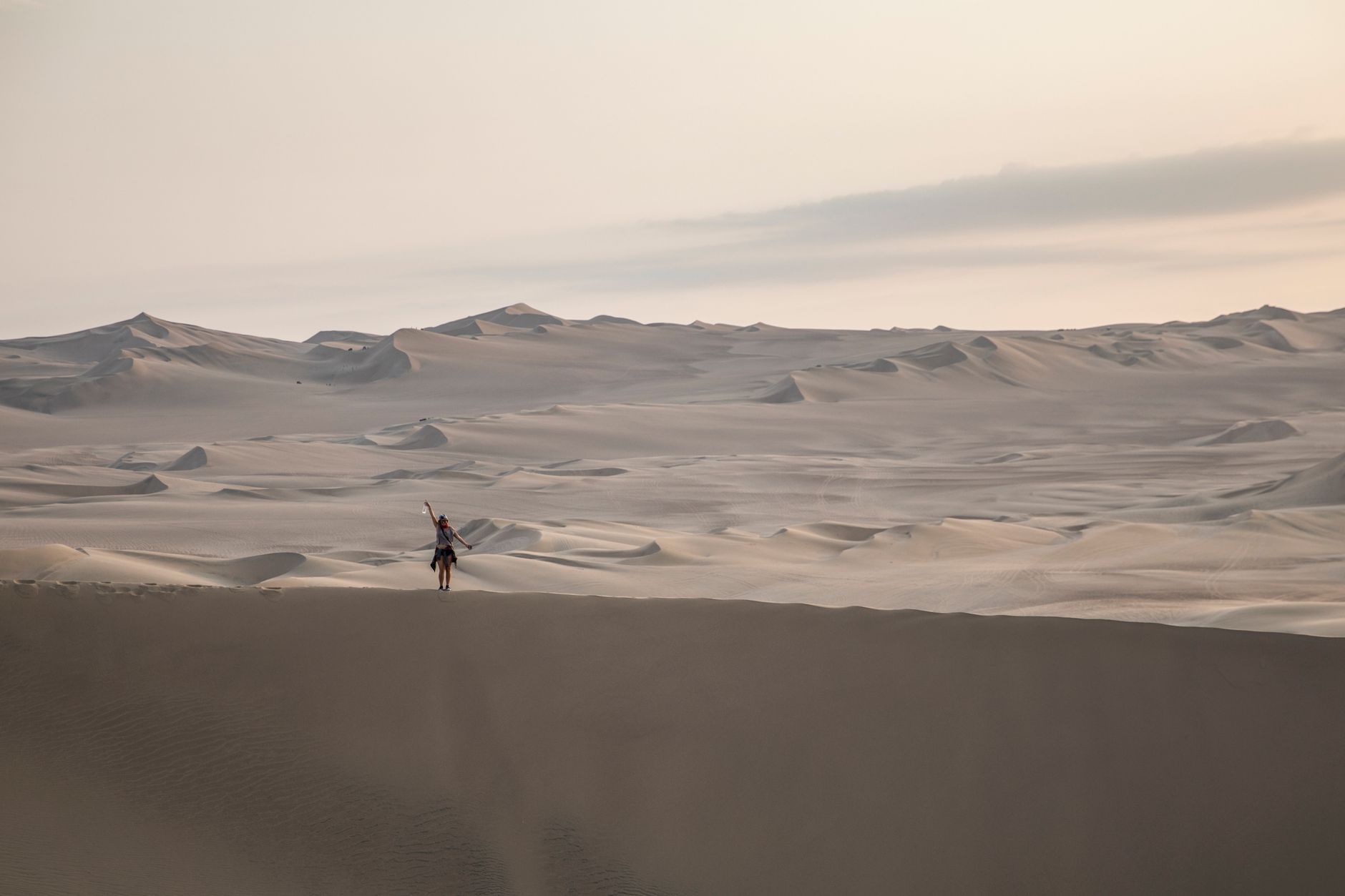
The dunes of Paoay don’t make a sound of their own. What they do is amplify everything else — the crunch of boots sinking into powder, the distant crow of a rooster from a barangay invisible in the pre-dawn dark, the low whistle of wind moving across a landscape that looks more like a miniature Sahara than anything that should exist in the northern Philippines. At this hour, the sand has no warmth in it. It feels like walking through flour that spent the night in a refrigerator.
A tricycle driver named Diego had quoted 250 pesos for the ride from Laoag proper, a price that seemed high until the road turned to gravel and the headlights revealed nothing but an unbroken horizon of sand ahead. He dropped his passenger at the Ilocos Norte Sand Dunes entrance gate, where a sign promised “Adventure Zone” in letters that had been bleached nearly illegible by years of sun and grit. The gate was locked. A handwritten note taped to the metal read, in ballpoint pen, “Back 6 AM.”
Twenty minutes to wait. The sky was already showing the first seam of grey-blue along the eastern edge.
The man who arrived to unlock the gate rode a motorcycle whose license plate had been worn smooth on one side — just a rectangle of reflective metal catching the growing light. He introduced himself simply as Sir Ben, a title that in the Philippines covers everyone from a teacher to a village elder to, in this case, the man who operates the sandboarding rental shack and has done so since before the first tourism board brochures listed Paoay as a destination worth visiting. The shack was a plywood structure with a thatched roof, its contents visible through the gaps: a stack of boards, a coil of rope, a plastic jug of water, and a pair of rubber boots that had seen more sand than any beach in the country.
“You’re early,” Sir Ben said. Not a complaint — just an observation. He unlocked the chain and swung the gate open, then gestured toward the dunes with his chin. “The sand will be cold for another hour. It makes a difference.”
The sandboarding boards were simple things — sheets of marine plywood cut into rough ovals, their edges sanded smooth, their surfaces waxed with what turned out to be a mixture of candle paraffin and coconut oil. Sir Ben demonstrated the application technique: a figure-eight motion with a rag, working the wax into the grain until the wood took on a dull sheen. “Tourists want the plastic ones,” he said, nodding toward a set of newer boards with bindings attached, the kind that look like snowboards painted in neon colors. “They don’t realize wood is better on this sand. The plastic sticks when it’s cold. Wood slides.”
The first dune rose maybe forty meters from the base, its slope steep enough that standing at the bottom and looking up gave the sense of a wall, not a hill. The wind had carved ridges into its face overnight — parallel lines running diagonally across the slope like the grain of a cut tree. The sand was indeed still cool, almost damp-feeling against bare feet, though it wasn’t damp at all. The presence of the Ilocos region’s groundwater aquifer, sitting close to the surface in the wet season, keeps the base layers of these dunes at a consistent temperature well into the morning. A detail not found on any brochure.
Sir Ben’s guidance was delivered in seven words: “Lean back, don’t fight the fall, commit.” He said it the way someone who has watched a thousand beginners wipe out says it — not as wisdom, but as a practical warning that very few people actually heed.
The first run was a disaster by any measure. The board tipped sideways within the first two seconds. A local photographer who had come along not to board but to shoot the light watched from the dune’s base as a body and a sheet of plywood tumbled separately down twenty meters of slope, generating a spray of sand that looked like smoke from a distance. The board came to rest first. The body followed, stopped by a small ridge of sand that had the good grace to be soft.
What sandboarding does not prepare anyone for is the interior of a dune. The sand finds every opening — ears, nose, the gap between shirt collar and neck, the space between socks and ankles. A single fall deposits what feels like a kilogram of grit into places one did not know could retain grit.
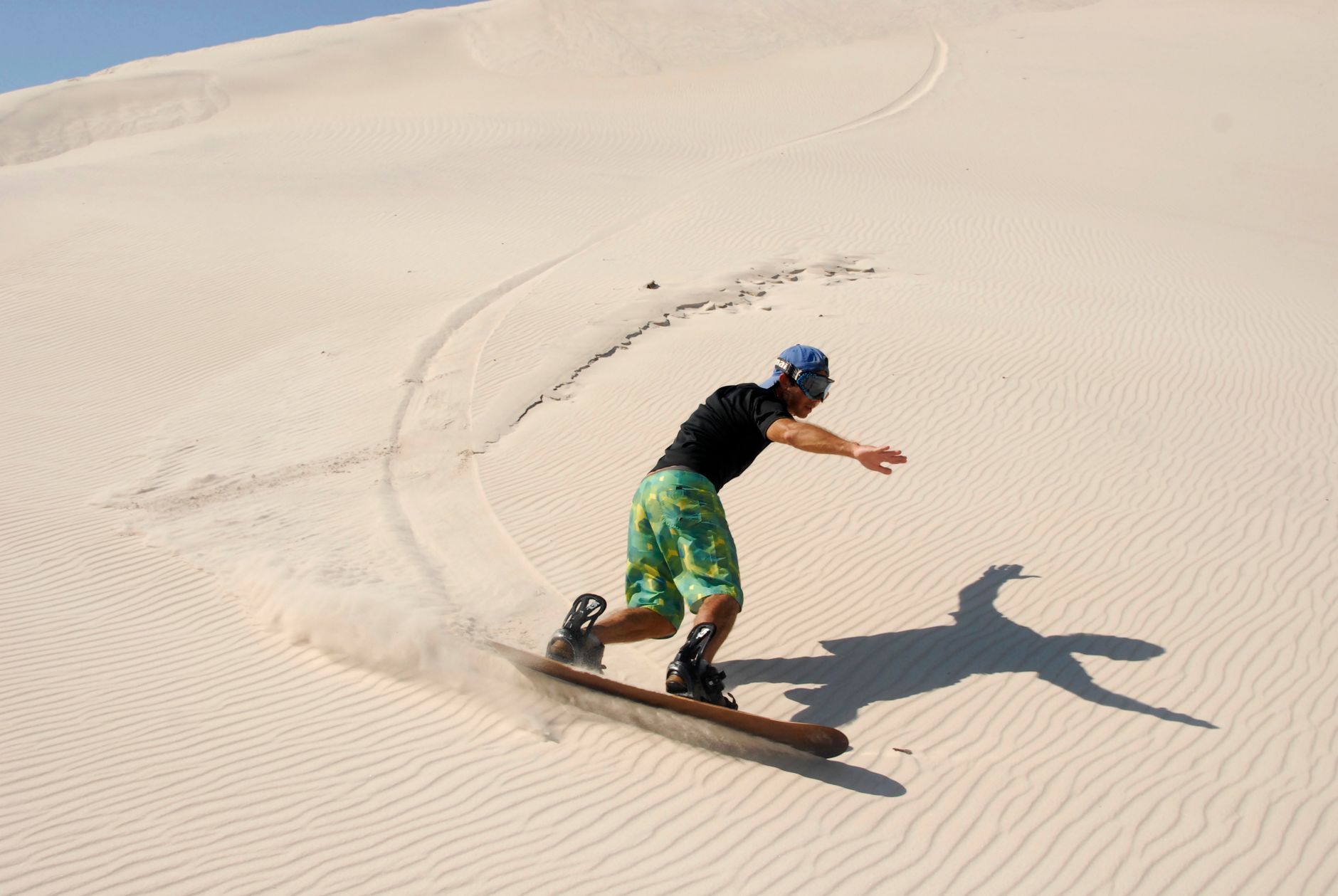
The second run went slightly better. The third, better still. By the fourth attempt, the board was staying flat, the descent was straight, and the speed was enough to make the wind in one’s ears sound like a rushing river. The trick, it turned out, was not in controlling the board but in surrendering to the physics of the slope. Fight it, and the board does the one thing a sheet of waxed plywood excels at — it takes the path of least resistance, which is sideways, into a face-full of sand. Surrender to it, and the board finds its own line.
The dunes stretch inland from the coast for somewhere around eighty-five square kilometers, according to the markers posted at various lookout points. This is a landscape that does not stay still. The wind moves it constantly — smaller dunes shift meters in a single season, and the larger ones, the permanent ones that have stood for centuries, rearrange their surfaces night by night. A path cut through the sand at noon will be gone by the next morning, erased and replaced by something entirely new. The sandboarder who returns to the same spot a month later finds a different terrain entirely.
By 7 AM, the sun had cleared the low hills to the east and the sand was beginning to warm. The shadows, which had been long and blue across the dune faces, shortened and sharpened. The photographer, shooting from a ridge above, described it as a shift from monochrome to color — the pale grey of early morning sand became a deep gold, then a near-orange in the direct light, and the sky behind it turned the particular shade of blue that only tropical mornings achieve, a color that seems to have no white in it at all.
A group of four Korean tourists arrived in a rented jeep, their boards new and shiny, their gear clearly bought from an outdoor shop in Manila. They watched the sandboarder for a few minutes, then consulted briefly among themselves. One of them approached Sir Ben and asked, in careful English, about the difference between the wooden boards and the plastic ones. Sir Ben gave them the same demonstration he had given earlier, working the wax-rag in his practiced figure-eight. The tourists exchanged glances, then chose the wooden boards anyway.
The dunes of Paoay have been used for sandboarding since the late 1990s, when a handful of local teenagers discovered that the surfboards their relatives brought from Hawaii worked just as well on sand as on water — perhaps better, since there were no waves to worry about. The plywood boards came later, a local innovation born of necessity. The surfboards broke too easily. The plywood, treated properly, could survive a full season of abuse.
The morning’s best run came at 7:23 AM. The sand had reached that temperature — warm on the surface, still cool two inches down — where the waxed board developed an almost frictionless glide. The descent took roughly eight seconds, but time seemed to stretch in the way it does when a body is moving faster than it expects to. The only sound was the hiss of sand against wood, a sound like pouring rice into a metal bowl.
Sir Ben’s operation runs on a simple model: 200 pesos per hour for board rental, no deposit required, no waiver to sign. He keeps a logbook in a plastic folder — a school composition notebook with a doodle of a palm tree on the cover — where he records the date, the number of boards rented, and the occasional note from a visitor. “Best sandboarding ever,” one entry read. “Will come back with friends.” Beside it, another hand had written: “I ate so much sand. 10/10 would eat more sand, or something like that.”
The sun at 8 AM was already aggressive. The dunes had become a heat trap, reflecting light upward from below while the sun delivered it from above. The sand was now too warm for the best glide — the wax began to soften, and the boards developed a sticky drag on the lower sections of each run. A lesson learned by experience: the ideal sandboarding window in Paoay is roughly ninety minutes, from the moment the sun crests the horizon until the sand passes a certain threshold of warmth.
The ride back to Laoag was hot and dusty, and the tricycle driver who appeared outside the gate — a different driver, one who had heard from the first driver that there would be a passenger at 9 AM — had a radio tuned to a station playing 1980s ballads at a volume that made conversation impossible. The road passed through several small settlements where the houses were built from a mix of concrete blocks and thatch, where children waved from doorways, where a carabao stood motionless in a field of rice stubble, looking at the passing vehicle with the placid disinterest of an animal that has seen a thousand such vehicles pass.
Back in Laoag, the public market was in full operation. A woman sold mangoes from a plastic tub, their skins a mottled green-yellow, their flesh the color of a tropical sunset. She cut one open with a knife whose blade had been worn thin by years of sharpening, and the juice ran down her wrist. The mango cost twenty pesos.
Between the sand and the sun and the physical effort of the morning, everything tasted different — sharper, more present, as if the senses had been recalibrated by the experience of falling down a dune and getting back up again. The mango was sweet, yes, but it was also cold, and it had a texture that alternated between firm and melting.
A note about the sand: it does not all come out. Days later, shaking out a pair of shoes in a hotel room in Manila would produce a small pile of fine tan grains, a reminder of the dunes that followed its visitors home. The sand finds its way into camera bodies, into the seams of backpacks, into the folds of clothing packed at the bottom of a bag. It becomes a kind of souvenir, unwanted and indelible.
What sandboarding in Paoay offers is the combination of genuine physical risk — a fall from the top of a forty-meter dune at speed is not a gentle event — with an absurdly low barrier to entry. No lessons, no equipment of one’s own, no fitness requirement beyond the ability to carry a board up a hill. The difficulty is not in doing it. The difficulty is in deciding to commit fully to a slope that looks, from the top, like a vertical drop.
Sir Ben had one final piece of advice for the day’s visitors, offered unprompted as he collected the boards and began wiping them down with a rag that had once been a T-shirt. “Come back in July,” he said. “The sand is different in the wet season. It packs harder. You can go faster before you fall.”
📷 Photos: Maria Camila Castaño (Pexels), Dener Vieira (Pexels)